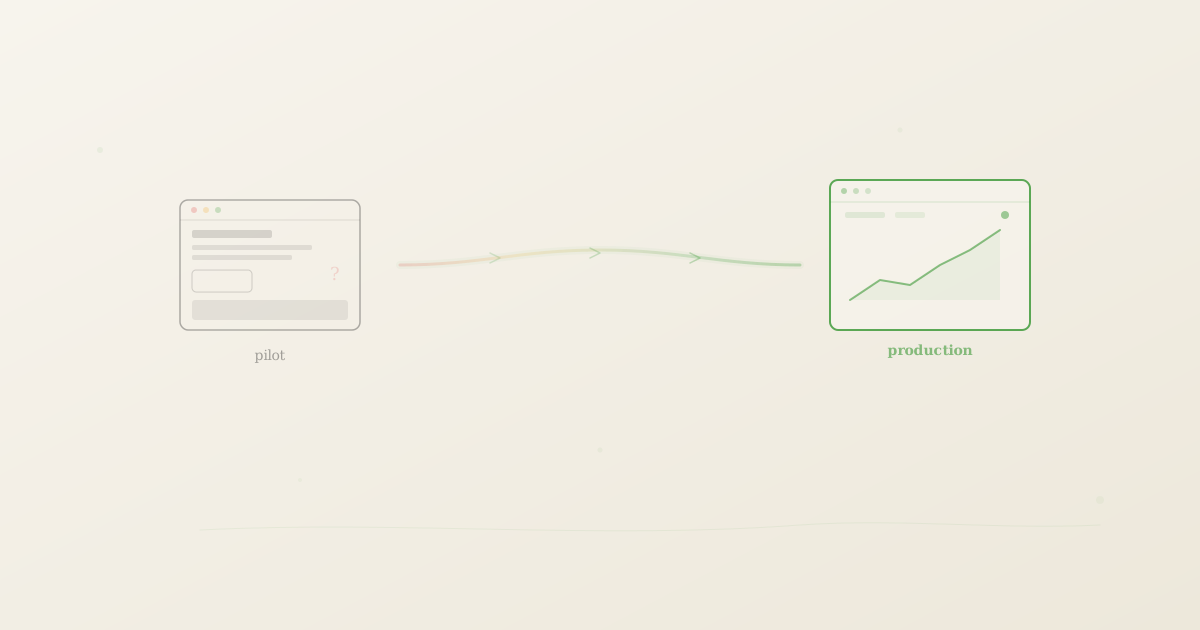
Your AI pilot worked. The demo impressed the board. The proof-of-concept proved the concept.
So why, six months later, is it still sitting in a sandbox?
If this sounds familiar, you are not alone. Research consistently shows that fewer than 5% of AI pilots ever make it to production. For Australian mid-market businesses, the number may be even lower.
The Pilot Trap: Why Success in the Lab Does Not Equal Success in Production
1. The Data Reality Gap
Pilots run on clean, curated datasets. Production systems face the full chaos of real-world data: missing fields, inconsistent formats, edge cases that nobody anticipated.
An AI model that performs at 95% accuracy on pilot data can drop to 60% when confronted with production reality. And 60% accuracy in a financial services workflow is not just unhelpful — it is a compliance risk.
What to do about it: Before declaring a pilot successful, stress-test it against the ugliest data your business actually produces.
2. The Integration Wall
Pilots live in isolation. Production systems must integrate with your ERP, CRM, document management system, email infrastructure, compliance tools, and whatever legacy platform your operations team has been running since 2008.
What to do about it: Map every system integration required for production deployment before you even start the pilot.
3. The Compliance Blind Spot
Australian businesses operate under specific regulatory frameworks — APRA for financial services, the Privacy Act, industry-specific requirements, and increasingly, AI-specific governance expectations.
What to do about it: Involve your compliance team from day one, not day 100. Build audit logging and explainability into the architecture.
4. The People Problem
Pilots are run by enthusiasts. Production systems are run by everyone else — the operations team who did not ask for this, the line managers whose KPIs just changed, the staff who see AI as a threat.
What to do about it: Design the production workflow around the people who will actually use it, not the people who built it.
5. The Scale Surprise
A pilot processing 50 documents per day performs very differently from a production system processing 5,000. Latency increases. Costs escalate. Error rates compound.
What to do about it: Model the unit economics at production scale during the pilot phase. What does it cost per transaction? Does the ROI hold?
The Production Readiness Framework
At Automata AI, we use a structured framework to assess whether an AI initiative is ready for production deployment. Here are the five gates every project must pass:
Gate 1: Data Maturity
Production data pipeline exists and is tested
Data quality monitoring is automated
Edge cases are documented and handled
Data refresh and retraining cadence is defined
Gate 2: Integration Architecture
All system integrations are mapped and tested
API contracts are defined and versioned
Fallback procedures exist for every integration point
End-to-end latency meets business requirements
Gate 3: Compliance and Governance
Regulatory requirements are documented and met
Audit trail is complete and queryable
Data residency and privacy requirements are satisfied
Model governance (versioning, monitoring, bias checks) is in place
Gate 4: Operations Readiness
Monitoring and alerting is configured
Runbooks exist for common failure scenarios
Support team is trained on escalation procedures
Performance SLAs are defined and measurable
Gate 5: Business Alignment
ROI model validated at production scale
Stakeholder sign-off obtained
Change management plan executed
Success metrics and review cadence agreed
Three Signs Your Pilot Is Ready for Production
It works on data you did not prepare for it. Not just your test dataset — the messy, real-world data your business actually produces.
Someone other than the builder can explain what it does. If only the data scientist understands the system, it is not production-ready.
You can articulate the cost of NOT deploying it. If you cannot quantify the ongoing cost of the manual process, you do not have a business case.
Why Specialist Help Matters
The skills required to build a successful AI pilot are fundamentally different from the skills required to deploy a production AI system.
Pilots need data scientists and ML engineers. Production deployment needs systems integration, DevOps, compliance expertise, change management, and deep understanding of Australian regulatory requirements.
Most businesses do not have both skill sets in-house. And that is perfectly fine — what matters is recognising the gap and filling it before your pilot joins the 95% that never make it.