Anthropic added Narasimhan to its board. Your legal, procurement, and risk teams almost certainly didn't flag it. That might be a miss.
Board composition is one of the more reliable forward-looking signals a company puts out. Boards are assembled for the phase a company is moving into, not the phase it is currently in. For Australian enterprises running multi-year Claude evaluations, that distinction is worth a second look.
Why board moves are worth reading
Venture-funded research organisations recruit academic talent and technical advisors. Organisations preparing to operate at the depth that large enterprises require recruit differently. They need directors who understand operational governance, audit-readiness, and what a regulated customer actually needs from a software vendor. Not what the customer says it needs in an RFP. What it actually needs when a procurement review lands, or when an APRA audit requires documentation of third-party AI dependencies.
The distinction shows up in the product and the relationship, not just in the marketing. Enterprise governance depth takes 18-24 months to build into contracting, legal, and support structures. Board appointments are an early indicator that the building has started.
Three signals the Anthropic board composition sends
1. The enterprise relationship is maturing
Anthropic is moving from "we sell to enterprises" toward "we operate at the depth the largest enterprises need." That means deeper contract structures, audit-readiness, SLA sophistication, and ongoing relationship management that looks more like a professional services vendor than a software startup.
For Australian mid-market buyers currently in negotiation, this shows up practically: the contracting counterpart you are working with today is more capable than the one available 12 months ago. The version of Anthropic you evaluated in 2023 is not the same entity you are contracting with now.
That is a positive signal. Not a complication.
2. Regulated-industry credibility is being built deliberately
Australian financial services buyers operating under APRA CPS 230 face a specific procurement challenge with frontier AI vendors. The product may be excellent. The vendor's ability to support your operational risk framework, engage credibly with your internal risk committee, and present with organisational substance in due diligence is a separate question entirely.
Board appointments aimed at enterprise and regulated-industry experience start to answer that question. For an institution evaluating a multi-year Claude commitment, the board composition tells you: this vendor is building the organisational capacity to be a credible counterpart in a regulatory conversation. That matters when APRA or ASIC asks about your third-party AI governance and you need your vendor to be part of a credible answer, not just a box on your vendor register.
3. Enterprise is a long-term strategic commitment, not a product phase
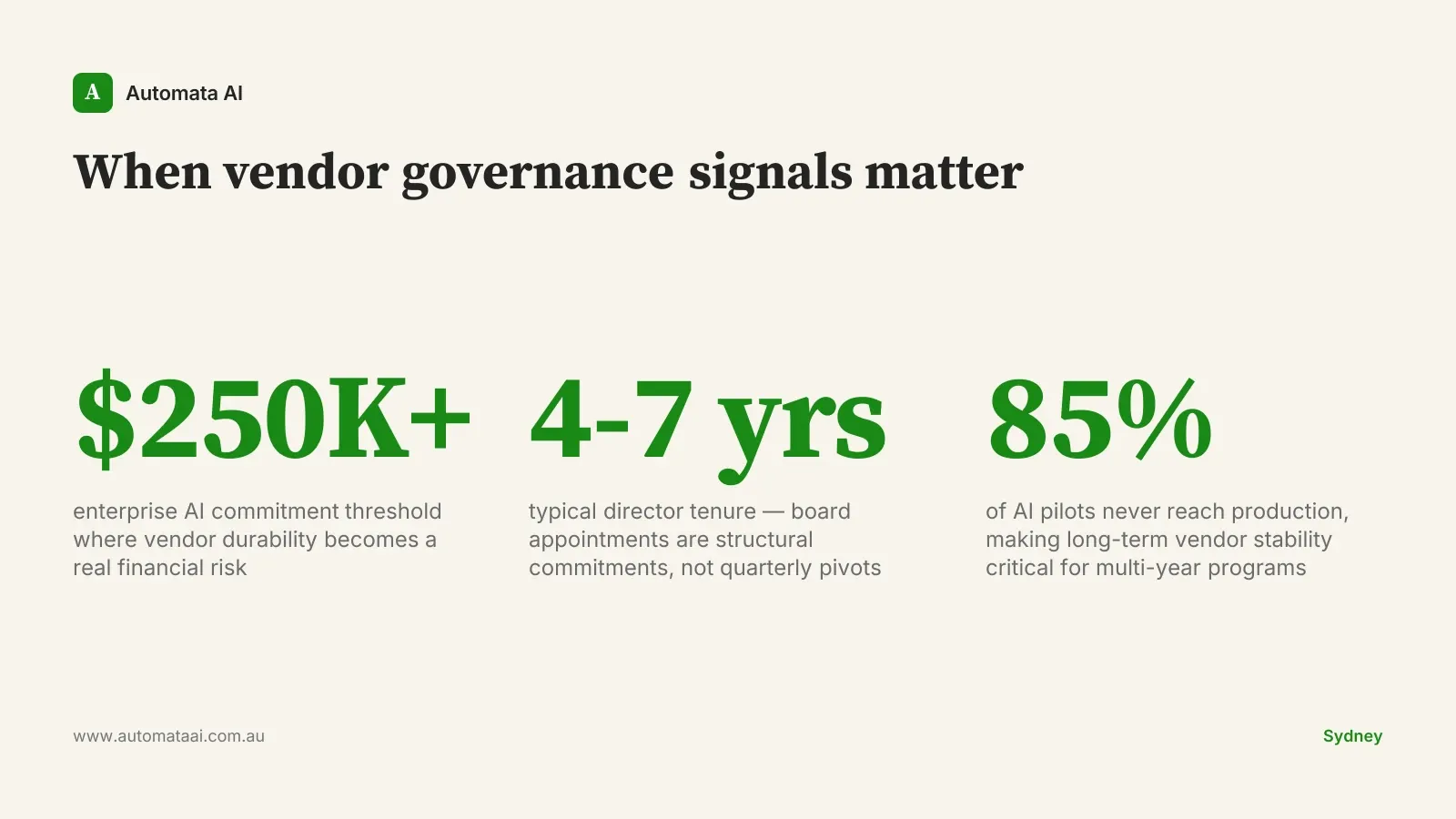
Board moves are durable. Directors typically serve four to seven years. This is not a one-quarter strategic emphasis. It is a structural signal that enterprise is Anthropic's market for the long term, not a phase it is passing through on the way back to consumer AI or pure research.
For Australian buyers who need confidence that a multi-year commitment to a vendor will still look reasonable in 2028, that structural signal belongs in your vendor stability assessment alongside financial health, customer concentration, and key-person risk.
When this signal doesn't matter to your procurement
If you are evaluating Claude for a $30,000-$60,000 proof of concept, board composition is not your risk variable. Evaluate the product, run the pilot, assess the pricing. Board-level governance signals matter when the commitment is durable: $250,000 or more over multiple years, regulated industry deployment, or any contract where vendor failure has real operational consequences.
Similarly, if your organisation does not operate in a regulated industry and your AI deployment is internal-facing with limited compliance exposure, the regulated-industry credibility signal is background noise for your evaluation. Read the product documentation.
Multi-year commitments of $250K or more. Vendor durability is a real financial risk. Board composition is a meaningful input to your stability assessment.
APRA, ASIC, or Privacy Act-regulated deployments. Your procurement and risk teams need organisational substance behind the contract, not just product capability.
Any deployment where your regulators may ask questions. If APRA or OAIC could audit your AI vendor relationships, your vendors need the capacity to support that conversation.
What to add to your vendor evaluation criteria
If "vendor governance maturity" and "organisational stability" don't currently appear as scored criteria in your AI vendor evaluation framework, add them. They are distinct from product capability. A vendor can have excellent benchmark scores and immature enterprise governance. At the $250K commitment level, those are two separate risks worth scoring separately.
Score each frontier lab you are evaluating on governance indicators: board composition, enterprise contracting sophistication, regulatory engagement history, and executive tenure in the enterprise team. Anthropic's board moves in 2024-2025 give it a materially stronger score on this dimension than it had two years ago. OpenAI's board history is messier. For a regulated Australian enterprise buyer, that is a real differentiator, not a footnote.
Pick the vendor you would want to negotiate a renegotiation with in 2028, not just the one with the best demo today. Board composition is one of the cleaner ways to tell those two things apart.