On 27 April 2026, Anthropic appointed Theo Hourmouzis as its first General Manager for Australia and New Zealand and opened its Sydney office.
For the past two years, running Claude in production in Australia meant signing US entity contracts, chasing the roadmap on a 16-hour delay, and patching together your own support path when something broke. A Sydney-based team was, by default, a tier-two customer even if it was paying full enterprise rates. That changes now.
Here is what the appointment means on the ground for AU businesses that are using, or seriously evaluating, Claude.
Procurement just got less painful
Hourmouzis comes from Snowflake, where he ran ANZ and ASEAN as Senior Vice President. He spent the better part of a decade closing enterprise data-platform deals with the same banks, insurers, and government bodies now evaluating Claude. CommBank, Quantium, and the recently signed Australian Government MOU are not cold introductions for him.
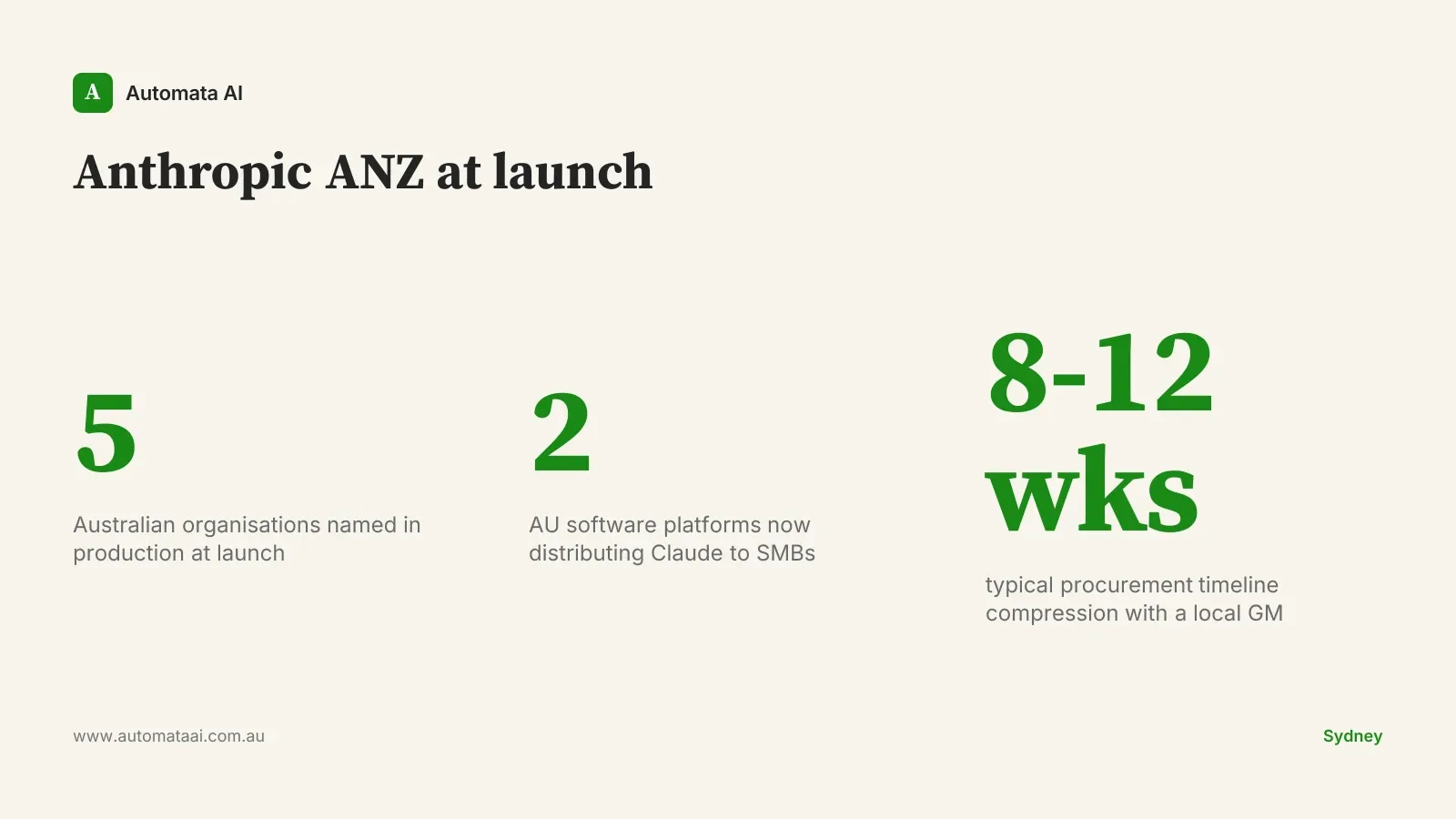
For mid-market businesses in Sydney and Melbourne, AU enterprise Claude procurement has involved navigating US-entity legal structures, negotiating data processing agreements under the Australian Privacy Principles, and managing commercial timelines across a 16-hour timezone gap. That process has routinely added 8 to 12 weeks to what should be a straightforward deal. A local GM with established ANZ relationships and a mandate to close AU business compresses that.
Enterprise contracts also move faster when the vendor has local staff who have already worked through AU-specific compliance requirements: privacy impact assessments, data residency questions, APRA expectations for regulated industries. Those are not blockers Hourmouzis will encounter for the first time.
Anthropic now has skin in the AU regulatory conversation
Hourmouzis's first public statement leaned hard on safety: "partners who take safety and rigour as seriously as they take the opportunity." That phrasing is not accidental.
Australia's AI policy posture sits between the US (largely hands-off so far) and the EU (prescriptive). APRA has been watching large-model deployments in financial services closely since CPS 230 came into force. The Privacy Act reforms are creating new obligations for businesses using automated decision tools on customer data. Australian regulators need commercial AI partners willing to engage on governance, not just lobby against it. Anthropic arriving in Sydney with a safety-first framing gives those regulators a real counterparty.
For AU businesses, the regulatory environment under a Claude deployment is now more likely to stabilise than crack open. Concrete Australian regulatory guidance on AI tends to follow when a major vendor engages locally. That is not a guarantee, but it is a better position than the alternative.
The Canva and Xero plays signal a distribution shift
The launch release mentions deep platform collaborations with Canva and Xero. Canva's Claude Design integration through Anthropic Labs. Xero's multi-year deal, with Xero's financial data flowing directly into claude.ai. Read those carefully.
Two of Australia's most recognisable software platforms are now Claude distribution channels. A meaningful percentage of Australian SMBs will encounter Claude through tools they already pay for, without making a deliberate AI adoption decision. Canva serves over 50 million users. Xero has more than 4.2 million subscribers globally, with Australia as its largest market. The perception that Claude is an enterprise product for tech-forward companies starts eroding from here.
Local case studies are about to get useful
Australian Claude case studies have been thin. The launch announcement names YMCA South Australia, Murdoch Children's Research Institute, the Garvan Institute, ANU, and Curtin University: all in production today, not in a proof-of-concept phase.
With a local GM, expect those to surface as reference engagements with outcomes and numbers, rather than logo strips on a partnership page. A board in Melbourne discounts a US bank's AI case study more than they discount a comparable one from an Australian institution. That is not entirely rational, but it is real, and it matters when you are trying to move a business case through an executive committee.
Sydney's AI engineering scene just got an anchor employer
Anthropic Sydney needs to be staffed. Australian ML engineers and product managers can now build careers inside a frontier AI lab without relocating to San Francisco. Senior engineering roles will compete at Sydney market rates of $180,000 to $280,000 fully loaded.
Engineers trained at Anthropic cycle into the broader AU ecosystem within three to five years: consultancies, enterprise AI teams, government technology units. Sydney's ML-engineering scene has been short on practitioners with direct model-level exposure to frontier systems. That gap starts closing now. Every Australian business building on Claude benefits as the talent market deepens, and every AU partner ecosystem player benefits from a cohort that has worked on problems at scale.
When the Sydney office doesn't change your situation
None of this moves the needle if your organisation hasn't done the internal work. A local Anthropic presence solves commercial and support problems. It does not solve strategic ones.
You haven't scoped the problem. A local GM doesn't define your use case. If you're still debating whether AI is relevant to your business, that conversation is internal.
Data governance isn't settled. If your Privacy Act obligations for a Claude deployment aren't defined, the contract structure around it doesn't matter yet.
The executive sponsor doesn't exist. Vendor announcements don't create internal authority or budget. A champion with decision rights and a defined problem still needs to exist inside your organisation.
The conditions that make Claude adoption succeed are internal: a well-scoped problem, data clean enough to work with, a sponsor with authority and budget, and a team willing to own the output. No ANZ General Manager changes those conditions. Get those right first.
What this means if you're already running Claude
The work doesn't change. The support structure does. Local SLAs, account management in your timezone, and a roadmap conversation that doesn't require scheduling around a San Francisco morning. If you've been patching around the absence of local infrastructure, those patches are becoming unnecessary. The priority now is using the improved support access to accelerate what you're already building.
What this means if you're still evaluating
The objection that Anthropic isn't really here yet expired on 27 April. By Q3 2026, running Claude in production will be an unremarkable line in AU enterprise architecture documents. The question isn't whether to adopt. It's whether you've built the foundations before the organisations around you already have: the scoped use case, the data pipeline, the governance framework.
Pick your highest-value process. Quantify the cost. Model the payback. If the numbers work, the business case almost sells itself.