The junior dev on your team just shipped a Claude API integration. The PR was reviewed. Tests passed. Three weeks later, you're chasing a production bug that traces back to deprecated parameters copied from a blog post written for SDK version 0.x.
That's the problem. Not the model. Not the architecture. Stale knowledge shipping to production because the people writing the code don't have a reliable source of truth for how the SDK works right now.
What the claude-api skill is, and what it is not
On 29 April, Anthropic announced that the claude-api skill is now bundled into JetBrains, Warp, CodeRabbit, and Resolve AI. A skill, in Claude Code terminology, is a reusable instruction bundle that activates when relevant. The claude-api skill captures the operational details that make Claude API code work in production: which agent pattern fits which job, when prompt caching applies and when it doesn't, how parameters shift between model generations, and what context compaction actually requires.
It's not a documentation wrapper. It reflects current SDK behaviour, including details that don't appear clearly in release notes. The practical result is fewer production errors, better cache hit rates, and cleaner model migrations. A developer using the skill gets the operational knowledge of someone who has already worked through several migrations, not just someone who found the docs.
What the skill does inside your IDE
With the skill bundled in JetBrains and Warp, the prompts that previously required Claude Code work inside the tools your team already has open. For Sydney and Melbourne teams already paying for JetBrains licences, nothing changes on the licensing side. In Warp, you're asking these questions in your terminal while running your build, without switching context. The CodeRabbit integration is different: it applies the skill during PR review, which means stale API patterns get flagged before they reach production rather than after. A few examples of what you can ask across all supported tools:
"Improve my cache hit rate." Applies prompt-caching rules most developers miss, specifically around cache breakpoints and message ordering.
"Add context compaction to my agent." Walks through the compaction primitives without three pages of docs reading.
"Upgrade me to claude-sonnet-4-6." Reviews your code, updates model IDs, adjusts effort settings, and flags parameters that changed between generations.
"Build a managed agent for contract review." Configures a Claude Managed Agents pattern specific to the workflow.
In Claude Code directly, some of these are also slash commands: /claude-api migrate handles the model upgrade workflow, and /claude-api managed-agents-onboard walks through managed agent setup from scratch.
The cache hit problem most Australian teams ignore
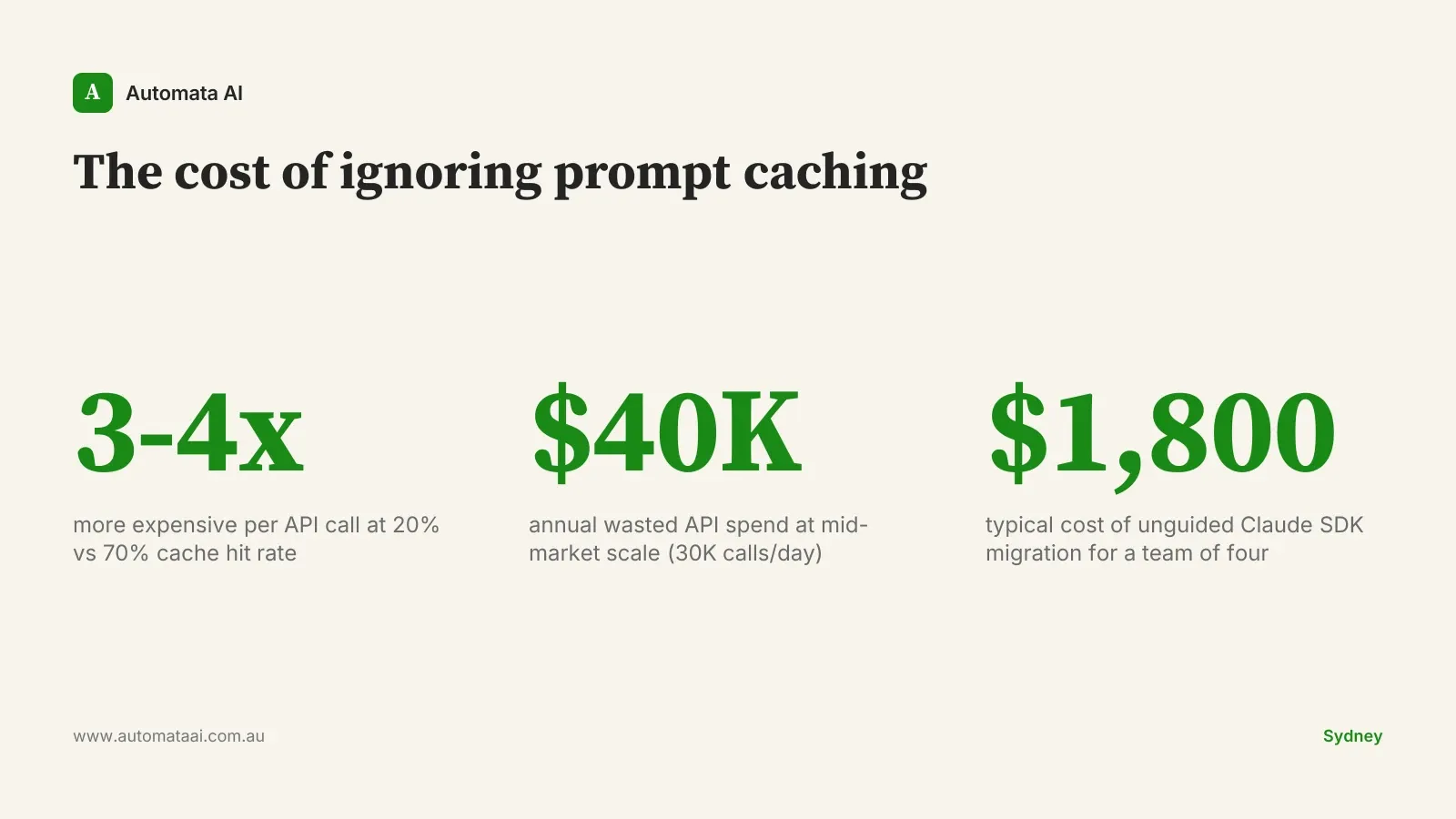
Poor cache hit rates are the API cost leak that surfaces slowly. A team running a document review workflow with a cache hit rate of 20% instead of 70% is paying three to four times more per document than necessary. At the scale a mid-market Melbourne professional services firm runs — 30,000 API calls per day across a contract review or compliance monitoring workflow — that gap translates to $18,000–$40,000 per year in wasted API spend.
The fix is specific, not complicated. Prompt cache breakpoints need to be ordered correctly. Static system prompt content must come before dynamic content. Cache headers need to be set per-block. There's also the minimum token threshold: caching only activates once a block reaches a minimum size, so fragmenting your system prompt across many small blocks defeats the mechanism entirely. The skill knows all of this. Most developers writing Claude API code from documentation alone don't, and the mistake doesn't surface until someone audits the billing dashboard.
That's not a developer failure. It's a knowledge transfer failure. Caching behaviour in the Claude API is documented. The ordering rules, the minimum token threshold, the block-by-block settings are the kind of detail that only become clear after a support ticket or a billing shock.
When the skill won't save you
The skill is a knowledge layer, not an architecture review. If you've built a synchronous request-response pattern for a workflow that should run as an async batch job, the skill will help you migrate the model name cleanly. The latency problem stays.
It won't catch Privacy Act 1988 compliance gaps either. If your Claude integration processes personal information about Australian residents without appropriate controls over consent, purpose limitation, and data residency, updating your SDK version changes nothing. That's a design decision, and it needs to be treated as one.
The teams that get the most from this are already running Claude API code in production and doing periodic dependency audits. For greenfield projects, the skill is useful from day one. For teams that haven't touched their integrations in 12 months, the migration workflow is a reasonable start. Teams with six-month-old integrations are the ones most likely to have mismatched model IDs, deprecated parameters, and cache configurations that predate Anthropic's updated guidance. Pair the migration with a structural review.
Three steps to roll this out across your team
Confirm the integration is active. The skill is bundled by default in the supported tools, but confirm with whoever manages your JetBrains or Warp licences that the Claude integration is enabled.
Add a handbook entry. One paragraph directing developers to use the skill for any Claude API work: new integrations, migrations, cache audits. The friction of not knowing where to look is what keeps developers defaulting to search results.
Run a migration audit. Use /claude-api migrate across your existing Claude integrations. Most teams find at least two or three easy wins.
A team of four developers spending three hours each on an unguided Claude SDK migration costs roughly $1,800 in fully loaded time at Sydney mid-market rates. The skill cuts that to under an hour. Across three or four model generations over the next few years, the saving compounds.
The reason Australian dev teams end up with expensive API bugs is rarely incompetence. It's the gap between when a pattern was learned and when it gets used. The skill closes that gap. Whether your team is set up to use it is the only question left.