Your engineering team has a backlog. Not a wish-list backlog. A real one, where work accumulates faster than it ships.
You have looked at AI coding tools and landed on two names: Claude Code and v0. Both have compelling demos. Both are backed by credible companies. Your head of engineering wants a recommendation by end of quarter.
The demos will not help you decide. They are optimised to impress, not to match your specific situation.
What each tool actually does
Claude Code is an agentic coding assistant that runs in your terminal. Point it at your codebase and it reads files, writes code, runs tests, and makes commits. It maintains context across your entire project, not just the file you have open.
v0 is Vercel's UI generation tool. Describe a component or paste a screenshot and it produces React and Tailwind markup. The output is clean and Shadcn-compatible. It drops straight into a Next.js project.
The distinction that matters: Claude Code works inside your existing codebase. v0 generates new UI artefacts that you then integrate. They are solving different problems.
The work Claude Code is built for
A typical mid-market engineering team has 3 to 10 developers, a codebase built over several years, and technical debt accumulated from fast early growth. The hardest problem for that team is usually not writing new code from scratch. It is understanding what is already there, modifying it safely, and doing it at the pace the business expects.
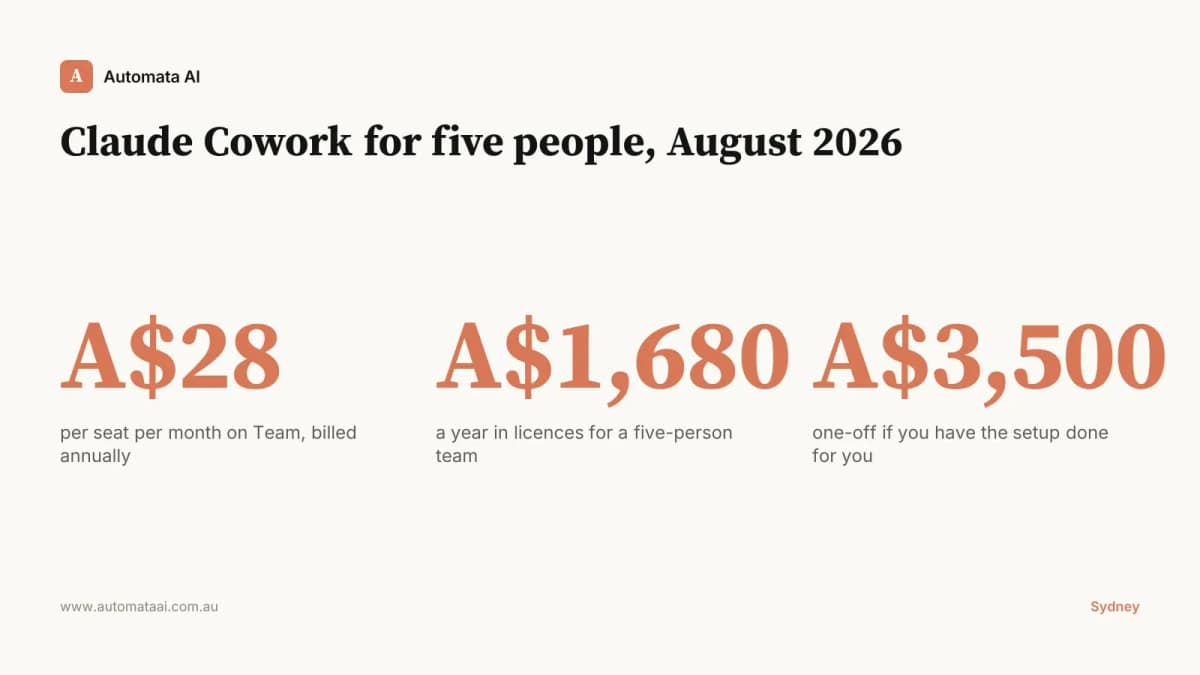
Senior developers in Sydney and Melbourne typically cost $140,000 to $180,000 fully loaded, including superannuation, benefits, and the overhead of ramping up on a new codebase. Claude Code Pro runs at roughly $155 per seat per month in AUD. That is under 0.15% of a senior developer's annual cost for a tool that reads your codebase and produces context-aware changes without needing to be briefed from scratch. One hour of saved developer time per week, at $100 per hour fully loaded, recovers the tool cost within weeks.
Three areas where Claude Code consistently delivers for these teams:
Refactoring legacy code. Claude Code reads 50 files, identifies the pattern, and makes consistent changes across all of them. A developer doing this manually burns 3 to 4 hours minimum.
Writing tests for existing logic. It reads the implementation and writes logic-aware tests. Not a template. Not boilerplate.
Backend feature work. API routes, database queries, service layers, third-party integrations. Anything where context from adjacent files is required.
The honest caveat: Claude Code is a terminal tool. It requires developers who are comfortable with command-line workflows and who review AI-generated diffs carefully. If your team merges without reviewing, Claude Code generates bugs at the same speed it closes tickets. It does not help non-technical stakeholders iterate on design.
The work v0 is built for
v0 excels at one specific moment in a product cycle: when you need to go from a rough design brief to working React components, quickly.
If your team's bottleneck is frontend scaffolding, where designers are waiting on developers to implement layouts before giving meaningful feedback, v0 closes that loop. A designer or product manager can generate a working prototype without writing code, then refine it visually before handing it to an engineer to wire up to real data. For Australian mid-market teams where the same person often owns product, design, and parts of frontend, that compression is genuinely valuable. What used to take a junior developer a full day becomes 30 minutes of iteration.
There is one thing v0 does better than Claude Code: generating pixel-accurate component layouts from a visual reference. Paste a Figma screenshot, v0 produces the markup. Claude Code produces functional output but not necessarily design-faithful output. For teams where visual fidelity matters early in the design process, that gap is meaningful.
When you should skip both
Neither tool will fix a broken development process.
If your backlog is long because requirements arrive vague, because you are shipping bugs faster than you are closing them, or because your data layer is poorly understood by the current team, then more code generation accelerates the problem. You produce more code faster, but it inherits the same confusion. Code generation does not fix unclear requirements.
The same logic applies if your constraint is code review rather than code writing. If pull requests sit for 5 days waiting for a senior engineer to review them, the bottleneck is attention. Adding either tool increases the volume of code waiting for review, without increasing the attention available to review it. That is a slower queue, not a faster one.
A few signals that point to a process problem rather than a tooling problem:
Developers report being blocked by unclear requirements more often than by writing speed.
Your deployment pipeline takes over 30 minutes and breaks regularly.
Your team carries technical debt that has been deferred for more than 12 months and nobody currently owns it.
How to make the call
The clearest frame: look at where your developers' time actually goes.
If most of the team's time is spent inside existing files, reading code, tracing bugs, and writing backend logic, Claude Code will have the higher impact. This is the majority of mid-market teams with a product that has been in production for more than 18 months.
If most of your frontend work starts from scratch and the constraint is the design-to-code handoff, v0 will have the higher impact. Teams building new consumer products or internal tools with heavy UI requirements fit this pattern.
Both tools have free tiers. Run each for two weeks on actual production work, not toy projects or tutorials. Track the hours saved per developer per week. If Claude Code saves 4 hours and v0 saves 1, the answer is clear. The teams that get this wrong are the ones running comparisons on demo repositories. The tools behave very differently on a real codebase with real constraints and five years of accumulated decisions.
Your sprint history already contains the answer. Look at where the last three months of developer time went, pick the tool that addresses the biggest slice, and trial it on something real.