The idea has been in your notes app for months. Maybe longer. You've described it to three people and they all said you should build that. The blocker isn't conviction.
Kostiantyn Vlasenko answered that question in six weeks. He's a project manager. He hadn't written a line of production code before this. He built Respiro, a live iOS stress-management app that detects stress signals and prompts calibrated breathing exercises, and shipped it to the Apple App Store. He won the Claude Opus 4.6 Hackathon along the way.
That's the data point non-technical founders in Sydney, Melbourne, and Brisbane have been waiting for.
What Vlasenko actually built
Respiro isn't a prototype. It's a published app on the Apple App Store that uses phone sensor data to detect stress and responds with breathing techniques calibrated to severity. The level of polish looks like several months of senior engineer time. The actual timeline was six weeks.
Anthropic, who profiled Vlasenko after the hackathon, make one thing clear: he didn't study programming before he started. He moved straight into building, with Claude Code as his collaborator. The code was real. The architecture was real. But Vlasenko's job was directing the outcome, not writing the syntax.
The hackathon win is notable but not the main point. The main point is that a working app, built to production quality, by someone with zero engineering background, now exists in the wild. It has users. It's live. Non-technical founders need to see that, not read about it in a trend piece about the future of work.
Why this matters for Australian founders
The non-technical co-founder problem in Australia is specific and underappreciated. Sydney's senior developer market runs $120,000 to $180,000 fully loaded before equity or the months it takes to recruit someone credible. Melbourne and Brisbane aren't materially cheaper for product-grade engineering talent. Agency MVP quotes for a polished iOS app sit between $50,000 and $120,000, and that assumes you've scoped it well enough to get an accurate quote.
The traditional path, finding a technical co-founder and granting them 30 to 50 percent equity, is slower than it sounds. Most non-technical founders spend three to six months finding the right person. Some never do.
Vlasenko's six weeks isn't just a good story. It's an arbitrage on the old model. The cost of the build was his time, not a $120,000 agency retainer or a 40 percent equity split.
Three things his build demonstrates
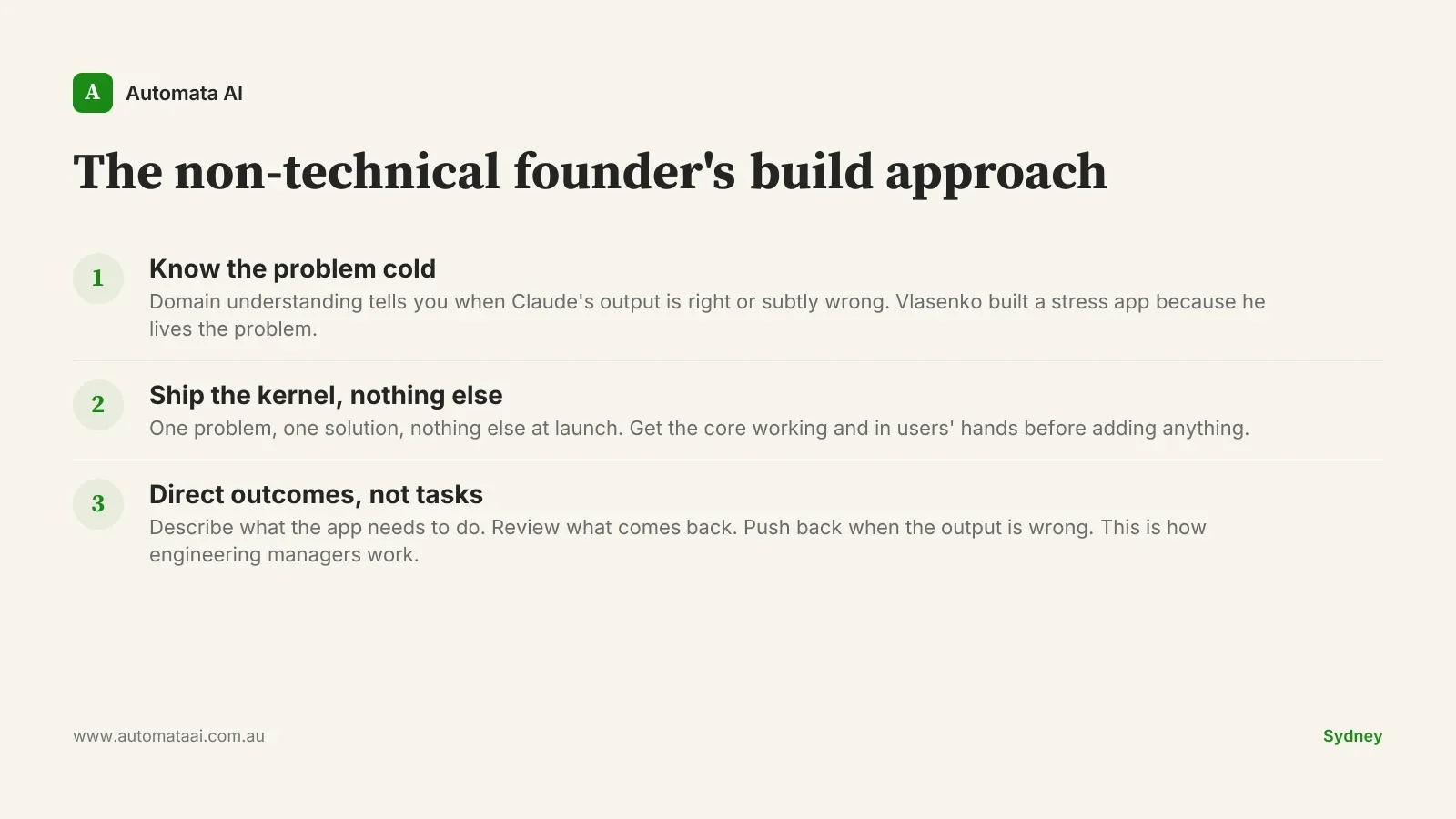
1. Domain understanding is the real differentiator
Vlasenko built a stress-management app because he lives with the problem every day. That domain understanding is what let him evaluate Claude Code's output accurately: he could tell when the breathing prompt logic was right versus when it was subtly off. This is the advantage non-technical founders often underestimate. A developer hired to build someone else's idea has to be told when the output is wrong. A founder who knows the problem intimately will feel it.
2. The kernel ships first
Respiro does two things: detect stress, suggest breathing. That's it. No gamification layer, no social features, no subscription tier at launch. Getting a non-technical founder to accept this constraint is usually the hardest part of any early build engagement. The tendency is to want a complete product on day one. Vlasenko shipped the kernel and got real users.
3. Direct outcomes, not tasks
This is the skill that separates founders who ship from founders who stall. Vlasenko didn't try to write code and then correct it. He described what the app needed to do, reviewed what came back, and pushed back when the output didn't match the intent. This is how experienced engineering managers run their teams. You describe the result you need clearly. You review the diff. You hold the standard. The code isn't yours to write; the judgment about whether it's right is.
When this is the wrong approach
Claude Code isn't the answer for every non-technical founder, and the Vlasenko story doesn't map cleanly to every product idea.
If your application needs to integrate with regulated infrastructure, the compliance surface grows fast. A platform operating under Australian Privacy Principles or touching APRA-supervised systems needs someone who understands what a Privacy Act (1988) breach looks like in production. Claude Code accelerates the build; it doesn't substitute for that judgment.
Real-time systems at scale. A high-frequency trading system or a platform processing millions of events per second requires engineering judgment that goes beyond prompt and review.
Products where the architecture is the IP. If your technical design is the core defensibility, you need an engineer who owns it. Claude Code is not a substitute for a CTO in that scenario.
Founders who won't direct the build. Claude Code requires consistent, outcome-focused direction. Founders who find that uncomfortable will get inconsistent outputs and stall.
The barrier is discipline, not technical skill
Six weeks from idea to App Store is now the ceiling for a motivated non-technical founder with a well-scoped problem. The cost comparison is stark: six weeks of focused time versus $120,000 to $180,000 in developer costs, a three to six month co-founder search, or a $50,000 to $120,000 agency engagement that delivers something you can't modify without going back to them.
The barriers have shifted. They're no longer about finding the right technical person or raising enough capital to pay an agency. They're disciplinary: will you commit two focused hours a day, scope the product down to something embarrassingly small, ship it, and iterate on real feedback rather than waiting for everything to be ready?
Most founders won't. The ones who do will look, six months from now, like they had an unfair advantage. The method is available. The question is whether you'll use it.