Your chatbot is live. The first demo went well. Twenty businesses signed up, gave positive feedback, and then quietly stopped coming back. The model was fine. The problem was the URL: you built a destination when you should have built a tool that lives where your users already are.
In 2026, Australian founders building on Claude face a strategic fork that has nothing to do with the model and everything to do with distribution. Chatbot or Claude App. Both are viable. The wrong choice does not kill a business. It quietly commoditises it.
What a Claude App actually is
A Claude App is a packaged product that runs inside Claude's surfaces: Claude.ai, Claude Code, the desktop app. Users install once. After that, they access your product from inside Claude, not from a separate domain, not from a URL they will forget to open.
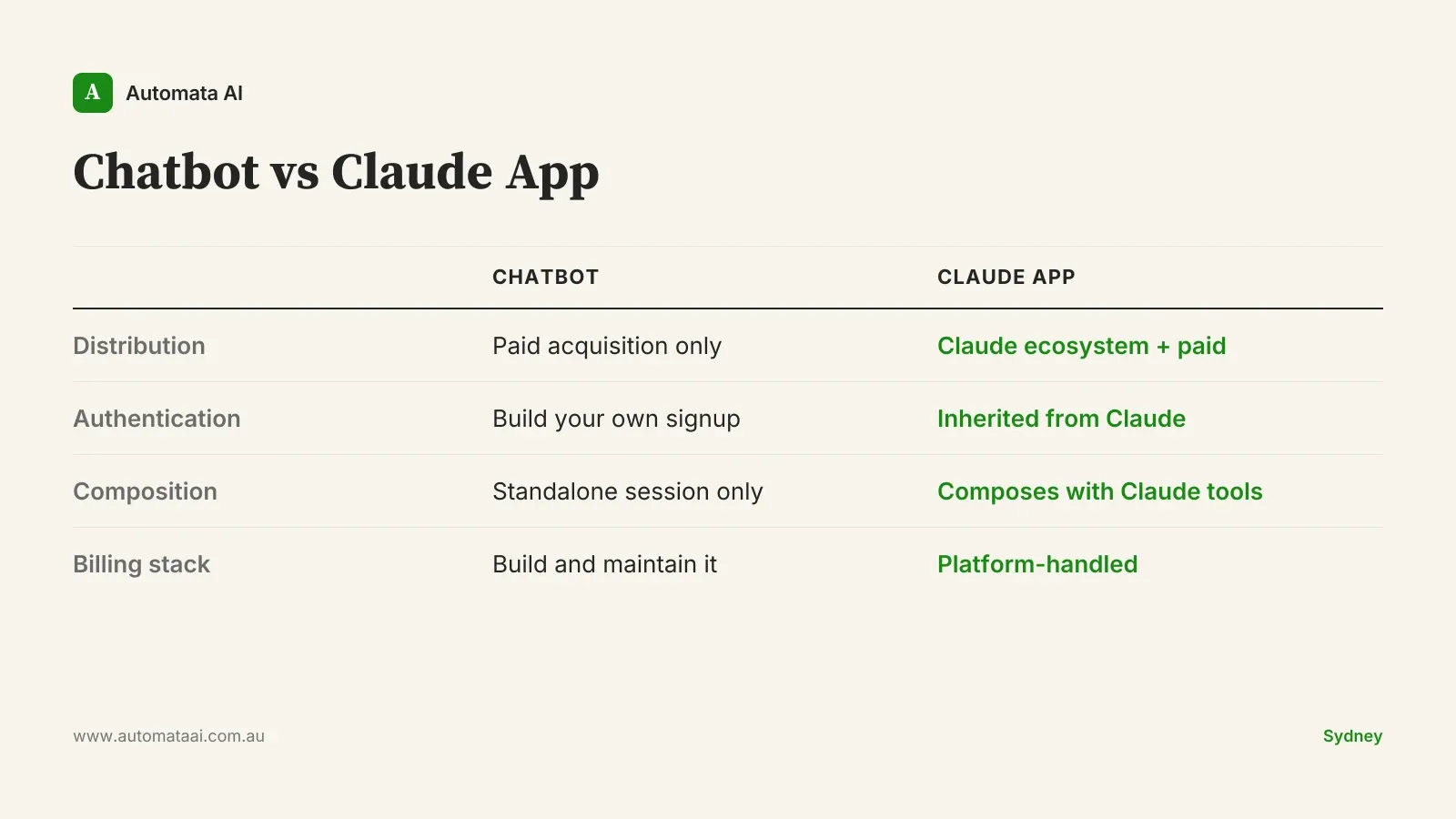
Four structural differences from a standalone chatbot that drive the strategic logic:
Distribution is partly Anthropic's. Your product appears in the Claude App ecosystem. Users discover it through a surface they are already using, not just through paid acquisition you fund entirely.
Authentication is inherited. Claude knows who the user is. You do not build a signup flow, and you do not absorb the conversion drop from it. Typically 30 to 40 percent of prospects abandon at signup.
Composition is possible. Your App can call Claude's other tools and other Apps in the same session. The product does more without you building more.
Billing can flow through the platform. You do not need to build and maintain a payments stack before you can charge your first customer.
None of those are marginal advantages. The authentication point alone removes what is, in most B2B SaaS products, the largest single conversion drop-off between intent and activation.
The three-question Claude App test
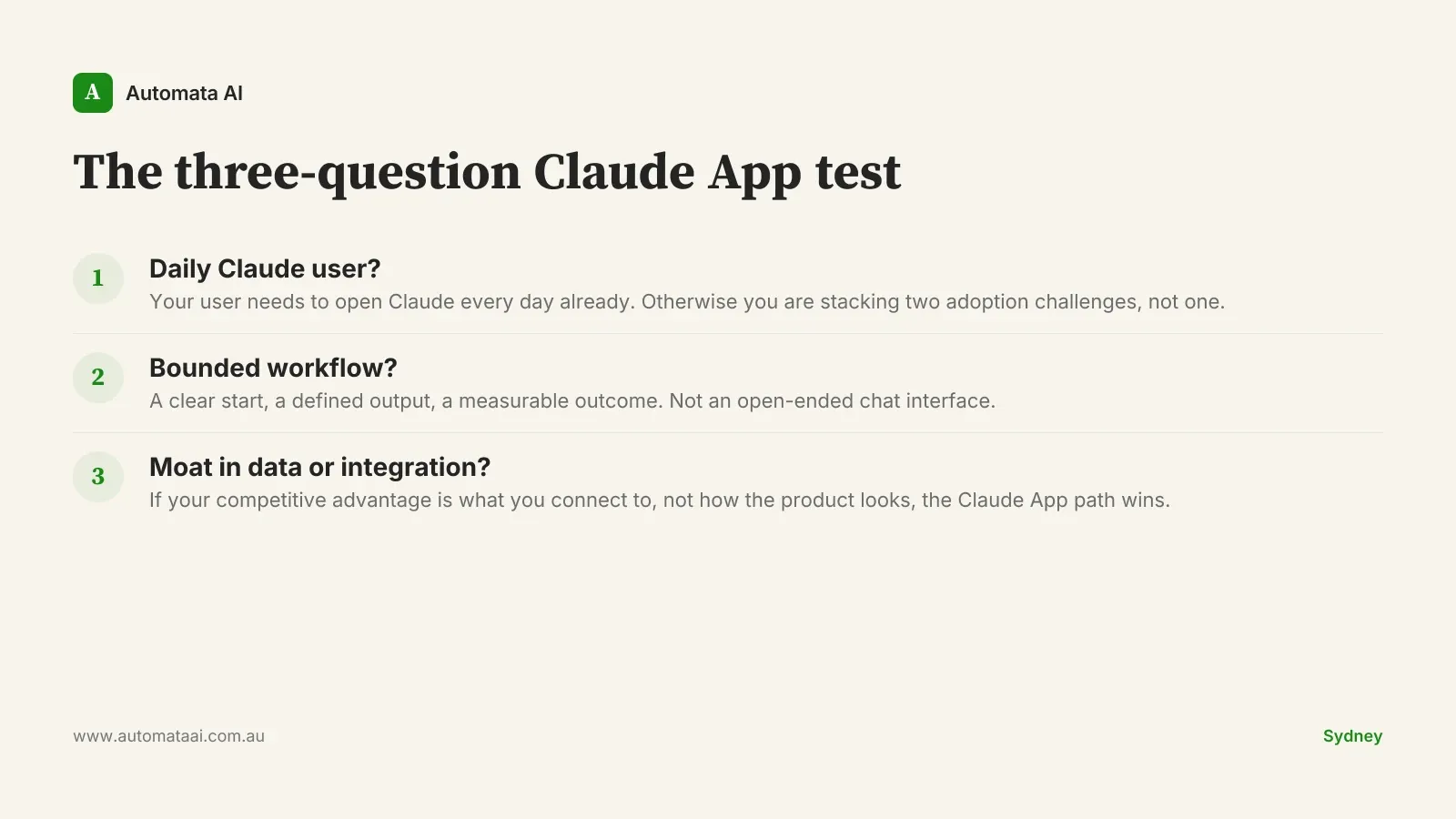
Not every product belongs on the platform. Before committing to the App path, work through three questions honestly:
Does your user open Claude daily? If not, you are not inheriting distribution. You are stacking two adoption challenges: your user has to adopt Claude before they can adopt you.
Is the core workflow bounded? Board-pack drafting, payroll preparation, tender response drafting, APRA compliance reporting. Each has a defined start and a measurable output. An open-ended assistant does not qualify.
Does your moat live in the data or the integration? If the advantage of your product is what it connects to, not how it presents (a proprietary dataset, a deep integration with an Australian payroll platform), Claude Apps work well. If the moat is the UI itself, own the surface.
Three yes answers is a strong signal to ship a Claude App. Two means scope it carefully. One means you are probably building a chatbot. That is a legitimate choice; it just needs different unit economics.
The fastest way to check whether your specific workflow qualifies is our AI Readiness Assessment. It walks through the decision with AUD payback estimates attached, in about ten minutes.
Where the argument is strongest for Australian founders
The clearest use cases in the Australian mid-market are back-office workflows that currently run on email threads, shared drives, and tribal knowledge. Payroll preparation for a firm running multiple awards and enterprise agreements. Property research briefs for a buyers' agent doing five deals a month. Tender response drafting for a services business hitting government procurement. Board-pack compilation for a mid-cap ASX company. Each workflow is bounded. Each produces a document. Each is done by someone who is already deep inside Claude.
A Melbourne professional services firm that opens Claude 30 times a day for client work will use your App on the same surface they already live in. You do not acquire them. You appear where they already are. That is a structurally different growth model from paid acquisition into a standalone chatbot.
When a chatbot is the right call
The honest version of this argument has limits.
If your target user does not currently use Claude, you are not inheriting distribution. You are building from scratch, but with a dependency on a platform your users have not adopted. The ecosystem advantage only materialises once your users are already inside it.
Three situations where a standalone chatbot is the better first move:
Your user is not AI-native yet. Trades businesses, healthcare operators in regional areas, manufacturing teams without a current AI workflow. These users need to form an AI habit first. A standalone chatbot meets them on their own terms.
Your product needs a deeply custom interface. Multi-step wizard flows, real-time data dashboards, complex form inputs. If the user experience is the competitive advantage, own the surface.
Your integrations require systems Claude cannot reach. Legacy on-prem infrastructure, heavily restricted enterprise environments, systems with no external API. If the data never leaves the firewall, the App architecture breaks at the integration layer.
Most professional services founders in Sydney or Melbourne, building for users who already live in AI tools, should default to Claude App. If you are building for users who have not yet adopted any AI workflow, start with a standalone chatbot that earns the habit first. Our AI Automation Services include scoped discovery for both paths.
What a first version costs and what it includes
A working Claude App for a first production version typically takes 8 to 12 weeks and costs $80,000 to $180,000 AUD in engineering time. The range is driven by two variables: integration depth (how many external systems the App needs to connect to) and eval rigour (how much automated testing is built to catch regressions before they reach production users).
The right first version has four components:
One bounded workflow with measurable outputs. Not a general-purpose assistant. One thing, done well, with a clear success metric.
A system prompt under 300 lines, tested against edge cases. The prompt is the product. It needs the same rigour as the code.
Two or three tools that compose into the workflow. Enough to connect the App to the data it needs. No more.
A basic eval suite that catches regressions. Before every deploy, a set of test cases verifying the model still behaves correctly.
Add scope only after version one has 100 paying users and 60 days of stable behaviour. The founders who over-engineer version one are usually the ones who run out of runway before they find product-market fit.
If you want to model the payback before committing to a build, our ROI Calculator runs the AUD numbers in three minutes: hourly rates, integration effort, and time-to-value in one place.
The chatbot path is faster. But a tool your user reaches from inside the AI surface they already live in is a structurally different business from one that competes for bookmarks and acquired habits. Pick the path that matches where your moat actually sits.