Your senior engineer knows the release checklist. They know which migration step to verify, which flag to flip before deploying to production, and which test suite runs flaky on Fridays. When they're at a conference in Melbourne, something goes wrong. Not because the junior engineers aren't capable. Because the checklist only exists in one person's head.
Slash commands fix that.
The problem isn't the junior engineers. It's that the process only exists in one person's head, and that person isn't always available. The same dynamic shows up in release procedures, test strategies, and incident response. Every time a new engineer joins, the senior explains it again. Every time the senior is on leave, something gets missed.
What Claude Code slash commands actually do
A Claude Code slash command is a named operation that runs in the context of your project. You define it in a markdown file inside .claude/commands/, describe the intent and the steps, and the command loads that context every time it runs. The command has access to your current working directory, your git diff, and any project-level context you include. /review opens the current diff and walks a review checklist. /release runs the deploy steps in order. /test finds the right test command for whichever package the engineer is currently working in.
The difference between a slash command and a Confluence page is durable execution. A wiki entry gets read once at onboarding and forgotten by week three. A slash command loads your convention every single time. The shift isn't about documentation quality. It's about whether the convention requires a human to remember it.
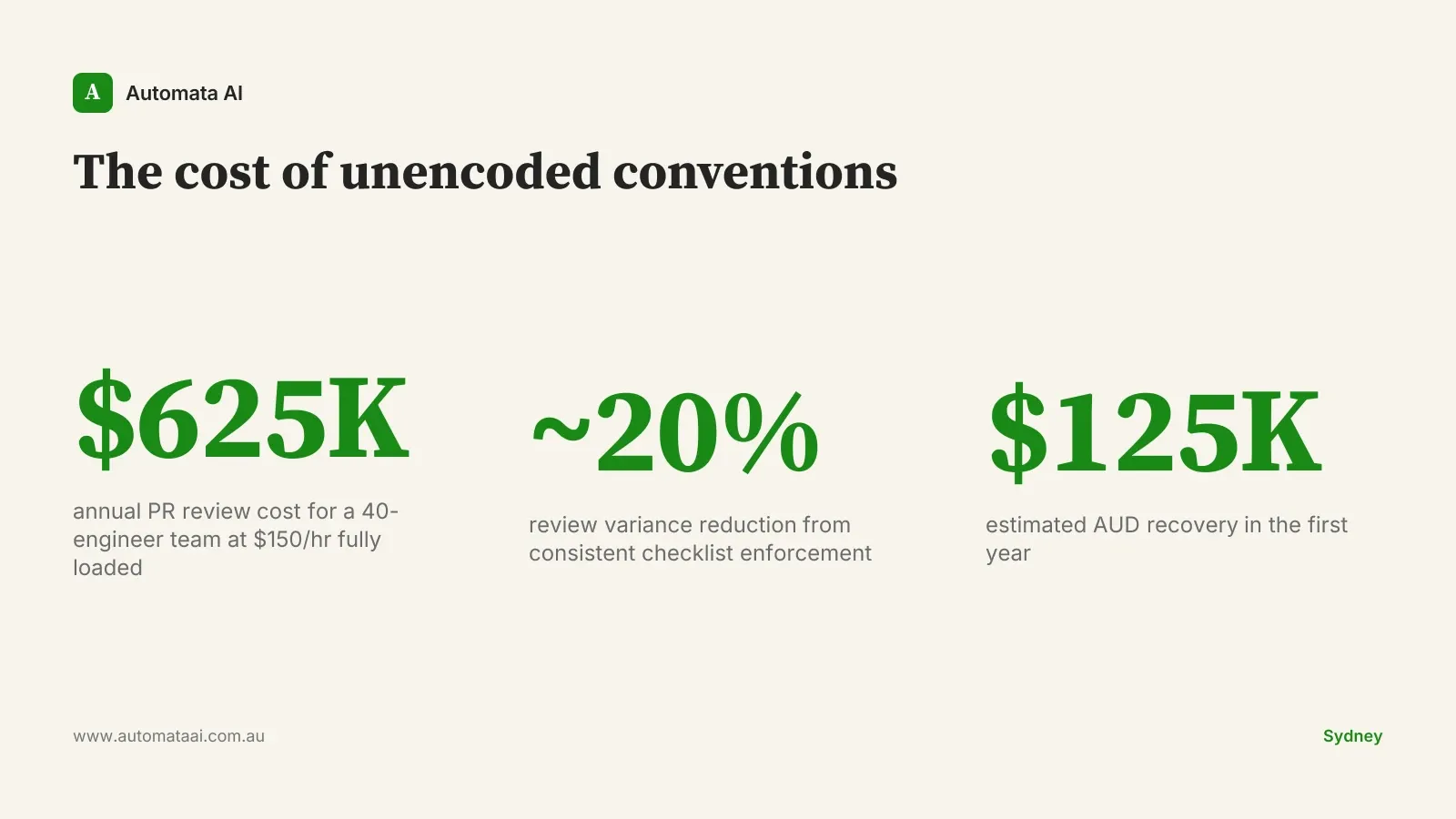
For a 40-engineer team running 200 PRs a week, review time at $150/hr fully loaded is roughly $625,000 AUD a year. That's not the cost of /review. It's the baseline. Slash commands that enforce a consistent checklist can recover an estimated $90,000–$150,000 of that by closing the gap between what your best reviewer catches and what an average reviewer misses. You can model your team's numbers in the ROI Calculator.
Pattern 1: /review for consistent PR quality
A /review command opens the current diff, runs the team's checklist as a structured prompt, and returns findings tagged by severity: tests passing, error paths covered, types matching the interface. Severity tags matter because not every finding is a blocker. A missing test in a utility function is a warning. A missing error handler on a payment path is critical. The reviewer reads the list, accepts or dismisses each finding, and merges when the critical column is clear.
Junior engineers benefit most. A /review command doesn't replace senior judgement — it ensures the routine checks don't depend on who's reviewing today. A junior engineer three months into the job gets the same checklist applied to their PR as a principal engineer with ten years of context. When the senior is in a meeting, the junior doesn't wing it.
The conventions a team calls obvious are exactly the ones they forget to write down. They're also the ones a junior engineer gets wrong in month two.
Pattern 2: /release for shipping discipline
A /release command walks the deploy checklist in order: changelog updated, version bumped, tests green, deploy gate criteria met, environment variables confirmed. Each step either passes or surfaces the fix before anything ships. What the command can't do is run the steps for you — but it can block the engineer from advancing past a failed step, which is the discipline part.
For Australian teams in regulated environments, the value extends beyond consistency. Financial services firms under APRA oversight, healthcare organisations, and any business with obligations under the Privacy Act (1988) need evidence that their deploy process was followed, not just that the code is correct. A /release command that writes a structured release record into the team's audit trail makes Claude Code defensible as part of the pipeline. That's what separates it from a shortcut. You can see what this looks like in our AI Automation Services.
Pattern 3: /test for the right command in the right context
In a monorepo with multiple test runners, engineers routinely spend 5–10 minutes figuring out which test command applies to the package they're working in. That's a friction tax on every run. It also compounds: an engineer who isn't sure whether to run jest or vitest, or which package.json to look in, tends to run nothing and push anyway. A /test command removes that ambiguity. The engineer types the command; the command figures out the rest.
Runs affected tests by default. Based on the current diff, not the full suite. Faster feedback, less noise between changes.
Full suite on request. An opt-in flag for when the engineer needs coverage beyond the current change.
Captures the test output. Appended to a session log so the reviewer can see exactly what ran and what passed.
Flags known flakes. If a test has failed intermittently in the past seven days, the command surfaces the pattern before the engineer wastes time on it.
When slash commands create maintenance debt
If your process changes every fortnight, encoding it in a slash command creates maintenance debt instead of reducing it. The command gets stale, the team stops trusting it, and you end up with both a broken command and an out-of-date wiki. Slash commands work best on processes that are stable and happen frequently.
High-change conventions. If the review checklist gets rewritten quarterly, the slash command needs quarterly maintenance. The ROI only holds if the process underneath it is stable.
Low-frequency processes. Anything that runs fewer than five times a month rarely justifies the setup cost. A shared doc is sufficient.
Broken processes. Encoding a bad process in a slash command makes it a consistently bad process. Fix the process first, then encode it.
The three-command stack: where to start
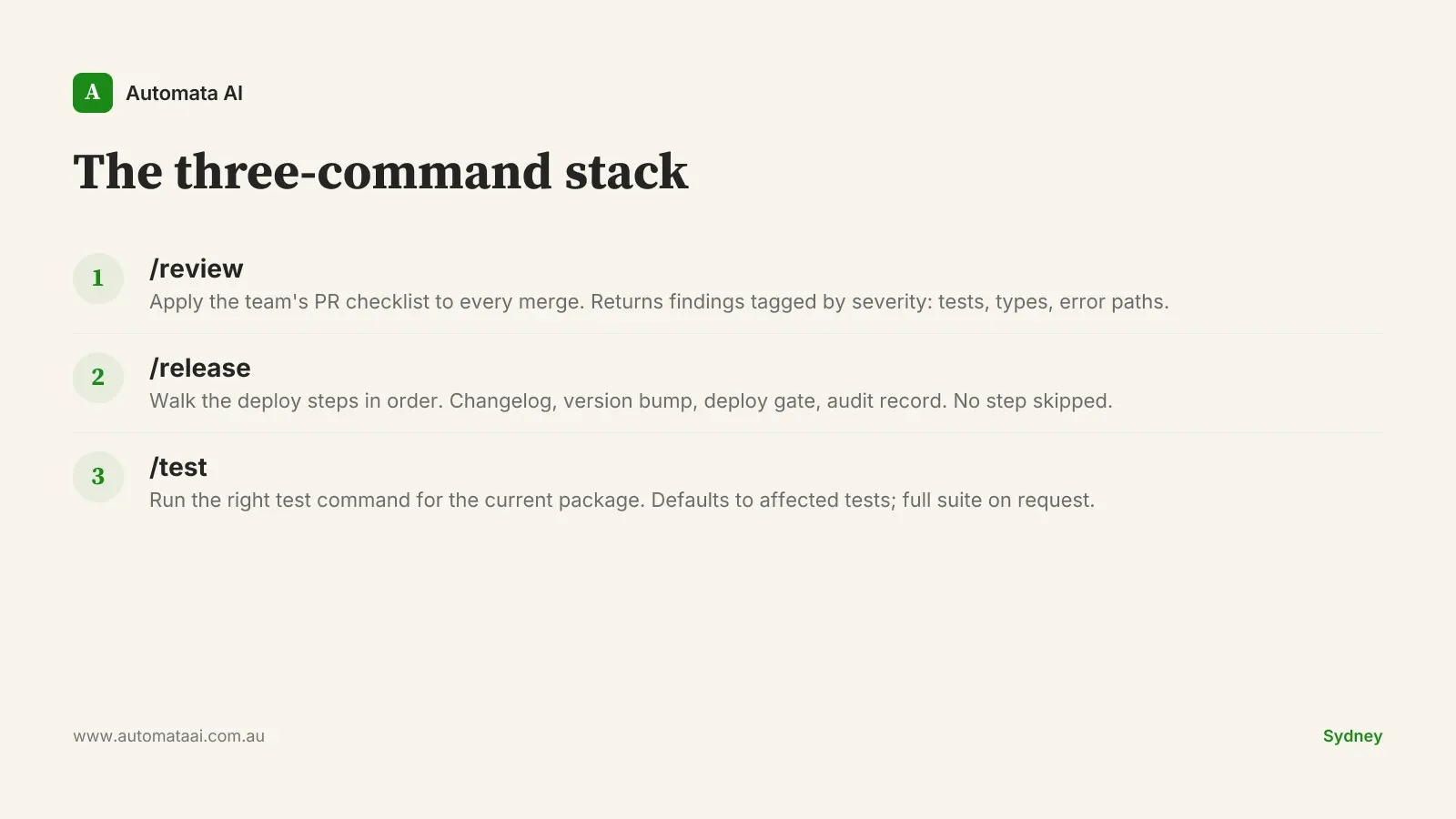
The teams that get value fastest start with three commands and nothing else. Ship /review first, get the team using it for two weeks, gather the friction points and the fixes, then ship /release. Then /test. The order is intentional: /review is the highest-frequency command and the fastest to validate. Shipping ten commands at once kills adoption. Engineers stop using them when they can't keep track of what each one does. If you want help identifying which conventions in your team are worth encoding first, the AI Readiness Assessment is a useful starting point.
The incremental rollout matters as much as the command content. A slash command the team trusts is worth more than five commands they ignore.
The conventions worth encoding aren't the ones in the style guide. They're the ones your most experienced engineer explains in the first five minutes of every PR review. When those explanations live in a slash command, they're available to every engineer, on every PR, whether the senior is in the room or not.