Your engineers are asking Claude the right questions. The answers are wrong.
Not wrong because the model is bad. Wrong because the model has no access. It can reason about your Notion workspace, your Linear backlog, your Stripe invoices. It cannot read them. Until it can, you are paying for a fluent system that has to guess.
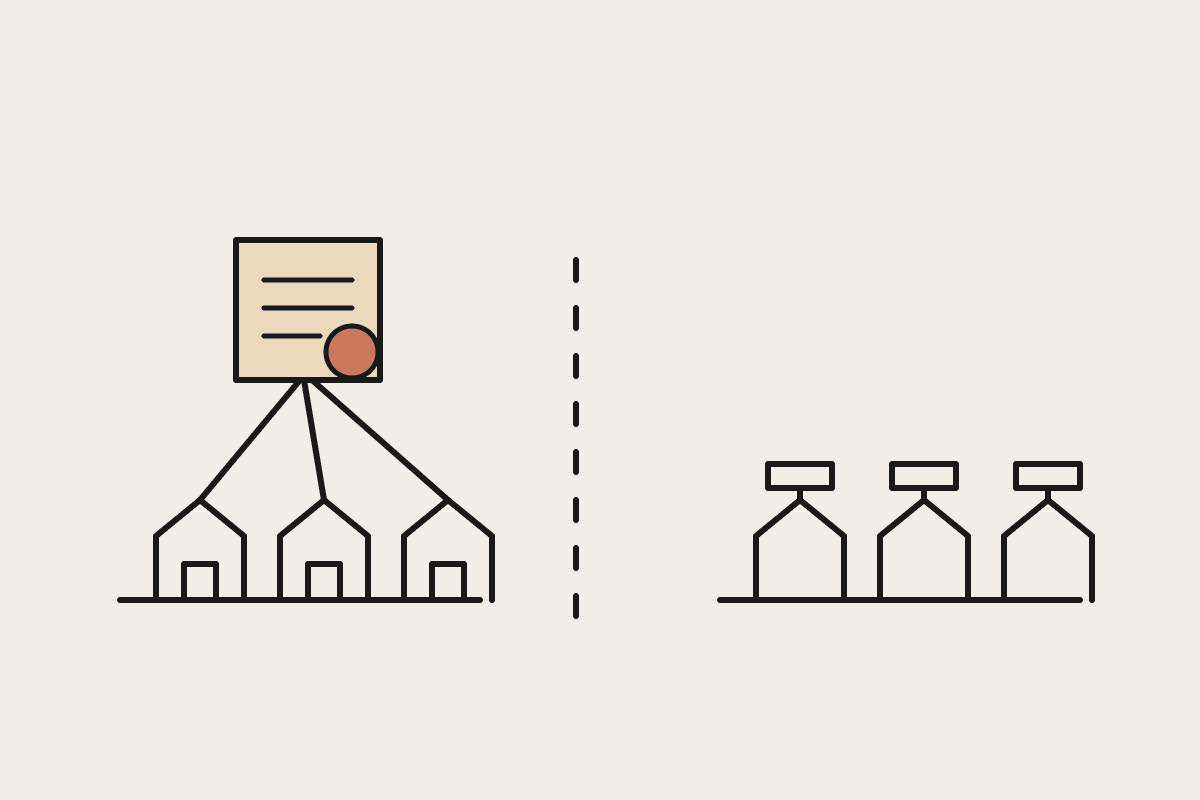
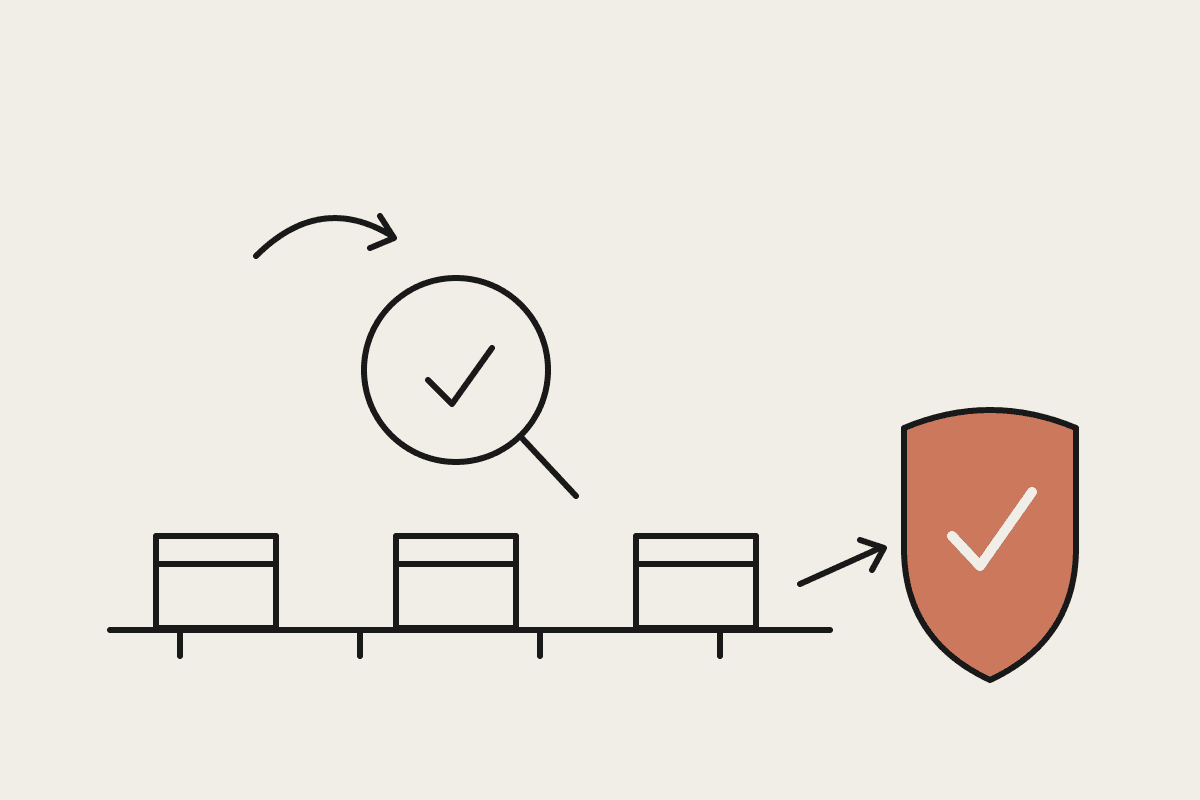
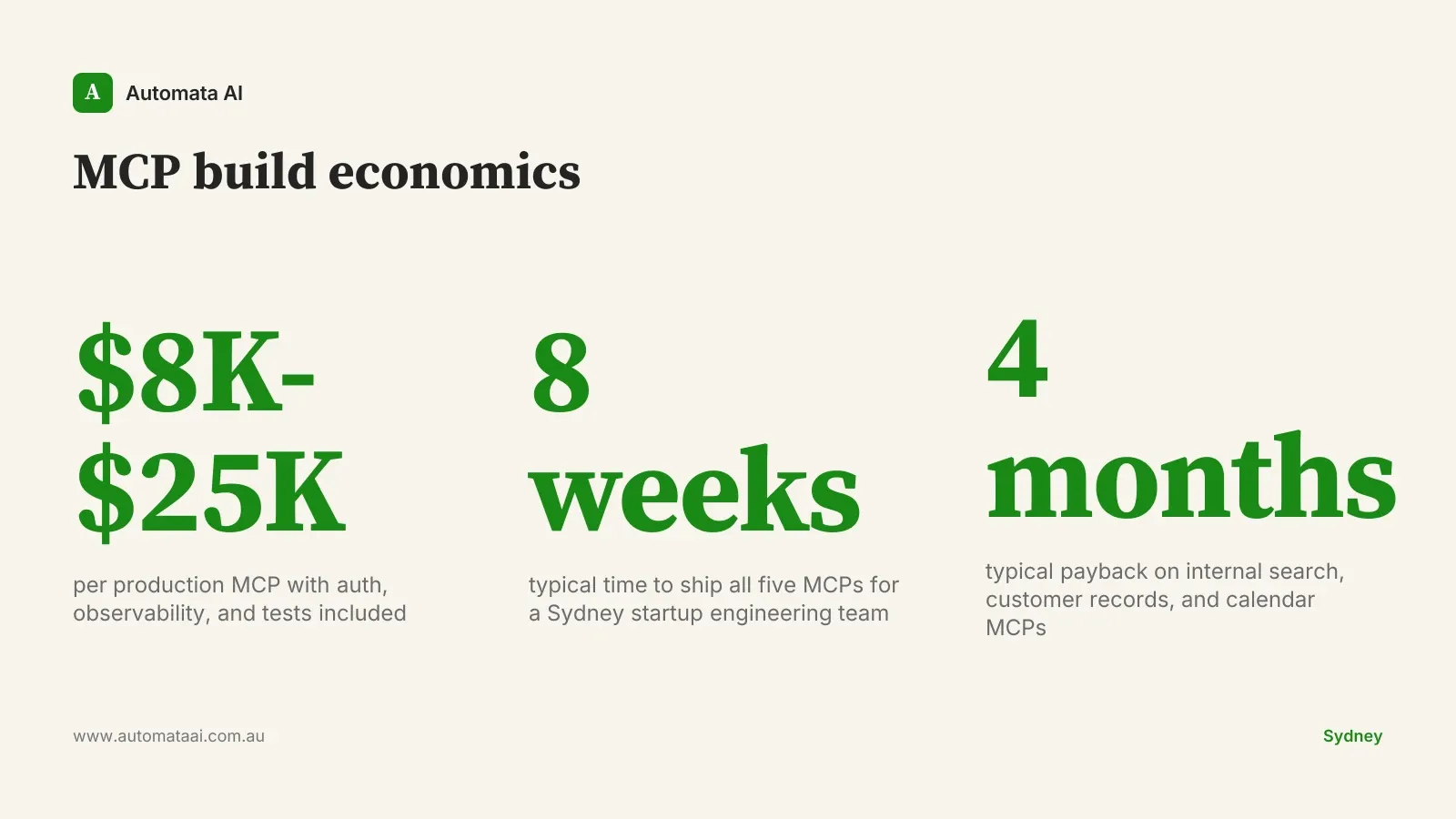
MCP, the Model Context Protocol, is an open standard that gives Claude authenticated, structured access to external systems. Instead of pasting context into a chat window, an MCP server sits between Claude and your stack, receives a request, queries the API, and returns a structured result. For Sydney startups scaling on Claude, a single production-grade MCP with auth, observability, and test coverage runs $8,000 to $25,000 in AUD. The payback is in recovered engineering hours and workflows that would otherwise need a bespoke interface per tool.
Five MCPs worth shipping before anything else
1. Internal search
Almost every internal request is some variant of where is X. A search MCP that queries Notion, Linear, GitHub, and Google Drive returns an answer in seconds and removes the Slack-as-search habit that costs every growing team thirty to sixty minutes per engineer per day. At $100/hr fully loaded, one engineer losing thirty minutes daily is $13,000 a year on a single recoverable process.
Embed nightly, not on query. Cache vector embeddings on a nightly job to keep query latency under 800ms. Real-time embedding at query time makes the experience slow enough that engineers stop using it.
Scope per user, not per team. The MCP must respect document permissions. Surfacing a document outside a user's access is a Privacy Act (1988) issue before it is a product bug.
Pull nested content. A Linear issue without its comment thread is half the context. Index the full thread, not just titles.
2. Customer record lookup
A founder asking about the status of a customer should not need to pivot through Salesforce, Stripe, and Intercom by hand. A customer MCP returns a stitched record: latest invoice, current plan, open support threads, last NPS score, and any recent account changes. The engineer who builds this typically saves the founding team three to five hours a week. At $200/hr for senior leadership time, that is $30,000 to $50,000 a year recovered from a process that should not exist.
3. Calendar and meeting context
Claude with calendar access can answer what is my day, draft prep notes before a meeting, and find available time across multiple Google Workspace accounts. The prep-note generation alone, pulling recent emails, CRM notes, and actions from the previous meeting, saves fifteen minutes before every important call. For a founder with eight client meetings a week, that is two hours recovered without changing a single habit. This is the workflow most founders cannot give up once they have it.
4. Billing and metering
For a SaaS business, an MCP that surfaces Stripe usage data, Chargebee plan state, and in-product feature flags removes back-and-forth in billing investigations and refund decisions. Customer success staff stop needing direct Stripe access for routine lookups. That is a reduction in your attack surface as much as a productivity gain.
5. Deploy and infrastructure
A Vercel or Render MCP combined with Sentry integration lets an engineer ask Claude what changed at 4pm yesterday and get a joined view of the deploy log, error rate change, and relevant commits. Without it, diagnosing a post-deploy incident means flipping between three or four tools in sequence. This is the most impressive demo of the five. It is also the most dangerous to build first. Start with read-only data sources. Ship write paths only after a month of audit logs and confirmed permission scoping.
Build standards across all five
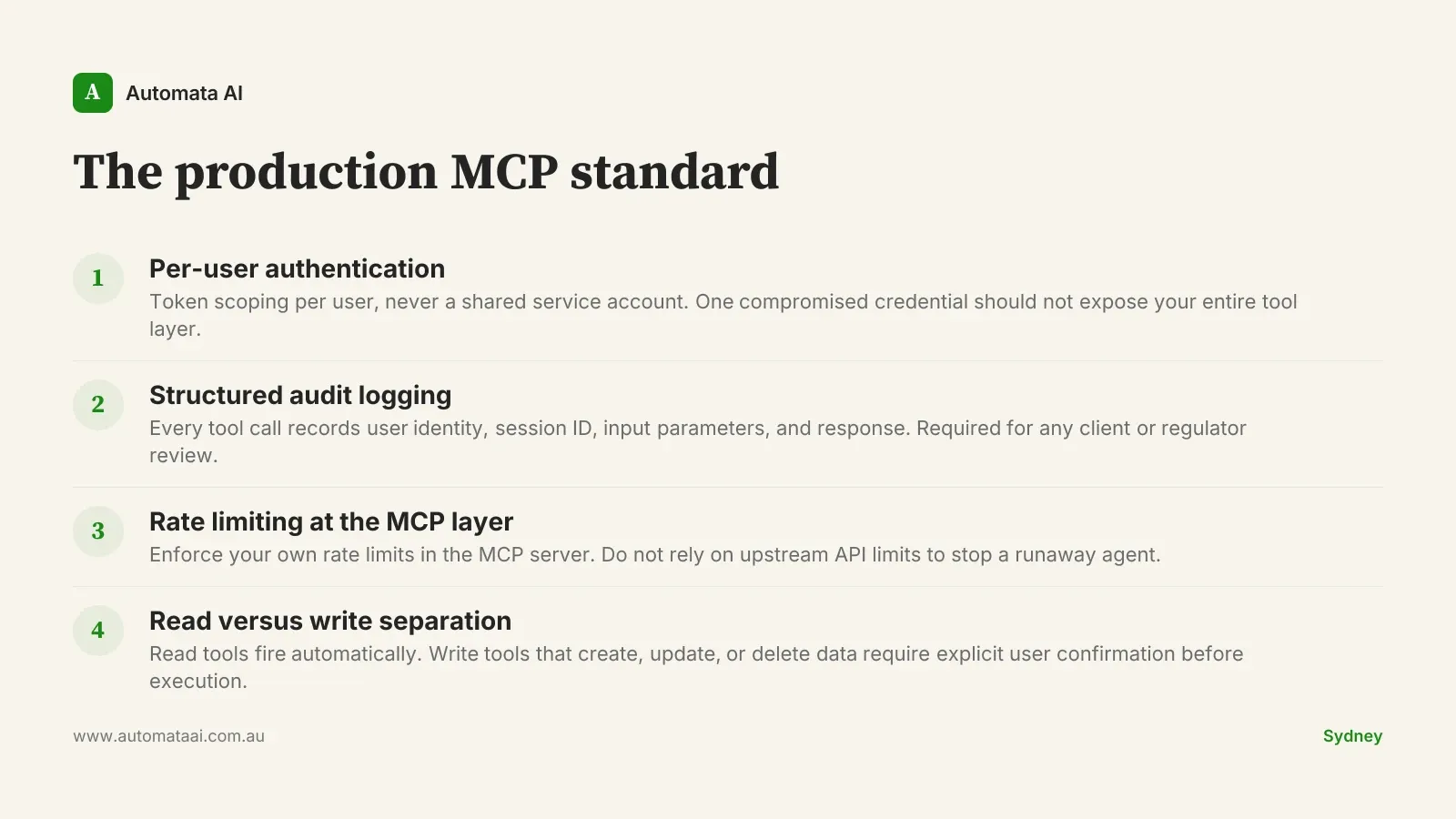
Per-user authentication. Token scoping per user, never a shared service account. One compromised credential should not expose your entire tool layer.
Structured audit logging. Every tool call must record user identity, session ID, input parameters, and response. This is what makes an AI implementation defensible in any client or regulator review.
Rate limiting at the MCP layer. Do not rely on upstream API rate limits. Enforce your own in the MCP server so a runaway agent cannot exhaust a third-party quota.
Read versus write separation. Read tools can fire automatically. Write tools that create, update, or delete data require explicit user confirmation before execution.
When not to build a custom MCP
Three situations make a custom build the wrong choice.
The tool already has a first-party MCP. Anthropic and major vendors are releasing official MCP connectors. Check before committing engineering time to a custom build.
The underlying process changes every quarter. An MCP wired to an unstable API or an internal tool being actively redesigned becomes a maintenance tax, not an asset.
The volume does not justify the cost. If a workflow runs twice a week for thirty minutes, the build cost will not pay back. Check the ROI Calculator before committing to a custom MCP.
The teams that waste money on MCP builds are the ones that scoped all five in sprint one. Ship one, measure the actual time saved over four weeks, then decide if the next one is worth it.
What the full build actually costs
Five production-grade MCPs with proper auth, observability, and read/write separation run $40,000 to $125,000 in AUD depending on scope and how many internal systems require SSO integration. Most Sydney engineering teams can ship all five in under eight weeks if they are not building custom auth from scratch. The payback on the first three (internal search, customer records, and calendar) is typically under four months for a team of ten or more.
If you are sizing a first MCP build, our AI Automation Services include a scoping engagement that maps your internal tool stack to MCP candidates and models the payback before any build begins.
Start with internal search. It has the widest blast radius: every engineer benefits, the data sources are read-only, and the auth model is simpler than CRM or billing. Ship it in the first sprint, measure the saved time after four weeks, and use those numbers to make the case for the rest.