GPT-Rosalind arrived quietly for most Australian organisations. OpenAI did not hold an event in Sydney. The launch partners (Amgen, Moderna, the Allen Institute, Thermo Fisher Scientific) are all American. But for CSL, WEHI, Telix Pharmaceuticals, and every biotech team running out of a Cicada Innovations cohort, this release is worth a serious look.
Not every tool designed for US research institutions translates cleanly to the Australian context. Rosalind does.
What GPT-Rosalind is actually built for
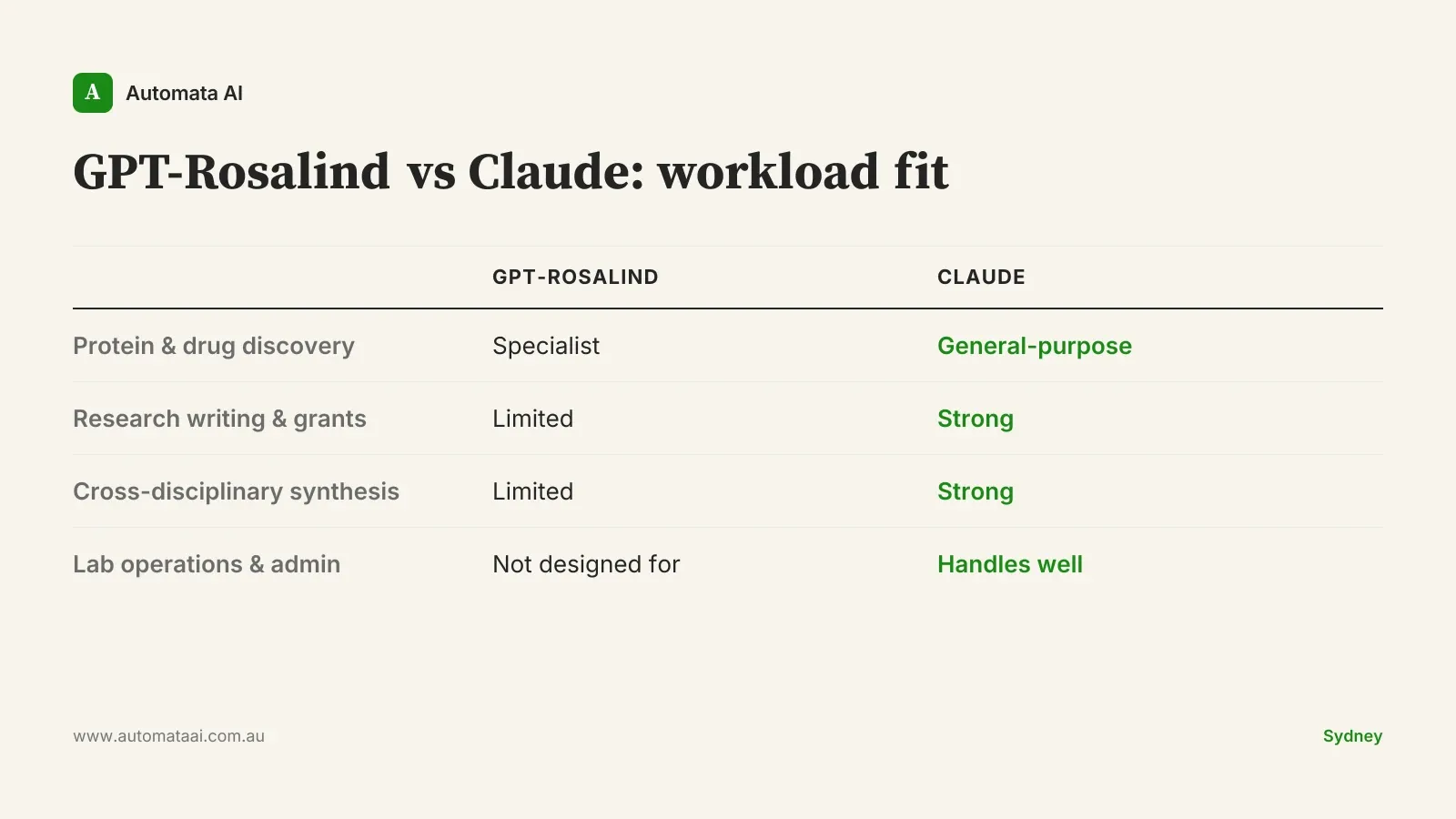
This is a frontier reasoning model trained specifically on life-sciences workloads. The capability profile is narrow by design: protein structure prediction, drug-target interaction reasoning, multi-step genomics analysis, and the kind of mechanistic reasoning that drug discovery requires at the edge of what existing models can handle.
It is not a general-purpose assistant with a biology fine-tune bolted on. That distinction matters more than it sounds. You do not use Rosalind to write a grant application or draft a regulatory submission to the TGA. You use it when the bottleneck is domain-specific computational reasoning, not communication or synthesis.
Access is currently gated through OpenAI's trusted partner program. Not broadly available.
Australian life-sciences teams that should be applying for access
Pharma R&D divisions. CSL, Mesoblast, Telix Pharmaceuticals, and the broader Australian pharma R&D sector running active drug discovery programs. Rosalind is worth evaluating for protein engineering and drug-target interaction work specifically, not as a wholesale platform replacement.
University medical research institutes. WEHI, the Garvan Institute, Murdoch Children's Research Institute, and NHMRC-funded groups doing computational biology. Many already run Claude for general research synthesis and writing. Rosalind is a complement for the specialised computational work, not a replacement.
Genomics-focused companies. Australia's genomics sector is growing. Organisations operating in genomic analysis, sequencing, and variant interpretation have a direct product fit with Rosalind's core capabilities.
Biotech startups. Sydney's Cicada Innovations cohort and Melbourne's biomedical precinct. Access to a frontier life-sciences model changes what a twelve-person team can attempt. That is a genuine competitive lever.
Where Claude still leads
Rosalind is narrow. That is a feature when the workload fits and a real limitation when it does not. Claude remains the stronger tool across three categories that every life-sciences organisation runs, regardless of whether they are doing frontier drug discovery.
Long-form research writing. Grant applications, clinical study summaries, regulatory submissions to the TGA, NHMRC grant narratives. The Australian regulatory environment has specific documentation requirements, and Claude handles these without the brittleness of a narrowly trained model.
Cross-disciplinary synthesis. Life-sciences organisations do not operate in isolation from their legal, commercial, and operational teams. Pulling together findings from a genomic analysis alongside IP protection considerations, MRFF funding terms, or a partner licence agreement is exactly where Claude's broad training pays off.
Lab operations and clinical workflows. Document handling, staff communications, scheduling, audit trails, standard operating procedures. Operational work. Using a specialist research model for administration is like hiring a neurosurgeon to take your blood pressure.
When the dual-vendor approach is the wrong call
The obvious pitch is that every Australian life-sciences organisation should be running both models. That is not true, and the honest version is more useful.
Rosalind via partner access typically runs $80,000 to $400,000 per year at AUD-equivalent rates, depending on usage volume and the partner tier OpenAI grants. The contracts are USD-denominated, which adds currency exposure to the procurement decision. That spend earns its place only when the specialised workloads are real and frequent. Three criteria determine whether they are:
Research volume. Rosalind earns its cost when computational biology is a core workflow, not an occasional support function. If your team runs protein structure or drug-target work weekly, the case is there. If it happens twice a year, it is not.
Team composition. You need at least two to three researchers whose primary work falls within Rosalind's domain. A single computational biologist sharing the licence is not the target use case.
Stage of discovery. Late-stage optimisation workloads may not need the heavy lifting of a frontier reasoning model. Earlier-stage hypothesis generation and target identification is where Rosalind has the most to offer.
What this costs in Australian terms
Claude Enterprise for a life-sciences team's operational, writing, and general research work runs $40,000 to $150,000 per year depending on headcount and usage tiers. Add Rosalind partner access and the combined annual spend sits between $120,000 and $550,000 for a serious research organisation.
For CSL or WEHI, that figure sits within normal research tooling budgets without a lengthy approval process. For a fifteen-person biotech startup, it is a material line item that needs a clear return before sign-off.
Do the calculation before applying for partner access. Identify the specific computational workloads that map to Rosalind's capabilities, estimate hours saved per week against fully loaded researcher rates (typically $120 to $180 per hour for senior life-sciences talent in Australia), and model the payback. If it comes out under six months, the business case almost writes itself.
The 2026 action list for Australian life-sciences leaders
Apply for Rosalind partner access now. The queue is real. Even if you are twelve months from a production decision, early access means early evaluation.
Separate the workloads before you pilot. Computational research on one side, operational and writing work on the other. Run parallel pilots, not sequential ones.
Brief your privacy and IP teams early. A dual-vendor model posture has data handling implications. Under the Australian Privacy Act (1988), organisations using multiple offshore AI providers for research involving patient data need a clear legal review before the pilots start.
Set a payback threshold before signing. If the combined Rosalind spend does not show a six-month payback against identifiable research outcomes, it is not ready.
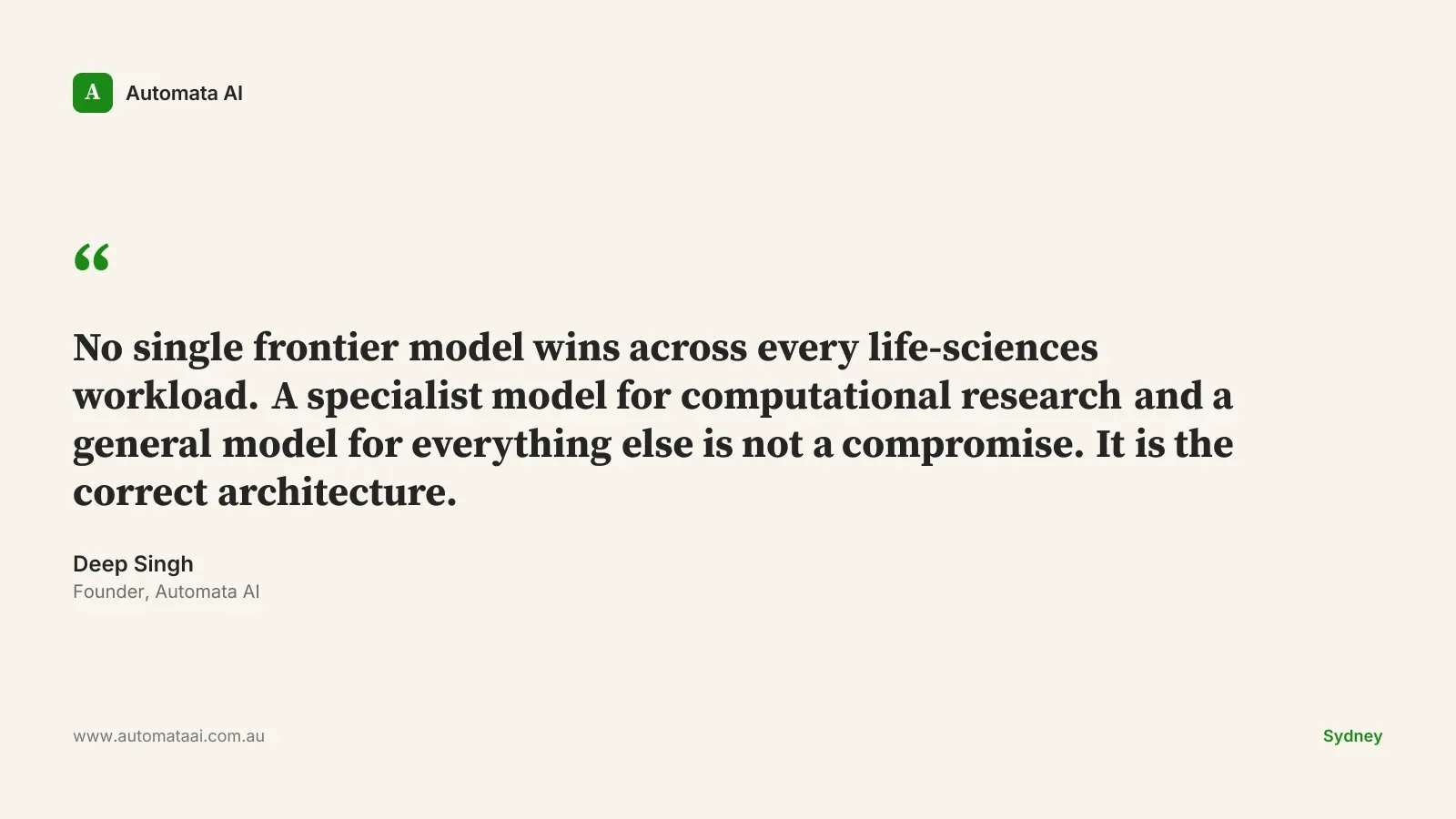
The organisations that pull ahead over the next three years will be the ones building workflows around the best tool for each specific job, not the ones betting that one frontier model handles everything. No single model wins across every workload. The smart call is knowing which one wins where.