The SMR queue doesn't shrink on its own.
AUSTRAC's reporting obligations have expanded steadily, and transaction volumes at Australian mid-tier banks have grown alongside them. Investigator headcount has not. The result is a backlog that senior analysts manage through informal triage. They are not choosing to work that way. There is simply no other option with current headcount.
At a fully loaded cost of around $100 to $120 per hour for an AML analyst, a 90-minute SMR narrative on a caseload of 8,000 cases consumes roughly 12,000 hours a year. That is the equivalent of six full-time analysts doing nothing but writing the same type of document, while the cases that need genuine judgement wait in the queue.
Claude changes that calculation.
What Claude Actually Does in an AML/CTF Workflow
Claude is not making regulatory decisions in this workflow. The decision to file an SMR, the risk rating, the customer outcome, and any communication with AUSTRAC stays with the qualified investigator. What Claude handles are the four tasks that consume investigator hours without requiring investigator judgement. The distinction matters for the compliance posture: Claude is a tool for evidence synthesis and documentation, not a substitute for the analyst's regulatory expertise.
First-pass SMR narrative drafting. Claude reads structured case data: transaction records, counterparty profiles, entity relationships. It produces a draft narrative. A senior investigator reviews and signs off. The 90-minute task becomes a 15-minute review.
Cross-system data synthesis. AML/CTF investigations routinely touch four or five siloed systems. Claude reads the outputs and produces a cited summary so the investigator doesn't manually piece together the same picture every time.
Pattern explanation for junior reviewers. Claude writes out why a transaction pattern looks suspicious in plain language. Junior investigators verify the logic rather than reverse-engineering it from raw data.
Backlog triage. Claude ranks open cases by risk profile and likely action type, so investigator attention follows risk rather than queue order.
The Numbers for a Mid-Tier Australian Bank
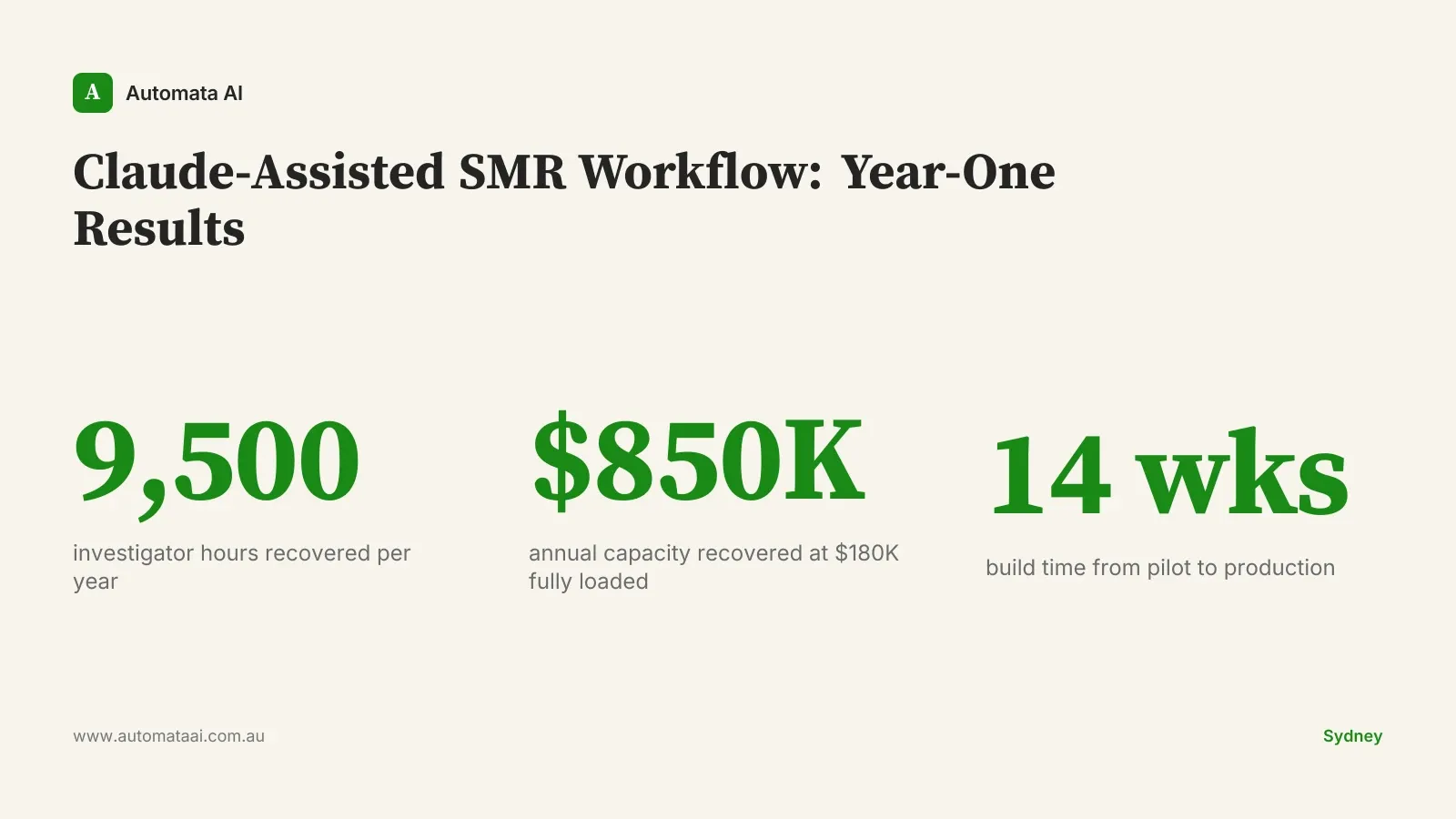
A mid-tier bank processing around 8,000 AUSTRAC-reportable cases per year ran a Claude-assisted SMR workflow for 14 weeks in shadow mode. The outcome: approximately 9,500 investigator hours recovered in year one. At a fully loaded analyst salary of $180,000, that recovered capacity is worth around $850,000 annually.
The build covered integration work, shadow-mode validation, and investigator training. The total came to approximately $120,000.
Payback in under two months.
A second saving that rarely makes it into the initial model: reduced analyst turnover. Teams where documentation overhead no longer dominates the day report measurably higher job satisfaction. A conservative estimate of reduced recruitment and onboarding costs across a team of eight analysts adds around $90,000 per year at the twelve-month review. That number doesn't appear on the original business case, but it shows up in the actuals.
The payback math for your specific caseload and team size is worth modelling before committing to a build. The ROI Calculator runs the numbers in AUD in under three minutes.
The Audit Trail Is Actually Stronger
The concern that comes up in every AUSTRAC-adjacent pilot is the same: if Claude drafted the narrative, how does that appear in the audit record? Regulators expect to reconstruct decision paths. The question is legitimate, and it is worth addressing directly before the pilot starts.
A structured Claude workflow leaves more breadcrumbs than a manual one. Every Claude action carries a citation back to the underlying data source and a structured log entry. An AUSTRAC reviewer can trace the decision path in minutes. Most manual processes, by contrast, are a combination of analyst memory, email threads, and case notes that nobody can fully reconstruct two years later.
Properly scoped, the audit trail becomes a compliance advantage, not a liability. That is an argument that regularly surprises compliance teams who expected to push back on the pilot. The manual process rarely produces a clean, reconstructible record of how the investigator reached their conclusion. A structured agent log does.
When This Workflow Is the Wrong Choice
Not every AML/CTF operation should run this. Four situations where the economics or compliance posture don't support it:
Case volume under 2,000 per year. Below that threshold, the build investment does not recover in year one. The manual process is still manageable.
Highly unstructured source data. Claude needs structured or semi-structured case inputs. If your case management system outputs freeform text with no schema, the integration work consumes the saving.
No human sign-off in the workflow. The workflow only works with a qualified investigator reviewing and approving every case output. If the intent is to remove the human reviewer entirely, this is the wrong approach and it will not clear your compliance team.
Active AUSTRAC scrutiny. A live regulatory engagement is the wrong time to introduce new tooling. Stabilise the existing process first.
The Rollout Pattern That Works
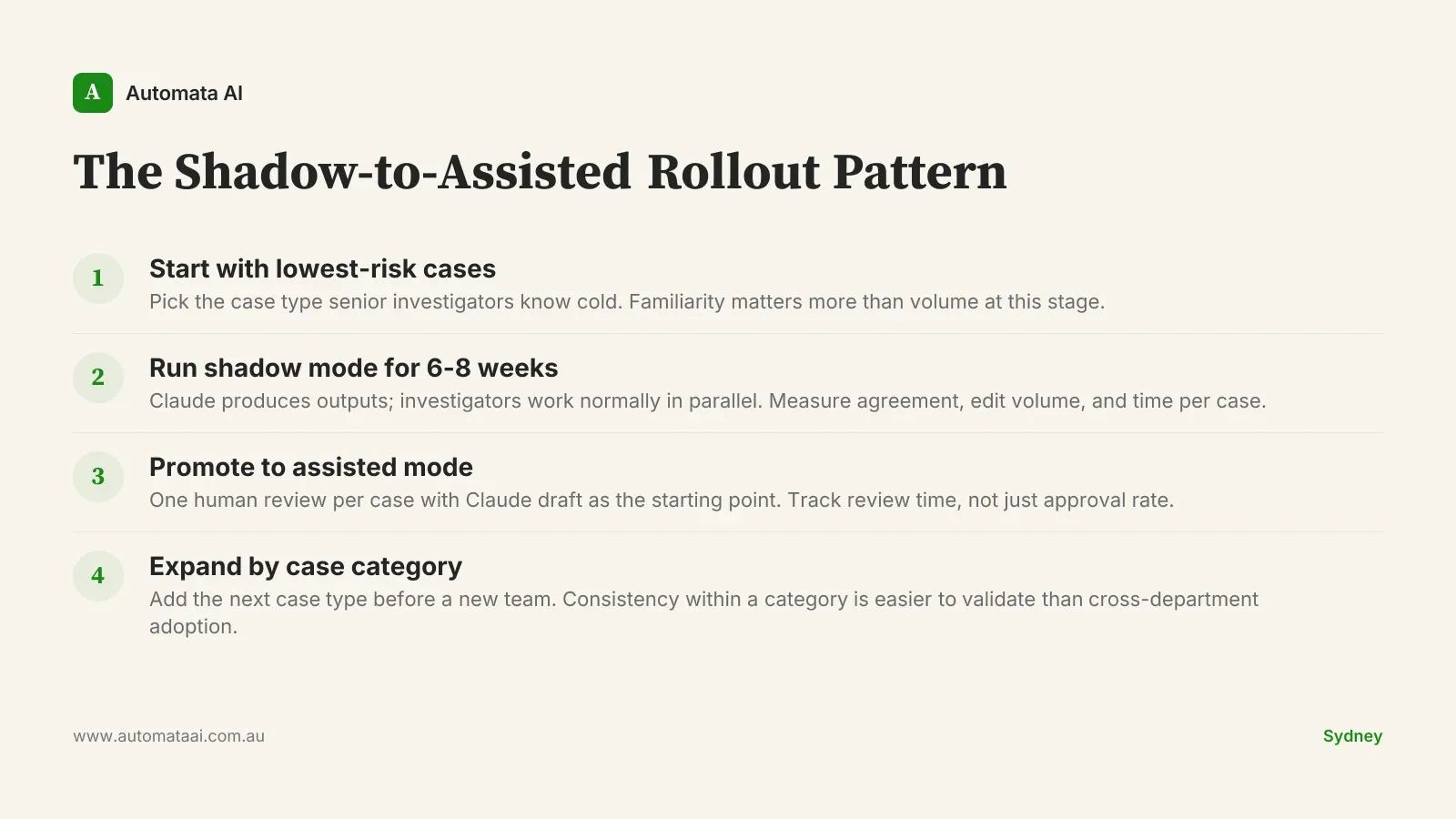
Big-bang rollouts fail consistently in regulated environments. The sequential pattern works. It is the same approach we take in AI for financial services engagements across the market: one case category, one team, six to eight weeks of shadow mode before expanding. We call it the shadow-to-assisted rollout pattern.
Pick the lowest-risk case category first. Volume matters less than familiarity. Start with the case type your senior investigators know cold, so they can quickly calibrate whether the Claude draft is accurate.
Run in shadow mode for six to eight weeks. Claude produces outputs; investigators work their normal process in parallel. Measure agreement on risk ratings, edit volume on narratives, and time per case. Do not promote until the numbers are stable.
Promote to assisted mode with one human review per case. Claude draft as the starting point, investigator sign-off before the case closes. Track how long the review takes, not just whether it approves.
Expand by case category, not by team. Add the next case type before adding a new team. Consistency within a category is easier to validate than adoption spread across a whole department.
Australian providers that roll this out across all teams simultaneously report adoption below 25 percent at the three-month mark. Providers that expand sequentially by case category hit above 70 percent by month six. The difference is not the technology. It is how much trust the investigators have built with the tool before they are expected to rely on it. An AI Readiness Assessment is worth running before you commit to a rollout sequence. It maps which case categories to start with and what shadow-mode metrics to target.
The investigator spending 90 minutes on every SMR narrative is not doing their best work. The backlog is manageable. For any bank processing more than 2,000 AUSTRAC-reportable cases a year, the payback math is straightforward. The harder part is the rollout discipline.