The drill results came back on Tuesday. The resource update goes to ASX on Friday. Between those two events, a senior geologist at a mid-tier Western Australian explorer will spend roughly 18 hours writing — not interpreting, not deciding, writing.
That 18-hour number is rough but defensible. Across a 12-project portfolio, that writing load adds up to around $480,000 a year of geologist time on first drafts, summaries, and operational reports. Geological reporting is the highest-ROI starting point for AI adoption in the sector. The Mining Industry overview maps where else the opportunity sits across a mining operation.
Where the time goes in geological reporting
The output that takes longest is also the most formulaic. Drill-log narratives, assay interpretation summaries, structural mapping write-ups, and ASX-ready resource update language all follow established conventions. They require domain expertise to verify. They don't require domain expertise to produce the first draft.
Claude reads structured intersection data (collar coordinates, from/to intervals, lithology codes, assay values) and drafts the narrative that normally takes a geologist an hour per hole. It cites the source row in the output so the reviewer can trace every claim back to the raw log without re-reading the original file.
The Pilbara pattern
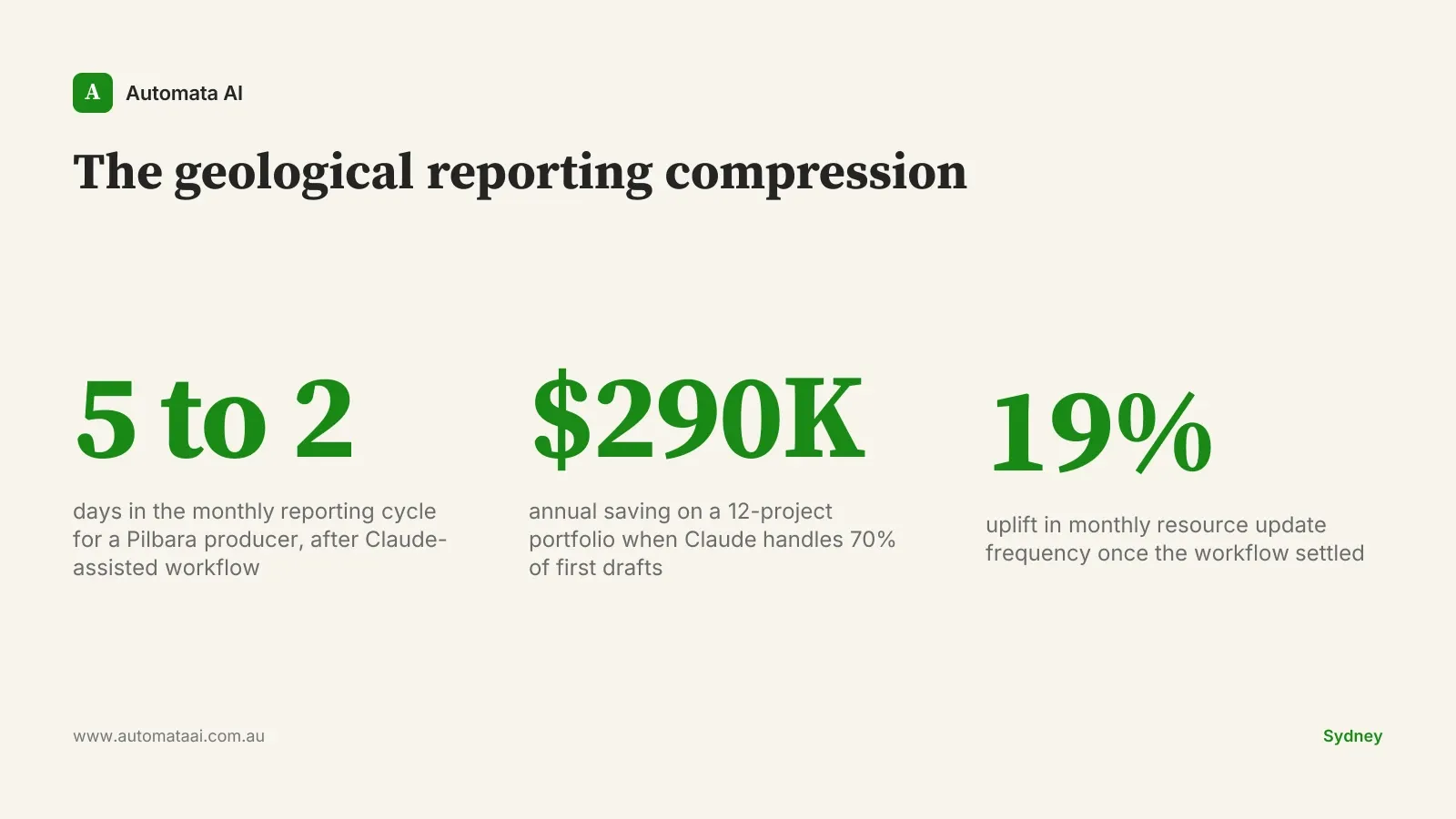
A Pilbara iron ore producer piloted this workflow across three active projects over 10 weeks. Monthly reporting had been running on a five-day cycle: one day of data consolidation, two days of first-draft writing, two days of review and sign-off. After the Claude-assisted workflow was in place, the cycle compressed to two days. The writing step, which had been the bottleneck, dropped to under half a day.
The freed time went into fieldwork and review. Monthly resource update frequency rose by 19 percent. Not because Claude did more geology, but because geologists stopped spending their best hours in Word.
The cost frame
At $120-$150/hr fully loaded for a senior geologist, an $480,000-per-year writing load across 12 active projects represents roughly 3,200 to 4,000 hours annually. A Claude-assisted workflow that handles 70 percent of first drafts brings that to around $190,000. The saving is approximately $290,000 per year before accounting for increased reporting velocity or staff retention.
There's a second number worth modelling. Geologists who spend the majority of their day on documentation show higher burnout rates than those with more interpretive work. Based on our client engagements, teams that shift to AI-assisted reporting see around $90,000 per year in reduced turnover costs once the workflow settles. That number is hard to model upfront. It is material once it lands.
For a quick check on what the payback period looks like for your operation, the ROI Calculator runs the numbers in AUD, specific to your project volume and geologist rate.
What Claude handles and what the Competent Person owns
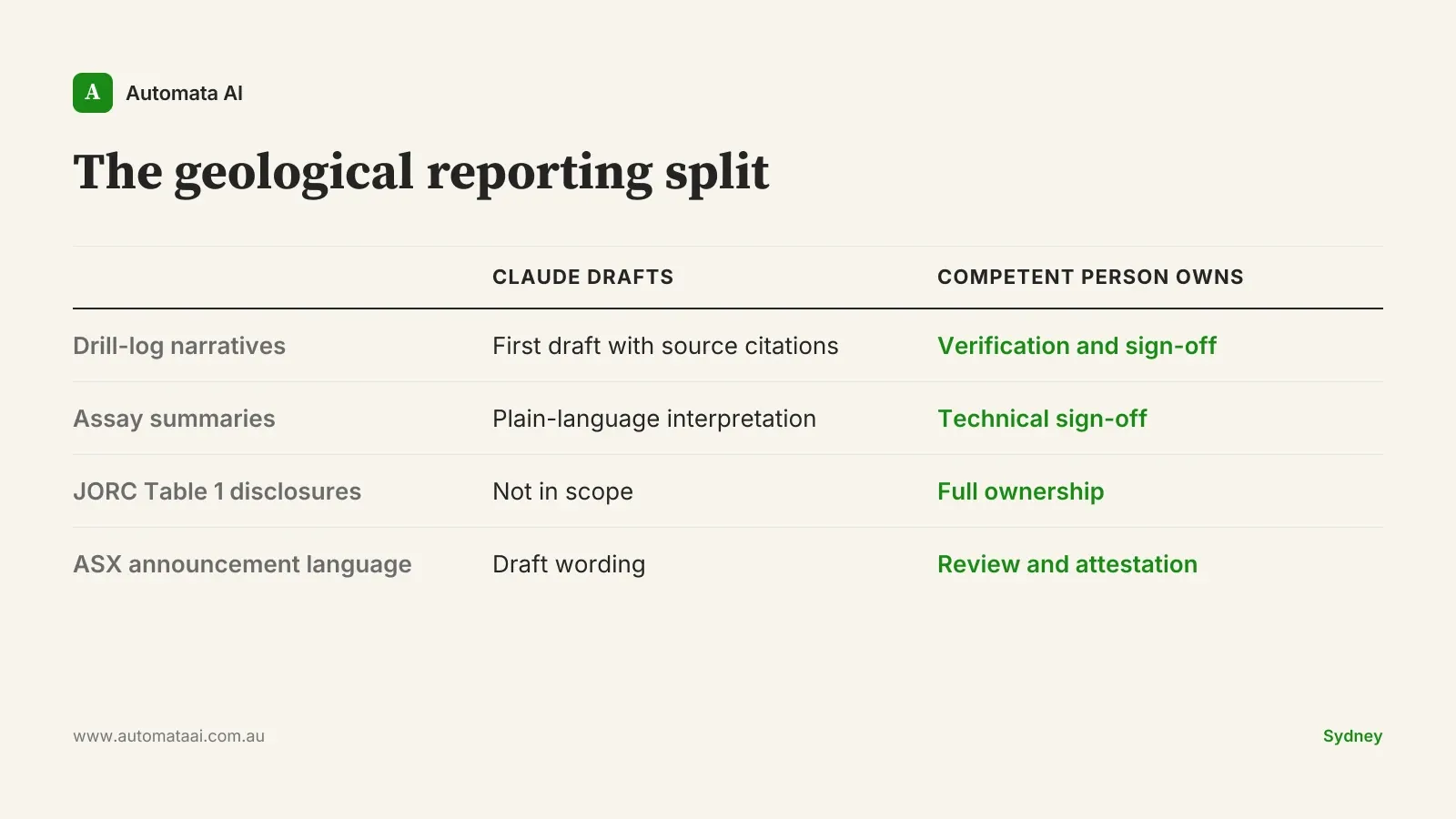
The split that works in JORC-regulated reporting environments is consistent across operations. It comes down to which tasks require domain expertise to produce versus which require domain expertise to verify.
Drill-log narrative drafting. Claude takes structured intersection data and produces prose narratives cited to row level. The geologist verifies, not writes.
Assay result interpretation. Claude contextualises results against the resource model with plain-language explanations a junior geologist can audit in under five minutes per hole.
Structural mapping summaries. Monthly operational reports draw on raw mapping inputs. Claude drafts; the mapper confirms the interpretation.
ASX-quality language. Resource update announcements require precise, regulator-facing wording. Claude drafts; the Competent Person reviews and signs.
What stays with the Competent Person
Resource estimation. Classification, estimation methodology, and JORC Table 1 disclosures stay with the Competent Person. Full stop.
Market-disclosed numbers. Any figure that goes to ASX has one owner. That is not Claude.
Regulatory attestation. The Competent Person statement is not a task for an AI model, and no audit trail changes that.
When this is the wrong choice
Not every geological reporting problem suits this approach. Three failure modes appear consistently across our engagements.
If your operation runs fewer than three active drill programs at a time, the payback is likely too slow. A production-grade build costs between $30,000 and $60,000 to do properly, covering prompt engineering, data pipeline integration, and review procedure design. For a single-project explorer running quarterly reporting, that's a multi-year payback on a workflow that may outlast the project. Our AI Automation Services page covers the engagement tiers and what's included at each level.
The second failure mode is unstructured data. Claude drafts from structured inputs. If your assay results live in inconsistent formats across spreadsheets from different contractors, the data consolidation problem has to be solved first. Teams that tried to skip this step found themselves spending more time cleaning Claude's citations than they would have spent writing from scratch.
The third: if your Competent Person hasn't been involved in designing the review workflow, don't ship it. JORC compliance isn't just about the output, it's about the process. A review procedure the CP hasn't signed off on creates audit risk that the cost savings don't justify.
The compliance architecture that makes this work
The reason this approach holds up in a regulated environment is citation density. Every Claude-generated paragraph carries a reference back to its source row in the underlying data. The Competent Person can check any claim in the report against the original log in under two minutes.
That's what separates structured Claude-assisted reporting from a geologist using a generic chat tool to write faster. The difference isn't the model. It's the structured source linkage and the audit trail that the Competent Person can follow without asking anyone where the numbers came from.
If you want to know whether your reporting workflow has the data structure this approach needs, the AI Readiness Assessment is the starting point. It takes about 20 minutes and maps your specific operation against the requirements.
The geologists who thrive over the next five years won't be the ones who write the most reports. They'll be the ones who verified the most interpretations, because they had the time to actually read the ground.
Pick one reporting cycle. Quantify the writing hours. If your operation runs three or more active drill programs, the payback period will probably surprise you.