A senior buyer at a national Australian retailer manages around 40 supplier relationships. Each one has an annual cost negotiation that moves somewhere between $200,000 and $2 million through the P&L. For most buyers, preparation means a spreadsheet opened the morning of the meeting and whatever they can recall from last year's discussion.
That's not a discipline problem. The data exists: 12 months of purchasing history, prior negotiation outcomes, volume trends, market pricing indexes, supplier margin signals from prior conversations. The issue is that pulling it together into a structured brief takes three to four hours per negotiation. A buyer managing 40 supplier relationships faces 120 to 160 hours of preparation work per year for this task alone, before the actual negotiations begin. That's four weeks of work that has to fit inside an already full buying calendar, and it's the kind of work that gets abbreviated under pressure.
What Claude does in a negotiation workflow
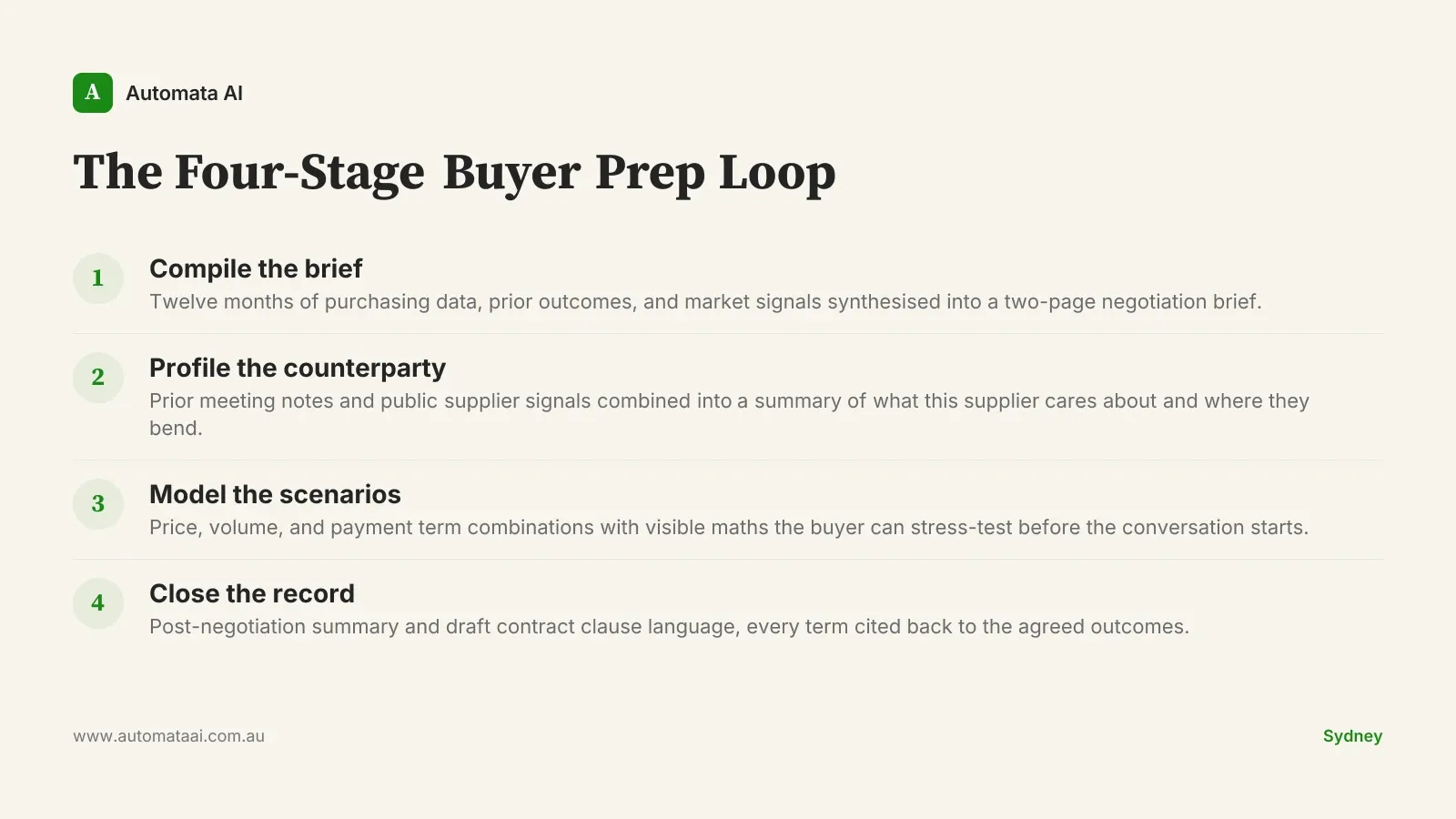
The workflow offloads four specific tasks to Claude, each with a defined input, a defined output, and a citation trail the buyer can check in under two minutes. Automata AI's AI Automation Services include a procurement-specific configuration for retail buying teams.
Pre-negotiation brief. Twelve months of purchasing data, prior negotiation outcomes, and market index signals synthesised into a structured two-page document. The buyer reads it in 20 minutes and walks in with three specific points.
Counterparty profile. Prior interaction notes and public supplier information combined into a single summary: what this supplier has cared about historically, where they have shown flexibility, and what the relationship record shows.
Scenario modelling. Structured what-ifs across price, volume, and payment term combinations, with the maths visible. The buyer can stress-test any combination before the negotiation starts.
Post-negotiation close. A summary of agreed outcomes and draft contract clause language, with every term cited back to the negotiation record.
The cost case
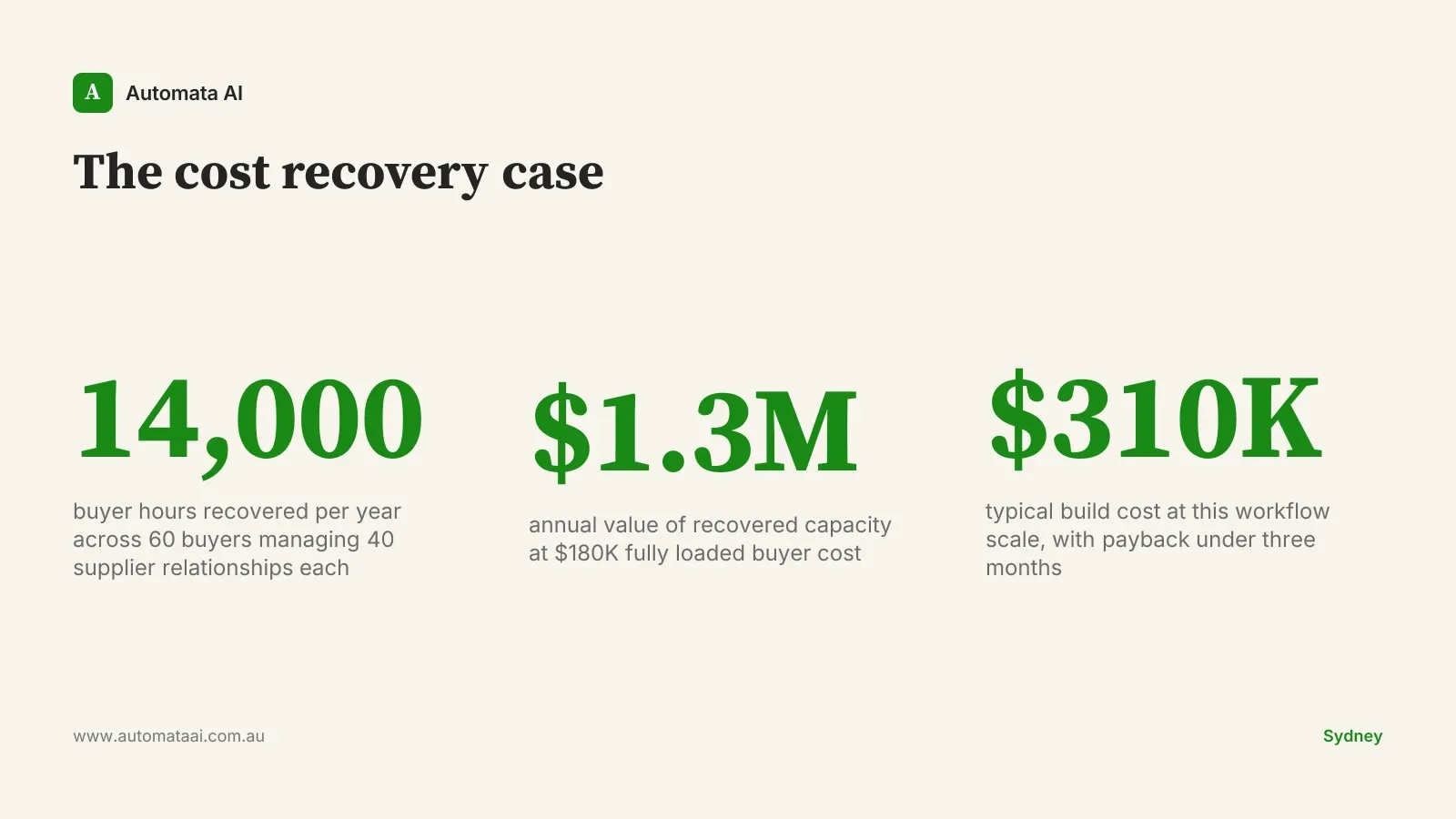
A national retailer running this workflow across 60 buyers, each managing around 40 supplier relationships, recovered approximately 14,000 buyer hours per year. That's not a marginal efficiency gain. It's the equivalent of seven and a half full-time buying positions freed from preparation work and redirected to category strategy, supplier relationship development, and commercial analysis. At a fully loaded buyer cost of around $180,000 per head, the recovered capacity is worth approximately $1.3 million annually. The business case isn't close.
The build cost for a deployment at that scale was approximately $310,000. The payback period was under three months once the workflow was embedded and buyers were using it consistently.
Those numbers come from a specific client engagement at a specific scale. If your buying team is smaller, the ROI still holds. It just takes fewer buyers and fewer relationships. Model the payback on your own supplier mix with our ROI Calculator; the inputs are buyer headcount, negotiation volume per buyer, and fully loaded hourly rate.
The compliance frame
Two regulatory layers shape supplier negotiations in Australian retail. Australian Consumer Law governs the terms buyers can include in supplier contracts and constrains certain negotiating practices. The Food and Grocery Code of Conduct (mandatory for major grocery retailers and voluntary for others) adds requirements around transparency, written terms, and dispute resolution that buyers need to account for in how they approach and document negotiations. Neither changes the workflow split. Claude drafts; the buyer signs. Every Claude output carries a citation back to source data, so the reviewer can trace any draft clause to the underlying negotiation record in under two minutes. Records are retained against the retailer's existing supplier management policy. No Claude output reaches a supplier without a human approving it.
When this workflow is the wrong call
Not every retail buying team should build this. The workflow pays when preparation volume is high enough to justify the overhead of implementing and maintaining it. The honest cases where it doesn't:
Buying teams under eight people. The implementation and maintenance overhead absorbs most of the hours you are trying to recover. The economics require enough preparation volume to dilute the fixed cost of the workflow.
Highly bespoke, long-tenure supplier relationships. If a category has two or three suppliers and the relationships have been built over 15 years, a structured briefing workflow adds process without unlocking meaningful new insight. The value is in the preparation density, not the relationship depth.
Unstable category pricing. If market prices in the category move week to week, a brief compiled Monday is stale by Thursday. The workflow assumes enough pricing stability to make structured preparation worthwhile.
What stays with the buyer
The relationship stays human. The negotiation conversation stays human. Every commitment, every signed agreement, every decision stays human. Claude is the briefing analyst, the scenario modeller, the summary drafter. Buyers who run this workflow consistently report the same observation: they spend more of the negotiation on the relationship work that actually moves outcomes, and less of their week on preparation overhead that drains attention without moving anything. The buyer spending 20 hours preparing for negotiations is 20 hours not spent on the category work that builds supplier relationships worth having. That shift shows up in quality, not just in hours.
The rollout pattern
Pilot with five senior buyers across three categories. Give them the workflow for a full negotiation cycle, typically six to eight weeks, and measure preparation time per negotiation and their own assessment of brief quality. Don't try to measure negotiation outcomes at pilot stage. Too many variables, too short a window. Start the scoping process with an AI Readiness Assessment to confirm the process fit before committing a full deployment budget.
Roll to the full buying team only after the senior buyers are advocates for it. The buying team takes its cues from experienced voices, not from IT rollout communications. Retailers that skip the senior-buyer pilot and push straight to a team-wide deployment see adoption below 25 percent, based on our client engagements. Retailers that run a six- to eight-week senior pilot first regularly see adoption above 70 percent. That gap is not about the technology.
Pick three buyers. Give them the prep workflow for their next supplier review cycle. Measure preparation time and brief quality after eight weeks. If those numbers move, you have a business case. The buyers who benefit most from this pattern aren't the ones who were struggling with preparation. They're the ones who were already good at the relationship work and were spending too much time on the spreadsheet work that wasn't the point. There's no shortcut to a better negotiation. There is a better way to prepare for one.