Most Australian mid-market firms frame the question wrong. They pull together a working group, someone raises Claude agents, and within twenty minutes the conversation has split into two camps: build it ourselves, or buy something packaged. Both camps have already lost, because neither is asking what actually determines which path wins.
That question is: what is our defensible advantage.
Here is the part that surprises most finance teams: the build-or-buy decision is not fundamentally about cost. It is about control over the workstreams that determine your margin. Get the capability question right first, and the cost model follows.
Buying wins when your advantage lies elsewhere
Generic use case. HR onboarding, expense categorisation, tier-one customer service. If hundreds of firms in your sector need the same workflow, there is a vendor whose product is already more sophisticated than anything you would build in the next twelve months.
Vendor scale you cannot replicate. A vendor processing millions of documents across hundreds of clients builds a feedback loop that compounds. You are not going to catch that on your own transaction volume.
Data that is not proprietary. Public pricing databases, industry reference tables, commodity document types. If your competitors have access to the same inputs, a build on the same foundation gives you no structural edge.
Shallow integration. A tool that sits on top of your systems rather than inside them can be swapped or removed without touching your core processes. That optionality is worth something.
Building wins when data and workflow are the differentiator
Proprietary data at the centre of your position. Supplier negotiation history, bespoke customer risk profiles, margin models that took years to calibrate. If this data is what makes you better than the firm competing for the same contract, it should not be inside a vendor's system improving their product.
A workflow unique enough that the vendor median is a compromise. Packaged products are built for the typical customer in your sector. If your differentiation lives in how you do the work, not just what work you do, the median build will erode it.
Deep integration into systems you own. A Claude agent wired directly into your ERP, your approval chains, your exception rules builds a structural moat over time. Packaged products can integrate at the surface. They cannot integrate at the logic layer without effectively becoming bespoke anyway.
Engineering capacity to own what you build. Build only if you have a named person who will treat this as a product with a roadmap, not a project with a launch date. A built agent without an owner degrades faster than a bought product without one.
Most Australian mid-market firms land in the middle
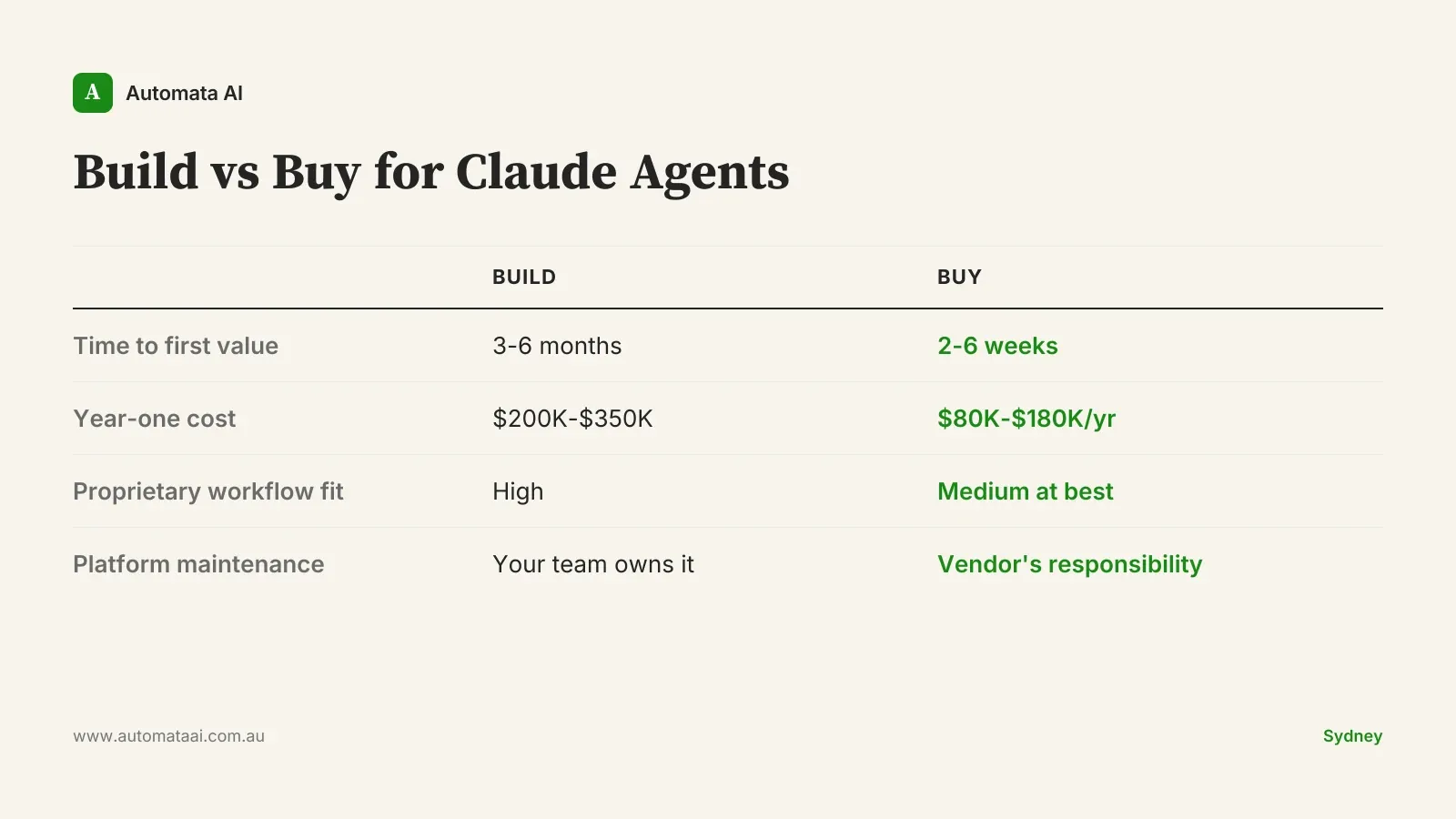
Few mid-market firms have engineering capacity to build everything from scratch. The answer is usually a hybrid: buy the generic workstreams, build the differentiating ones, and integrate both through a shared platform layer. This is not a hedge. It is a deliberate capability shape.
A Sydney logistics firm with $80 million in revenue ran this analysis in 2024. They bought customer service automation from a packaged vendor, built supplier-onboarding agents on Claude, and integrated both through a shared MCP layer. Build cost: approximately $260,000. Annual cost of bought components: approximately $140,000. Total year-one investment: roughly $400,000. Steady-state from year two: approximately $200,000 per year. The ROI Calculator can model this structure against your own workstream mix before you commit to either path.
The split was not arbitrary. Customer service automation was generic. Their supplier-onboarding process had proprietary exception logic, pricing rules, and supplier-tier classifications that had taken a decade to develop. Any packaged product would have required enough customisation to effectively become a build anyway, at higher cost and lower control.
The Capability-Shape Test: four questions that resolve most decisions
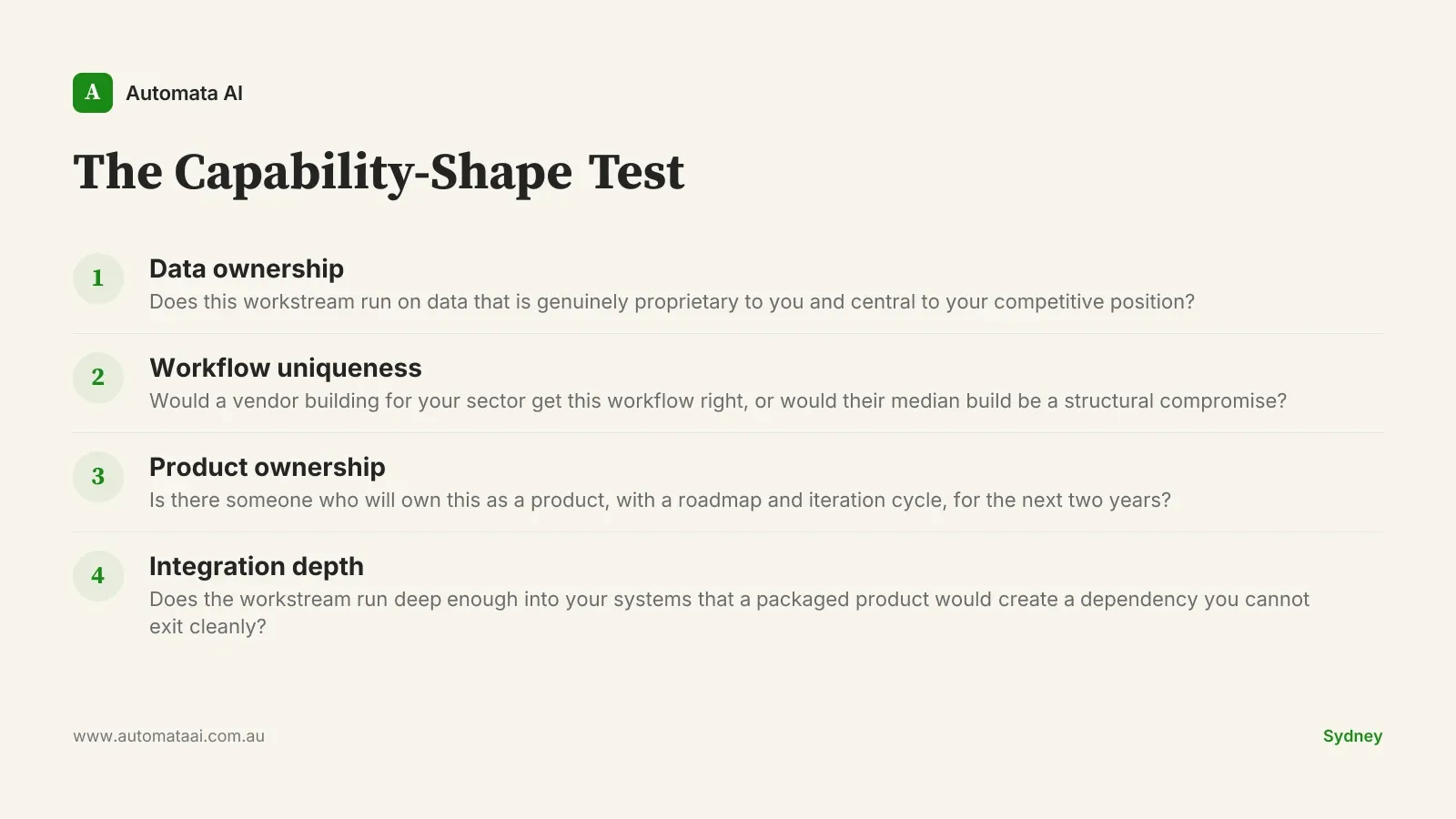
Before you open a procurement process or brief an engineering team, run each candidate workstream through what we call the Capability-Shape Test.
Does this workstream run on data that is genuinely proprietary to us? If no, you are building on inputs any competitor can access.
Would a vendor building for our sector get this workflow right without significant customisation? If yes, buy. The vendor has already done the expensive work of mapping the edge cases.
Do we have someone who will own this as a product, not a project, for the next two years? If no, do not build. The agent will decay and the business case will evaporate with it.
Is the integration deep enough that a packaged product would create a dependency we cannot exit cleanly? If yes, build. Lock-in at the logic layer is expensive to undo.
If the first, third, and fourth answers are yes, and the second is no, you build. If the answers reverse on most of those, you buy. Mixed answers mean hybrid. Most mid-market workstreams land in the hybrid zone, which is why the platform integration question matters as much as the build-or-buy question itself.
When the build path fails
Underestimating the platform tax. The agent logic is the smaller piece of the build. Audit trails, security controls, observability, deployment pipelines. A $260,000 build estimate that does not include platform infrastructure is not a real estimate. Budget an additional $80,000 to $120,000 before you have something production-ready.
Treating the agent as a one-off project. A Claude agent is a product. Products need roadmaps, owners, and iteration cycles. Teams that build once and step back find their agent degrading within six months as the business it serves keeps moving.
No internal owner. This is the one that kills more builds than technical failures combined. A build without a named, accountable owner will decay. The pattern is consistent enough across engagements that owner assignment is now a prerequisite, not a nice-to-have.
When the buy path fails
Buying for the workstream you should be building. If the workflow is differentiating, buying it from a vendor is not a shortcut. It is a decision to let someone else standardise your advantage. You will notice this about eighteen months in, when competitors who built the same thing start operating it differently.
Buying ten products that should be three. Integration debt compounds. Every additional vendor API is another failure mode, another renewal cycle, another contract to negotiate. The savings from individual product deals erode when you count the cost of holding ten of them together.
Buying without measurement. Finance will ask. If you cannot produce output metrics at the next planning cycle, you cannot defend the line item. Bought products without measurement are cut regardless of the value they are actually delivering.
The AI Automation Services we offer are structured around the Capability-Shape Test. Before any engagement starts, we map each candidate workstream against these four criteria to determine what should be built, what should be bought, and what the integration layer needs to hold both together without accumulating structural debt.
Pick one workstream. Run it through the four questions. If the answers are ambiguous, that ambiguity is information — it usually means the workstream needs tighter scoping before any dollar moves. The AI Readiness Assessment maps your candidate processes against these criteria and returns a prioritised view before you commit budget to either path.