The compliance officer at a mid-sized Australian aged care provider starts Monday with three facility audit findings, a continuous improvement plan due to the Quality Commission, and a care minute variance report for the board. That is four to five weeks of drafting work. It arrived in her inbox on Friday.
The Aged Care Quality Standards have not just added new requirements. The Strengthened Standards reform and the statutory duty that came into effect in 2023 have added volume. More standards, more structured narratives, more incident reports with prescribed timeframes. Providers who respond by adding compliance staff are treating a structural problem as a headcount problem.
The compliance overhead is structural, not a staffing problem
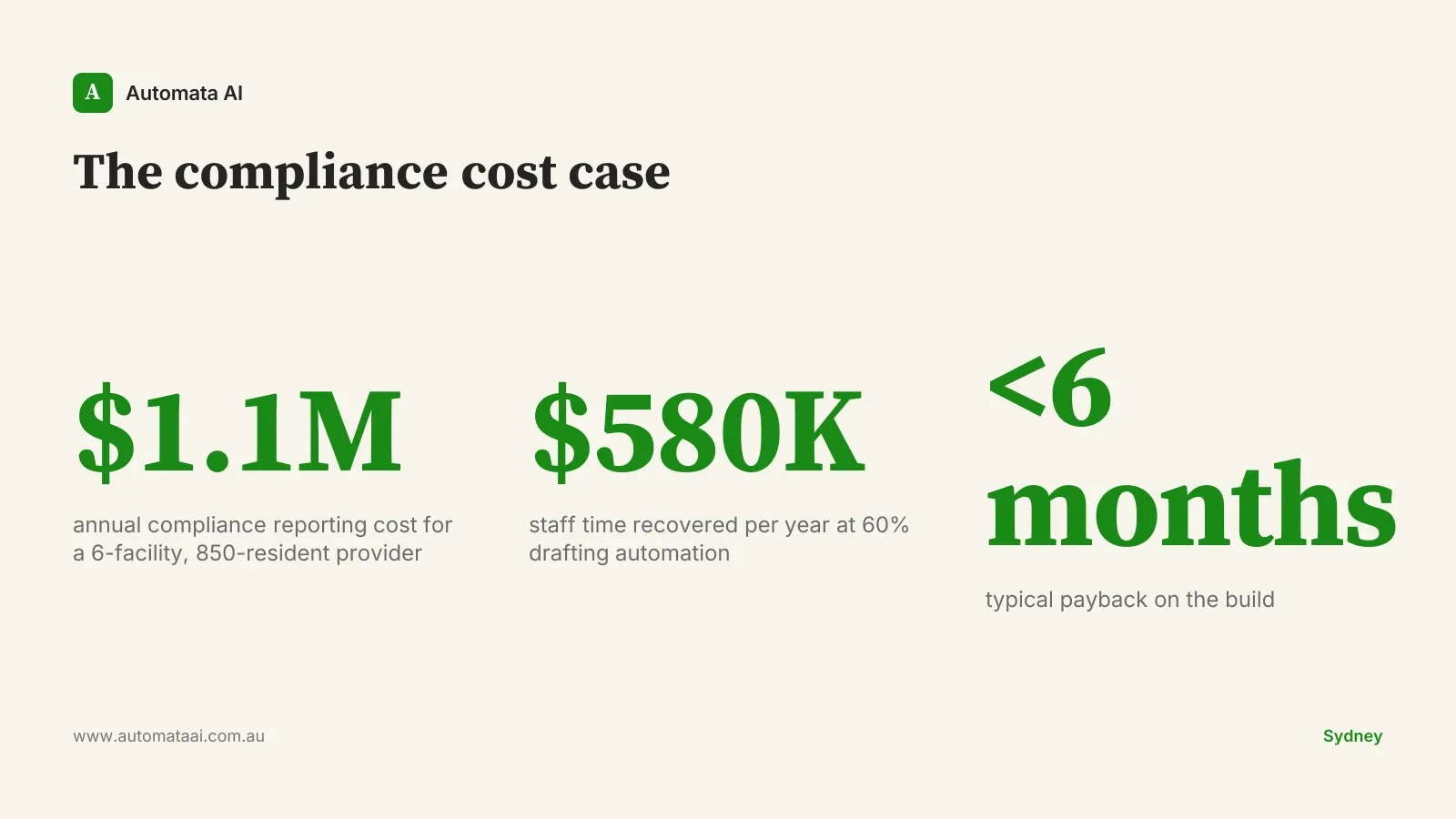
A medium-sized provider running 6 facilities and around 850 residents typically employs four to six compliance and quality staff. Fully loaded at $120,000 to $180,000 per year, total expenditure on compliance reporting and self-assessment work sits at approximately $1.1 million a year. That is the cost of the people. It does not include the hours clinical and operational staff spend gathering and formatting the data those reports rely on.
Most of that $1.1 million is going into drafting. The same structured tasks, at predictable intervals, against data the organisation already holds. That is precisely where Claude is built to help.
What a Claude-assisted workflow covers
Four categories of compliance work move well to a Claude-assisted workflow:
Continuous improvement plan drafting. From incident data, complaints, and audit findings, structured inputs produce consistent narratives that the compliance officer reviews rather than writes.
Standard-by-standard self-assessment narratives. Grounded in operational data the provider already holds, with explicit citations the reviewer can verify in under two minutes per artefact.
Care minute reporting. Against the mandatory targets, with plain-language explanations of variance that reviewers edit rather than write from scratch.
Statutory duty incident response drafts. Claude produces the draft. The compliance officer reviews, edits, and approves before anything reaches the regulator.
The recurring theme is drafting. Claude does not determine the organisation's compliance position or make regulatory judgements. It turns structured operational data into coherent, citation-backed prose so the compliance officer spends 15 minutes reviewing a draft rather than 90 minutes writing from scratch. The compliance officer still signs off. The board still sees the documents. The Quality Commission sees only the approved final report.
The cost case for a medium-sized provider
A Claude-assisted workflow that handles 60 percent of compliance drafting for a provider of that size recovers around $580,000 a year in staff time. The build, covering integration with the provider's care management system and a six-month rollout across all six facilities, typically comes in at $220,000. That is a payback period of under six months. Run the full model in our ROI Calculator to size it against your facilities and reporting volume.
A further $90,000 a year in implicit cost shows up as reduced staff turnover. Compliance teams that move the documentation overhead to Claude report the work feels less grinding when drafting is no longer the dominant part of every week. That benefit is hard to model before the rollout and material once it settles.
The privacy frame: no resident data to external services
Resident data is sensitive personal information under both the Privacy Act 1988 and the Aged Care Act 1997. It cannot flow to external AI services without explicit consent frameworks that most providers do not have in place and that residents and their families would not expect.
The correct deployment runs inside the provider's existing cloud boundary, on AWS Bedrock or Google Cloud Vertex AI, with no resident-identified data flowing to Anthropic's external services. The model runs within the provider's own environment. Audit logs are retained for seven years, the period currently required by the Australian Aged Care Quality and Safety Commission.
Providers evaluating vendor solutions should ask directly: where does the data go when the model processes it? Vendors that route requests through a shared US-based API endpoint are creating Privacy Act exposure the provider probably has not modelled. That is a procurement question, not a technical detail.
When a Claude workflow is not the right answer
Not every aged care provider is positioned for this to work.
No structured operational data. If incidents and complaints live in disconnected spreadsheets with inconsistent coding and categorisation, the data infrastructure needs work before any AI layer will produce reliable drafts.
Single-facility providers. A facility with 60 to 80 residents and one part-time quality coordinator faces real compliance overhead, but the reporting volume rarely creates the drafting burden that justifies a $220,000 build.
Under-resourced compliance teams with no clear owner. Adding a new tool to a team already stretched to capacity, without a designated champion and a training plan, will reduce adoption without reducing workload.
If you are unsure which category applies, the AI Readiness Assessment gives a plain-language view of where AI investment will and will not pay off in your specific operation.
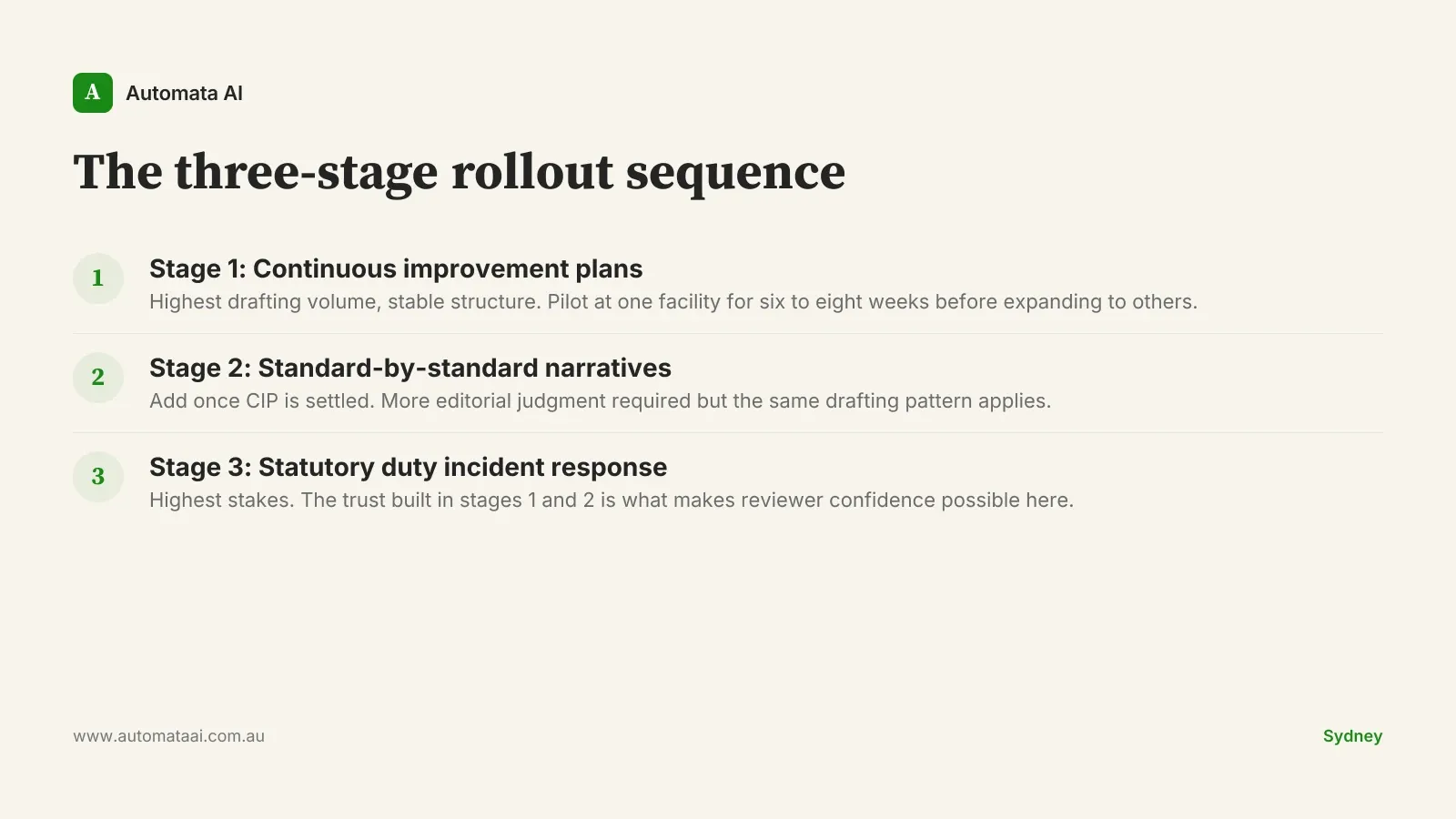
The three-stage rollout sequence
Australian providers that roll out across all facilities and all use cases in the first week get adoption below 25 percent. Providers that deploy sequentially over six months hit adoption above 70 percent. The difference is trust. Compliance officers need to see the tool produce reliable drafts before they will recommend it to peers or defend it to the board.
Stage one is the continuous improvement plan. It has high drafting volume, stable structure, and it is the work compliance officers most want to hand off. Pilot at one facility over six to eight weeks. Track draft quality, edit volume, and reviewer satisfaction. Expand to other facilities only after those numbers move.
Stage two is the standard-by-standard narratives. These require more editorial judgment from the reviewer but follow the same drafting pattern. Stage three is statutory duty incident response. The stakes are higher and the compliance officer's editorial role is more demanding. The trust accumulated from six months of reviewing CIP and narrative drafts is what makes stage three work.
Pick the facility where the compliance officer is most stretched. Quantify their monthly drafting hours. Model what a 60 percent reduction looks like in cost and time freed for actual risk analysis. If the payback is under six months, the business case writes itself. Our AI automation services for aged care cover the full build, from data integration to rollout training.