Here is a pattern becoming common in Australian SaaS. A Melbourne payments startup receives a Privacy Commissioner inquiry. Their ChatGPT accounts are locked down. WebAuthn, device authentication, anomaly detection. The inquiry has nothing to do with their accounts. It is about how they built their product.
No encryption at rest on customer PII. Session tokens persisting beyond expiry. No documented data retention policy against APP 11. Their OpenAI security posture was impeccable. Their product security design was not.
What OpenAI's Advanced Account Security actually covers
The feature set is real and well-executed. Phishing-resistant credentials via WebAuthn, device-based authentication, and anomaly detection for suspicious login patterns. For enterprise teams worried about account compromise, this is the right investment.
Phishing-resistant credentials. WebAuthn eliminates the password-based attack surface on ChatGPT accounts entirely.
Device-bound authentication. Login is tied to a verified device, not just a credential string.
Anomaly detection. Unusual access patterns trigger friction before damage is done.
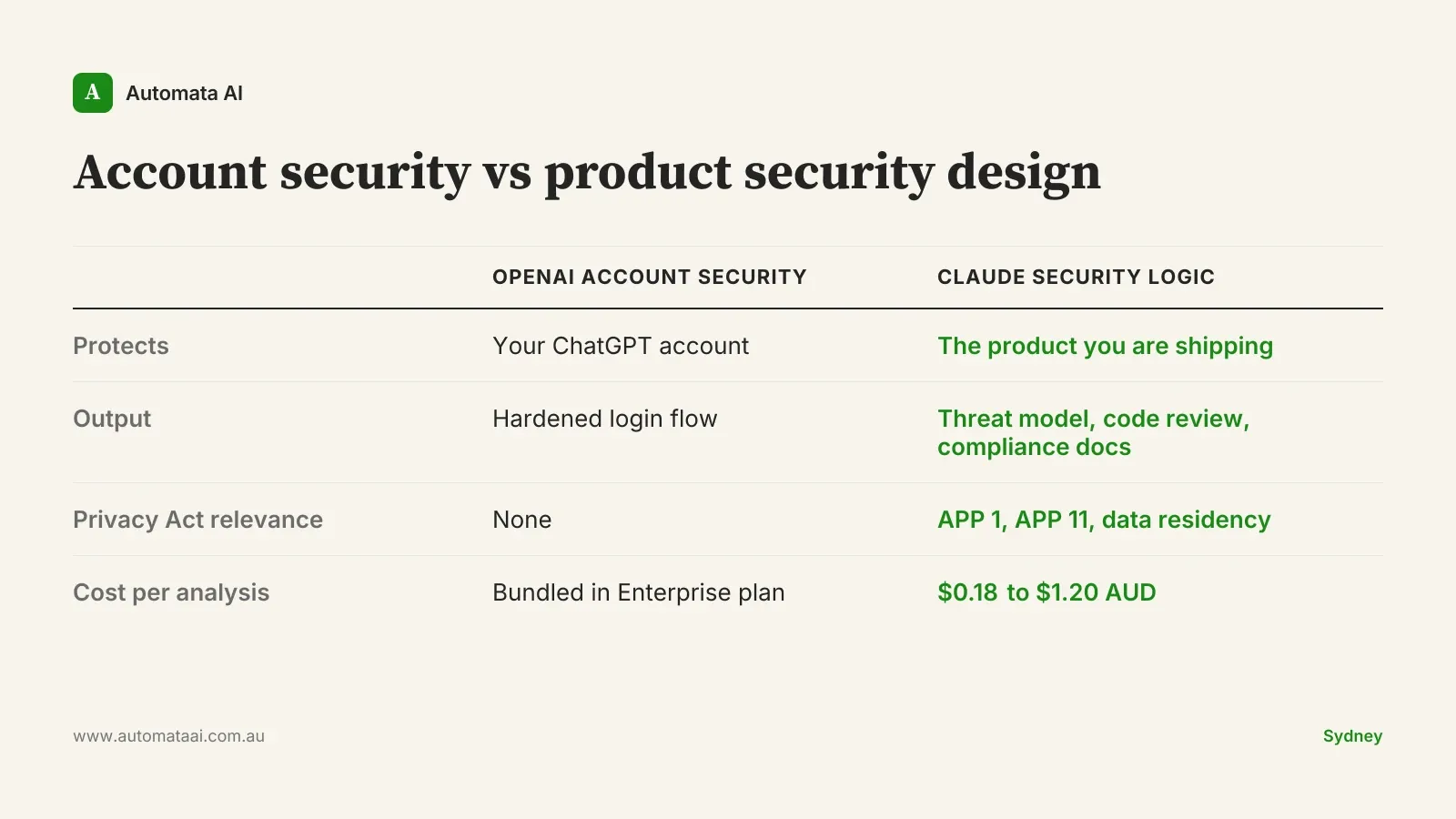
These are the right protections for the right problem. That problem is account compromise. Not product architecture. Not code-level vulnerabilities in what your team is shipping. If your SaaS product is what an auditor is reviewing, hardened ChatGPT login flows will not help you.
The security gap Australian SaaS teams actually face
ASIC and the Privacy Commissioner have both increased scrutiny of data handling practices in Australian SaaS businesses. The Australian Privacy Principles, particularly APP 11 which mandates reasonable security safeguards, are framed as outcome-based obligations. They ask whether security was designed in, not bolted on before launch.
Most mid-market teams in Sydney and Melbourne are building fast and shipping features. Security gets treated as a layer to add before launch. It rarely does. When an inquiry arrives, the question is always the same: where is your documented threat model?
This is the gap Claude fills. Not as a product security posture in the same sense as OpenAI's account features. As a reasoning partner for the security design decisions that happen before the first commit and after the last one.
Three ways Australian SaaS teams are using Claude for security logic
1. Architecture threat modelling
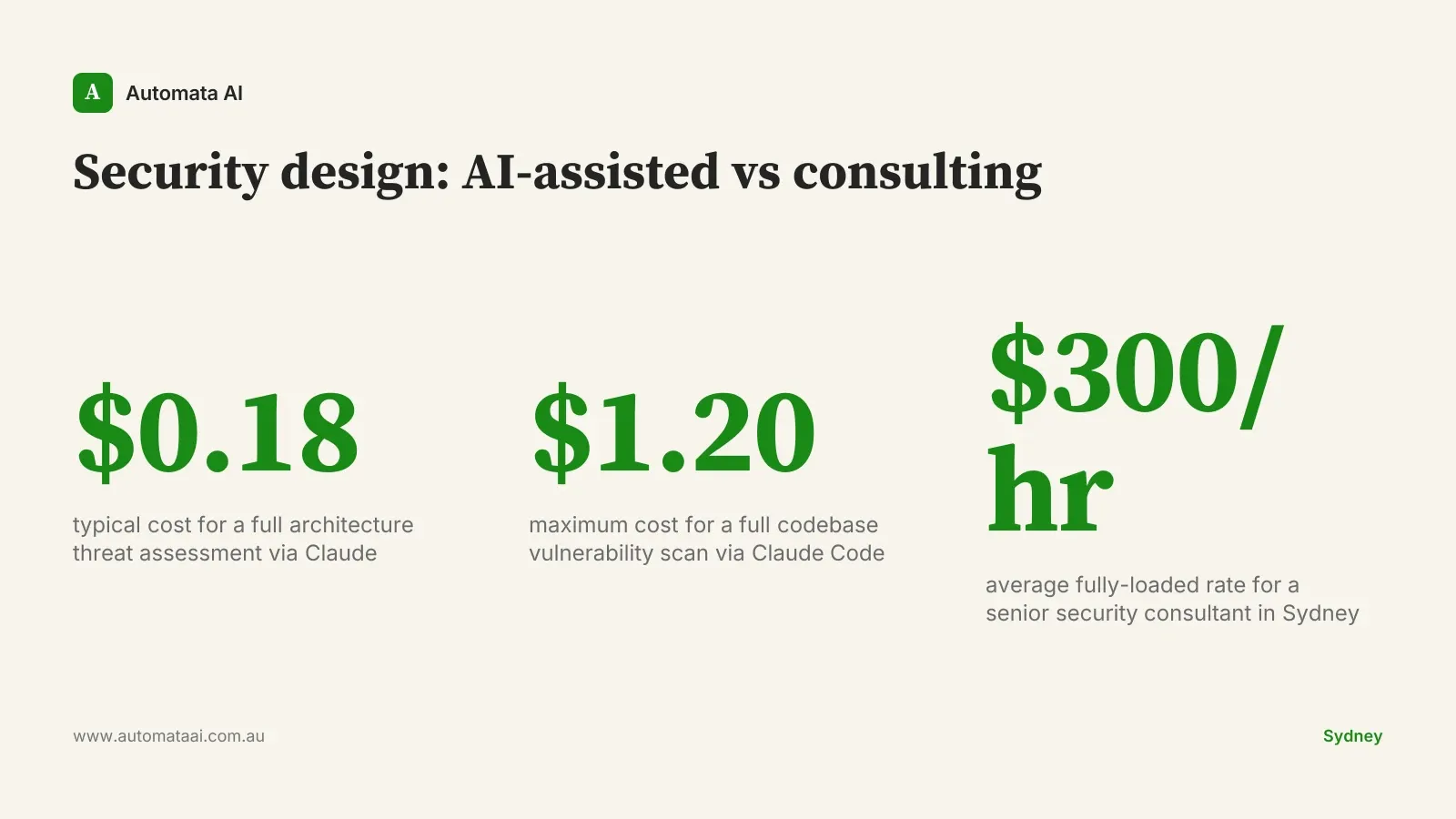
Feed Claude your system diagram. A screenshot of a Miro board, a text description of your data flows, a rough architecture document. Ask it to identify attack surfaces, privilege escalation paths, and data residency risks. In one engagement with an Australian financial services team, Claude produced a 1,200-word risk assessment covering threat actors, mitigations, and compliance gaps in under two minutes. Cost: AUD $0.18.
That does not replace a security architect. It means your team has a working threat model before the sprint review rather than after the audit.
2. Code-level vulnerability review
Claude Code scans a codebase for OWASP Top 10 patterns and returns specific findings with line references. It handles context well enough to flag a SQL injection risk without suggesting a fix that breaks your ORM's query builder. That last part matters more than it sounds.
Injection vulnerabilities. SQL injection, NoSQL injection, and command injection patterns across the codebase.
Broken authentication. Session management flaws, insecure token storage, and expired credential handling.
Sensitive data exposure. PII fields stored in plaintext, logs that capture customer identifiers, misconfigured object storage policies.
Insecure direct object references. Unvalidated user-supplied IDs that allow one customer to access another customer's records.
Cost per audit: AUD $0.40 to $1.20 depending on codebase size. A senior security consultant in Sydney runs $250 to $400 per hour fully loaded. Running Claude against the codebase before that engagement means the consultant spends their time on findings, not on discovery you are already paying for.
3. Privacy Act compliance documentation
When an APP 11 audit looms, the most time-consuming work is mapping your data flows to the specific requirements. Claude drafts the initial mapping, flags gaps against APP 1 transparency obligations and APP 11 security safeguards, and identifies cloud storage configurations where data residency may not meet Australian expectations.
A compliance team might spend two days producing that documentation manually. Claude produces a first draft in under ten minutes. The team validates and refines it rather than building from scratch under deadline pressure.
The cost argument
If your team runs one architecture review, two code audits, and one compliance documentation pass per quarter, the fully loaded Claude cost is under AUD $10. The same scope with a security consultancy at market rates runs AUD $3,000 to $8,000. Run the numbers through our ROI Calculator. AUD figures, three minutes, no signup required.
When Claude is the wrong tool for this
Not every SaaS team has a security design problem worth solving with AI-assisted analysis. Claude's security reasoning is overkill in a few specific scenarios.
No PII, no regulated data. If your product handles no personal information and operates outside regulated sectors, a threat model is unlikely to surface risks worth the time investment.
Simple no-code or low-code deployments. Zapier workflows and form-to-CRM automations have a small attack surface. Claude's architecture review is designed for systems with authentication layers, data stores, and external API integrations.
You already have a dedicated security function. If your team includes a security architect, Claude is a drafting assistant, not a replacement. The value drops significantly when the real work is already happening.
The honest version: if your annual revenue is under $5M and you are handling no sensitive customer data, a Claude security audit is not your next investment. Build the product first.
The security design trifecta
Australian SaaS teams that stay ahead of Privacy Act obligations tend to follow the same sequence. We call it the security design trifecta: three lightweight checks that create a documented trail without slowing the build cycle.
Threat model before sprint planning. Feed your architecture to Claude at the start of each build cycle. Fifteen minutes, before any code is written.
Vulnerability scan before merge. Run Claude Code against pull requests that touch authentication, data access, or external API calls. Catch the pattern before it reaches production.
Compliance map before the audit clock starts. Keep a living APP 11 mapping document. Update it quarterly, not reactively when an inquiry lands.
Teams that follow this sequence have a documented trail when the inquiry arrives. That is not compliance theater. It is the difference between an inquiry that closes in two weeks and one that runs for six months.
Pick the one layer your team is currently skipping. Start there. The AI Readiness Assessment walks through which processes in your stack are worth addressing first.