Most Australian engineering leads know the feeling. The internal CLI that would save two hours per developer per week has been on the backlog since 2023. The dashboard that surfaces deployment status across six services keeps getting deprioritised. The release-tagging process is still manual because nobody could justify the build cost.
Anthropic published a write-up this month on Claude building a working C compiler from scratch. It designed the architecture, wrote the lexer, parser, code generator, and runtime. Real binaries from C source code.
For most readers, that's a curiosity. For engineering leads with a graveyard of deferred internal tooling, it sets a capability ceiling and raises an uncomfortable question about everything well below it.
The capability floor has moved
Building a C compiler is not a novelty task. It requires understanding grammar rules, symbol tables, type systems, memory layout, and register allocation. A junior engineer couldn't do it alone. Most mid-level engineers couldn't ship it in a week. Claude built it.
That sets a floor. If Claude can produce a working compiler, it can certainly handle the class of tools that has been sitting in your backlog:
A CLI tool that automates your release tagging process
An internal dashboard that surfaces deployment status across six services
A test harness that generates edge-case fixtures from your production schema
An integration between your project management tool and your on-call rotation system
Internal tooling economics have flipped
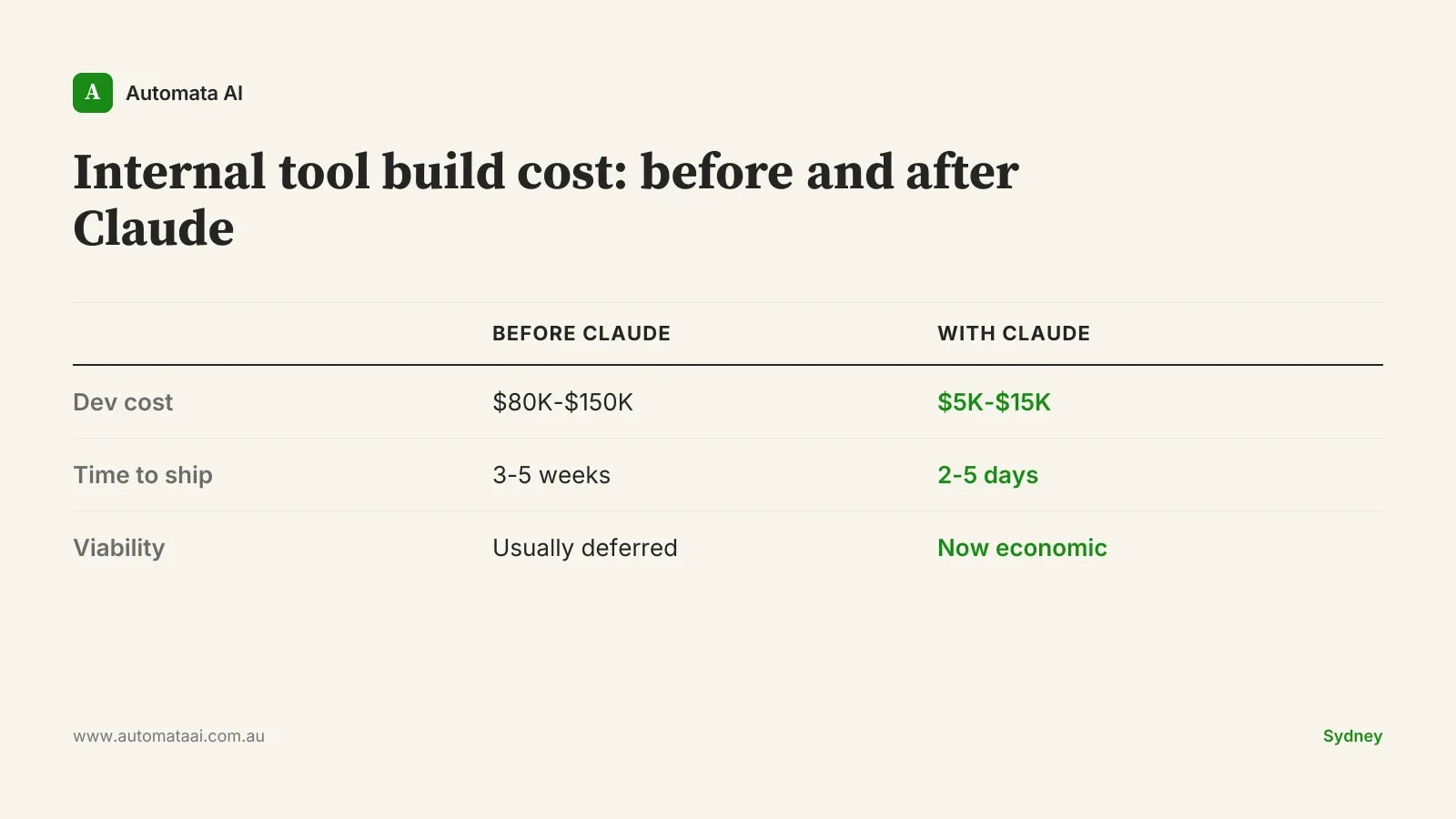
The typical custom internal tool — a developer CLI, an internal dashboard, a lightweight automation layer — has historically cost $80,000 to $150,000 to build and ship properly. That's three to five weeks of senior engineering time at $120-$180/hr fully loaded, plus review cycles, documentation, and the inevitable scope growth.
That calculation made most internal tooling uneconomic. Teams lived with rough edges because the alternative was an expensive engineering project with no customer-facing outcome. The CFO would ask what it shipped for. 'Faster deploys' was the answer. Valid, but hard to defend in a budget review.
With Claude Code in the loop, the same tool ships in two to five days. Development cost drops to $5,000-$15,000. You can model your specific tooling backlog through our ROI Calculator to see what each deferred item actually costs to build now versus what it costs to leave manual.
Build vs buy thresholds have shifted
The standard engineering lead playbook has been: buy SaaS for anything that isn't core differentiation. The logic was correct. Building was expensive, maintaining was expensive, and vendor SaaS kept improving. Nothing about that reasoning was wrong. The cost structure just changed.
When a bespoke internal tool costs $5,000-$15,000 instead of $150,000, some categories that were obvious buys become obvious builds. Developer tooling that wraps your specific deployment pipeline. Internal reporting that reflects your exact data model. Integration layers that connect the three tools your team actually uses.
The exception holds: anything with strong network effects (communication platforms, shared ticketing systems) or specialised compliance obligations (financial data, health records under Australian Privacy Act 1988) stays as a vendor buy. But the viable build space is wider than most engineering leads currently model.
Junior engineers face a different job
The work historically given to junior engineers is largely the same category as what Claude now handles well. Write the boilerplate. Wire up the integration. Generate the fixtures. Produce the first draft of the test suite. Not that the work was beneath them. It was real, useful learning. But it was also pattern-matched to existing code and could be specified with enough precision for someone new to execute it.
That pipeline has changed. The scaffolding work goes to Claude. The question is what junior engineers do instead, and the answer is: judgment work, earlier.
Australian engineering organisations that get this right will pair junior engineers with senior-engineer-plus-Claude from week one, not month six. The junior's job becomes reviewing Claude's output critically, identifying the edge cases Claude didn't consider, and raising the risk they can see but the senior is too deep in to notice. That is judgment work. It's more valuable than any boilerplate they'd otherwise write. If you're not sure how ready your team is for this model, the AI Readiness Assessment is a useful starting point.
When this doesn't always apply
Your backlog is deferred for product reasons, not cost reasons. If the spec is contested, or the process the tool would automate is about to change, lower build cost doesn't help. Claude doesn't resolve alignment problems.
Your team can't evaluate Claude's output. Claude Code is fast when a senior engineer is directing it. It produces plausible-looking code that fails in production when nobody is reviewing the output. The build cost drops; the review requirement doesn't.
The tool touches regulated data. Internal tools handling health records, financial data, or anything covered by the Australian Privacy Act 1988 need proper scoping regardless of what toolchain you use. A lower build cost doesn't change your compliance obligations.
These aren't arguments against building. They're arguments against building without thinking. The engineering leads who make the most of this shift apply the right filter before they start.
The internal tooling value test
Three questions determine whether an internal tool is worth building with Claude in the loop. The same three questions Automata AI uses when helping Australian engineering teams audit their backlogs.
Does the process run at least weekly? Monthly processes rarely justify even a $5,000 build. The ROI math only works at volume.
Is the spec stable for the next twelve months? A process that changes quarterly requires quarterly tool maintenance. The ongoing cost matters as much as the build cost.
Does your team have a senior engineer available to review Claude's output? Claude needs direction and review to ship production-ready code. Without it, you're deferring technical debt rather than eliminating manual work.
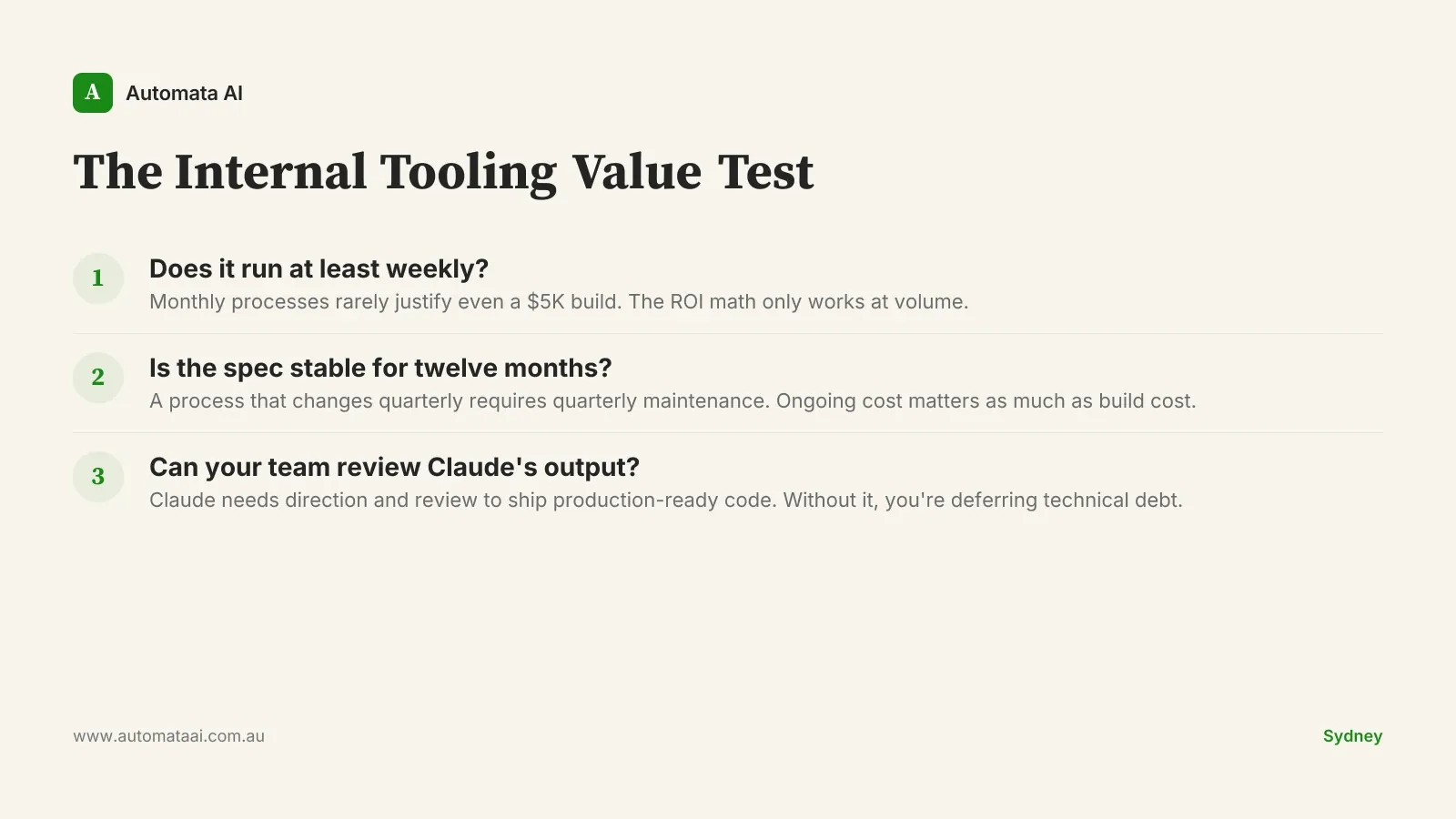
If the answer to all three is yes, build it. If two or more are no, the deferred status is probably correct. The constraint isn't cost.
Three moves for Australian engineering leads this quarter
Audit your backlog against the internal tooling value test. Most teams have five to ten deferred items that pass all three questions. Identify them before someone else does.
Ship one as a proof-of-concept this fortnight. Pick the simplest item that passes the test and run it through. The learning from one real build is worth more than a strategy document about capability.
Update your junior-engineer onboarding model. Automata AI's AI automation services include onboarding support for engineering teams making this transition, from tooling audit through to the first production build.
The C compiler is a benchmark. Most internal tooling is nowhere near that level of complexity. If Claude can build one, the honest question for Australian engineering leads is why the release-tagging CLI has been sitting on the backlog since 2023.