The research director at a Sydney management consulting firm isn't running a proof-of-concept. She's doing competitive analysis every week, pulling from internal deal notes, ASIC filings, IBISWorld reports, and the AFR. She tried Gemini Deep Research. It impressed her on the general web. Then she asked it about her firm's own client history. It had nothing to offer.
That's the real Gemini Deep Research vs Claude question. Not which model is smarter. Which tool can actually see your data. And how often does this workflow run.
What Gemini Deep Research actually delivers
Gemini Deep Research is a managed research agent. You give it a research question, it plans an investigation, browses public sources, synthesises findings, and returns a structured report. The quality is solid. Google's index gives it genuine breadth on anything publicly available.
The time-to-value argument is not trivial. Sign in, ask the question, and a research report lands in 10 to 20 minutes. No engineering. No infrastructure. No vendor contract to negotiate. If your research need is public-web-heavy and doesn't recur more than a handful of times a month, that is a real answer to a real problem.
Most Australian mid-market teams asking the Gemini Deep Research vs Claude question are framing it wrong. Gemini is not the inferior option waiting to be replaced. It's the right answer for a specific and common class of work.
Three areas where custom Claude research agents lead
1. Internal data research
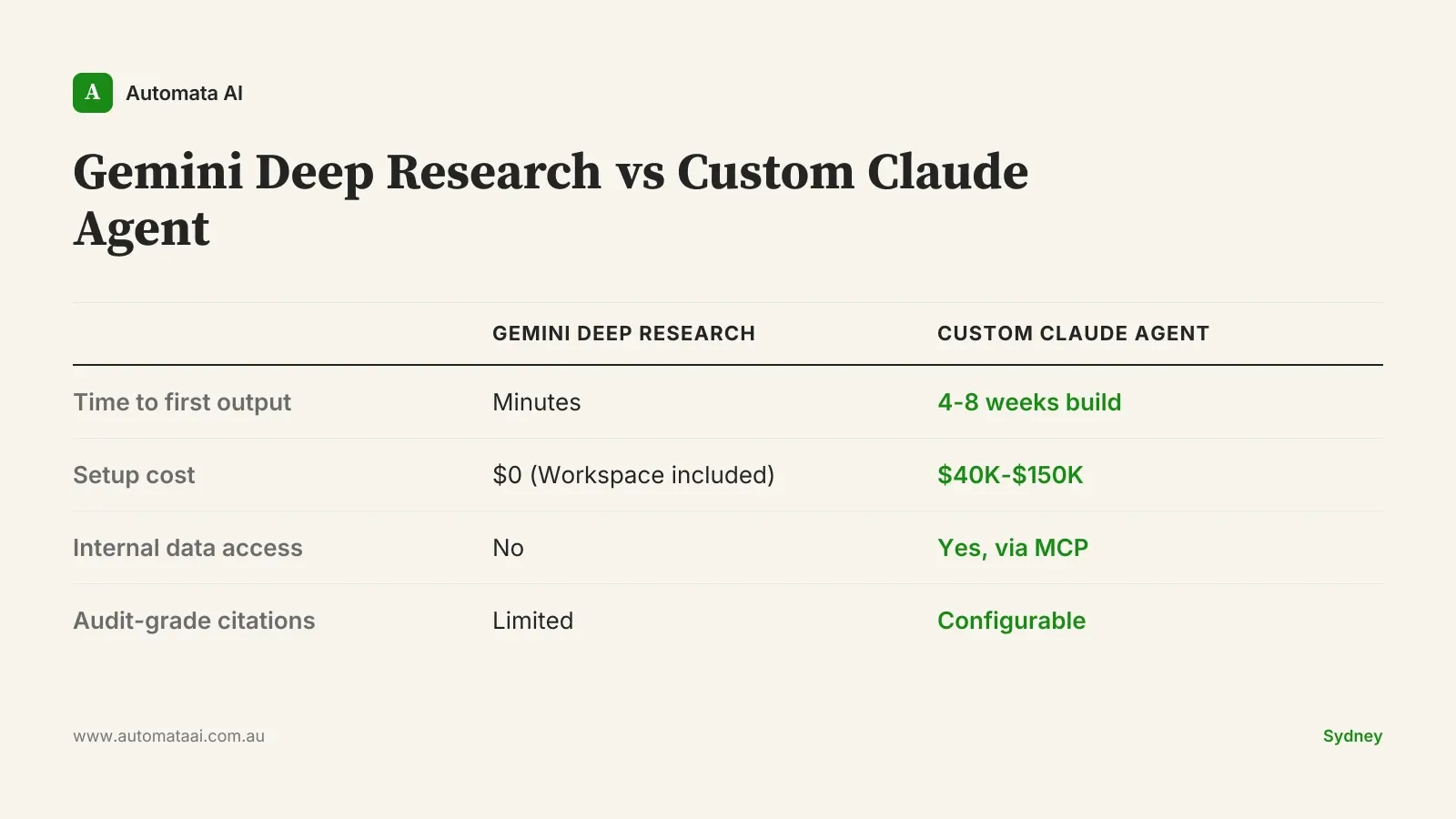
Gemini Deep Research operates on the public web. A custom Claude research agent, built with MCP servers connecting your CRM, data warehouse, and document storage, can research across your private data. That is a fundamentally different capability.
For a Sydney law firm researching precedents across its own matter archive, or a Melbourne insurer pulling claims history to underpin a market analysis, the public web is the wrong place to start. The answer is in your private data, or it doesn't exist.
2. Australian source priority
A custom research agent can be configured to prioritise ASIC filings, APRA publications, the AFR, IBISWorld AU sector reports, and state government data sets. Gemini Deep Research pulls from Google's index, which skews toward US sources by sheer volume. For Australian market analysis (sector sizing, regulatory landscapes, competitive intelligence on local players), that weighting matters.
This isn't a criticism of Gemini. It's a structural fact about the public web.
3. Citation rigour for regulated outputs
APRA-regulated financial services firms and government clients often need research outputs with exact citations and traceable provenance. Not a vague reference to a credible source. Every claim linked to a source document, every source document retrievable for audit. A custom Claude agent can be built with that discipline from the ground up. Gemini Deep Research wasn't designed for that level of compliance rigour, and retrofitting it doesn't work.
Where Gemini Deep Research genuinely wins
Zero setup cost. A well-built custom Claude research agent costs $40,000 to $150,000 for build and first-year operation. Gemini Deep Research is included in a Google Workspace subscription most Australian firms already have.
Breadth on the public web. Google's index is unmatched. For general industry sizing, scanning competitor press, or pulling summaries from published research reports, Gemini has coverage that would take months to replicate with a custom agent.
No infrastructure to operate. You're not managing it. No model updates to coordinate, no API limits to architect around, no incident response when it breaks on a Tuesday afternoon.
When a custom build is the wrong answer
The $40,000–$150,000 build cost doesn't amortise on a one-off project. If you're running a research sprint for four weeks and then stopping, a custom agent is the wrong tool. Gemini Deep Research handles it.
Same logic applies if your research is public-web-only. There's no case for private-data infrastructure if all the data you need is already indexed.
And if your team hasn't run a production AI workflow before, start with the managed service. Understand what a research agent actually produces, what prompting discipline it requires, and where it fails. Then decide whether those limitations justify investing in something custom. Building a $100,000 system before you've done $5,000 worth of managed-service research is backwards.
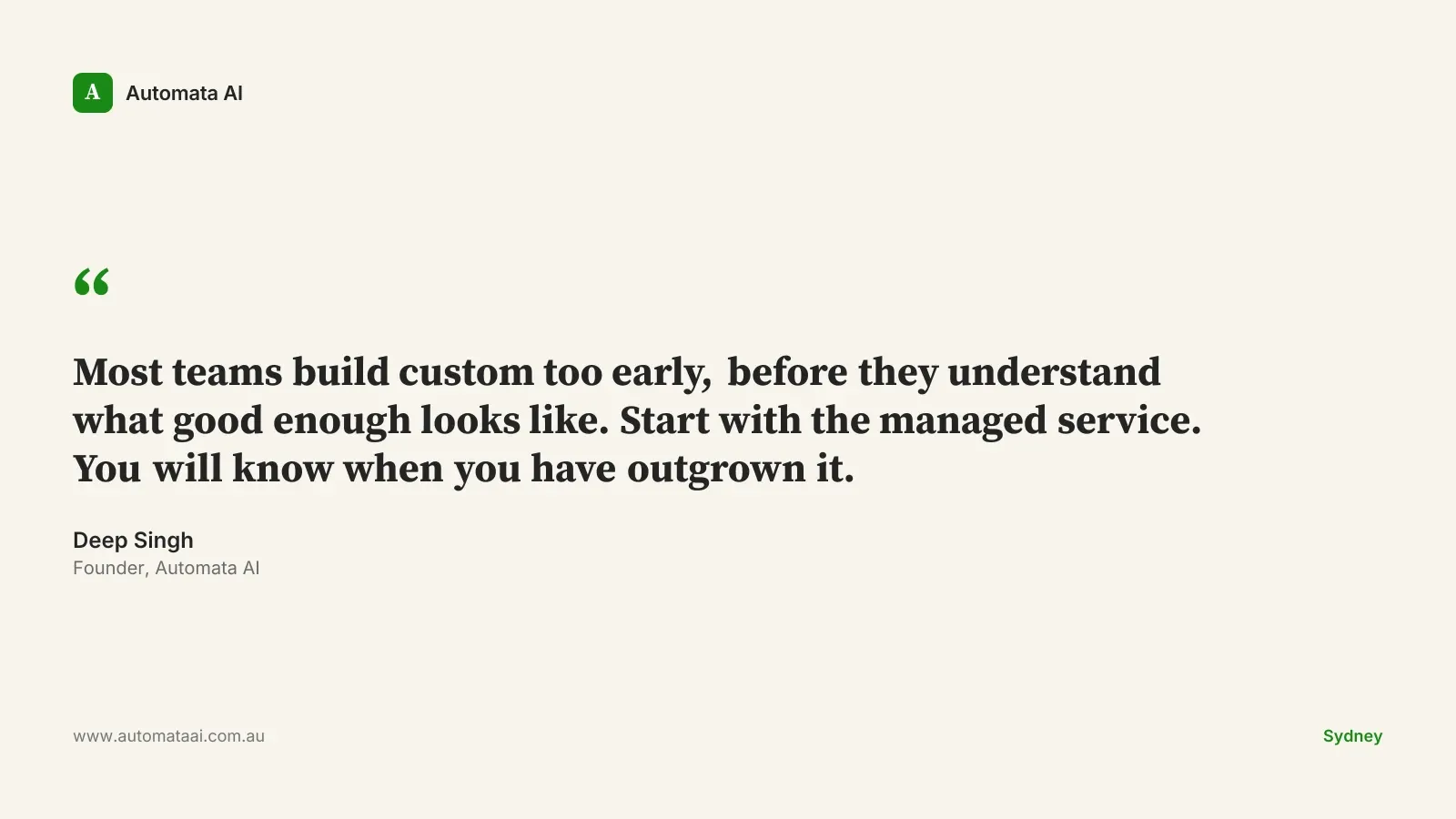
Most teams build custom too early, before they understand what good enough looks like. Gemini Deep Research is often good enough.
Three workload patterns and the right tool for each
One-off research, public-web-heavy. Use Gemini Deep Research. Save the engineering budget.
Recurring workflow with internal data. Build a custom Claude agent. At roughly 20 research tasks per month involving private data, the build cost of $40,000–$70,000 amortises within a year. At $150/hr fully loaded for a senior analyst, that's 270 hours — about seven weeks. If the agent handles what was taking the analyst 20 hours a week, the maths closes in four months.
Regulated output where citation provenance is mandatory. Custom from day one, with citation discipline designed in. This includes APRA-regulated financial services research, government procurement analyses, and any output ending up in a board pack or regulatory submission. Retrofitting citation rigour costs more than building it right the first time.
Gemini Deep Research and custom Claude agents aren't competing for the same work. Gemini owns the general-web, low-frequency workloads. Custom agents exist for the recurring, private-data, or audit-grade work a managed service can't reach.
Most mid-market Australian firms need both. The mistake is applying the expensive tool where the simple one works — and settling for the simple one where only a custom build will do.