Your designer finished the mockup last Thursday. Your developer picked it up Monday morning. By Wednesday, there are 23 Slack threads about border radius, whether that blue is the correct brand blue, and which button variant belongs to which state. The designer rewrites the spec. The developer revises the component. By Friday nobody is sure which file is current.
That's a $130/hr senior developer spending three hours doing communication work.
The handoff cycle costs more than most teams measure
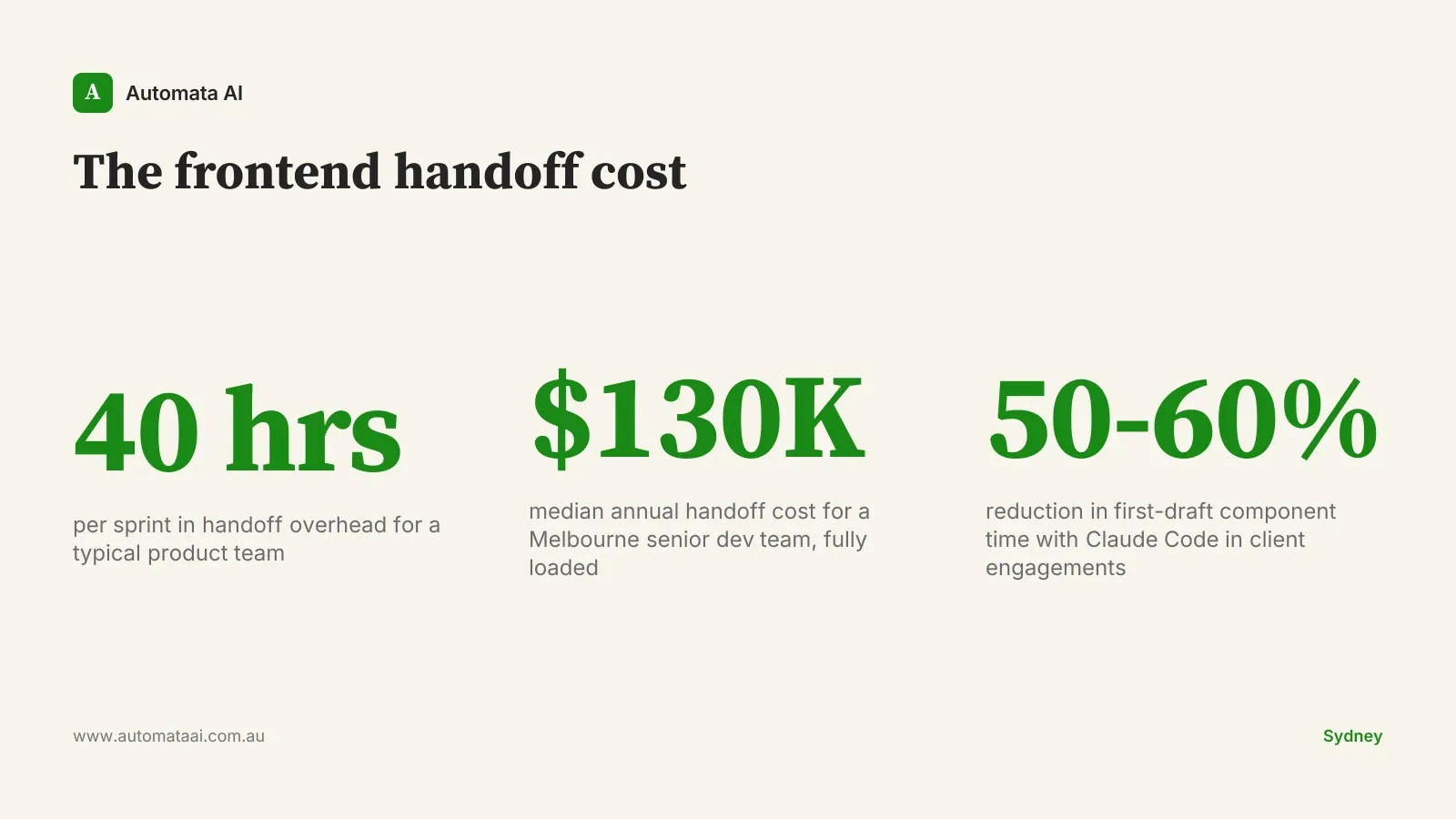
A typical review cycle runs three to five hours per component batch. Designer reviews output, flags inconsistencies, developer revises. Often there's a third round because the revision introduced a new issue. For a team shipping eight to ten components a sprint, that's 30-50 hours of handoff overhead. At $130/hr fully loaded for a Melbourne senior frontend developer, that's $3,900-$6,500 per sprint. Over a year: $100K-$170K on a single team, just in the gap between design completion and production-ready code.
What Claude Code actually does in a frontend session
Claude Code is not a Figma import tool. It won't produce pixel-perfect React from a screenshot, and teams expecting that will write off a tool that has a narrower, more useful job. What it does: it acts as a pair programmer that understands your design system if you describe it clearly. Paste your Tailwind config, your colour tokens, your spacing scale. Reference an existing component as a pattern. Then ask Claude Code to scaffold a new component following those rules. Good context in means a coherent starting point out.
In client engagements, this reduces first-draft component time by 50-60%. The developer still reviews and refines, but starts from something structurally coherent rather than a blank file and a Figma screenshot.
The three-pass component loop
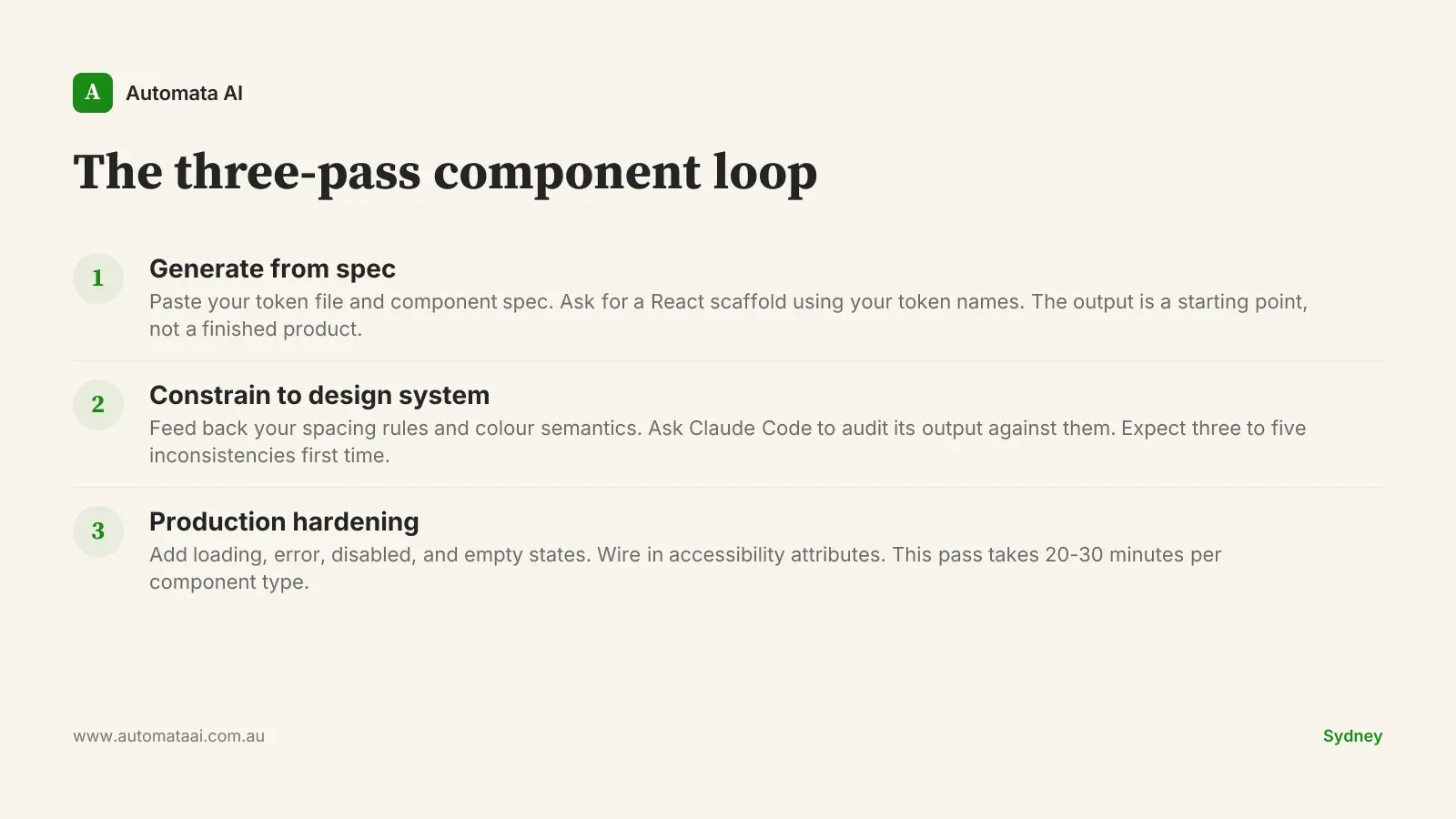
The workflow that consistently produces usable output is what we call the three-pass component loop. Each pass has a distinct goal: raw generation, system conformance, and production readiness. Skipping any one of them doubles the clean-up work. Teams that skip pass two consistently find their generated components drifting from the design system within two sprints.
Generate from spec. Paste your token file and component spec into Claude Code. Ask for a React scaffold using your token names. The output is a starting point, not a finished product.
Constrain to design system. Feed back your spacing rules and colour semantics. Ask Claude Code to audit its output against them. Expect three to five inconsistencies on the first pass.
Production hardening. Add loading, error, disabled, and empty states. Wire in accessibility attributes. The Figma spec shows the happy path. You have to ask explicitly for everything else.
When this approach breaks down
If your design system lives in someone's head, Claude Code cannot help you. It has nothing concrete to work with. The generated output will be inconsistent, and you'll spend more time correcting it than you saved generating it. That's not a Claude Code problem. It's a prerequisite problem. This is the pattern we see most often among Sydney and Melbourne mid-market product teams: the component library exists, but only two or three people know the unwritten rules.
Your design system has no token documentation. Spend two weeks documenting it first. Claude Code needs machine-readable rules, not institutional knowledge.
Component conventions change sprint to sprint. Unstable design language means generated components drift from the system within weeks.
Your time savings are under $30K AUD per year. The calibration effort is real. Low-frequency processes won't pay back.
Teams that skip documentation and start generating anyway accumulate design debt faster than they can review it. Document first, generate second.
The cost case for a Sydney product team
Consider a twelve-person Sydney product team: four frontend developers, two designers, roughly 40 hours of handoff overhead per sprint. A 40% reduction through the three-pass loop saves 16 hours. At $130/hr fully loaded, that's $2,080 per sprint, approximately $54K over a 26-sprint year. Run your team's numbers through the AI Automation ROI Calculator with your actual hourly rate and sprint cadence.
Getting Claude Code into your frontend workflow
The starting point is always the same: document your design system in plain language. Not a Figma file. A text document with token names, spacing rules, component anatomy, and naming conventions. That document becomes the context you paste at the start of every Claude Code session. Pick one component type and run the three-pass loop twice. The second run is noticeably faster as you calibrate what context Claude Code needs from you.
The calibration effort is front-loaded, typically two to four hours. After that, each new component type adds 20-30 minutes of loop time per sprint rather than hours of review back-and-forth.
If you're not sure where your documentation stands, the AI Readiness Assessment maps the gaps before you invest in tooling. The teams we work with through our AI Automation Services typically see measurable handoff reduction within six weeks.
Australian product teams are not short of frontend tooling. What they're short of is a design system clear enough to be machine-readable. Fix that constraint, and Claude Code becomes a genuine multiplier on every sprint.