A developer has four Claude Code sessions open. Three are running. One just finished. She hasn't written a line of code herself in 45 minutes and has shipped more than she would in a full day.
This is what the redesigned Claude Code desktop app makes routine. Not in theory. In practice, on engineering teams that have built the orchestration discipline to use it.
What changed in the desktop app
The redesign is built around one insight: agentic coding is a coordination problem, not a speed problem. The old Claude Code was a one-conversation-at-a-time tool. The new desktop app treats you as the orchestrator of a small fleet.
Session sidebar. Every active and recent session in one panel. Filter by status, project, or environment. Group by repository. Resume on demand without losing context.
Workspace layout. Arrange sessions side by side or in tabs. No more hunting through terminal windows to find which agent is handling what.
Integrated terminal and file editor. Less context-switching to a separate IDE mid-task.
Performance improvements. Faster startup, better diff rendering, smoother handling of agents working on large files over extended runs.
None of these are flashy in isolation. Collectively, they shift the work pattern from serial to parallel.
The multiplier math that matters for Australian engineering teams
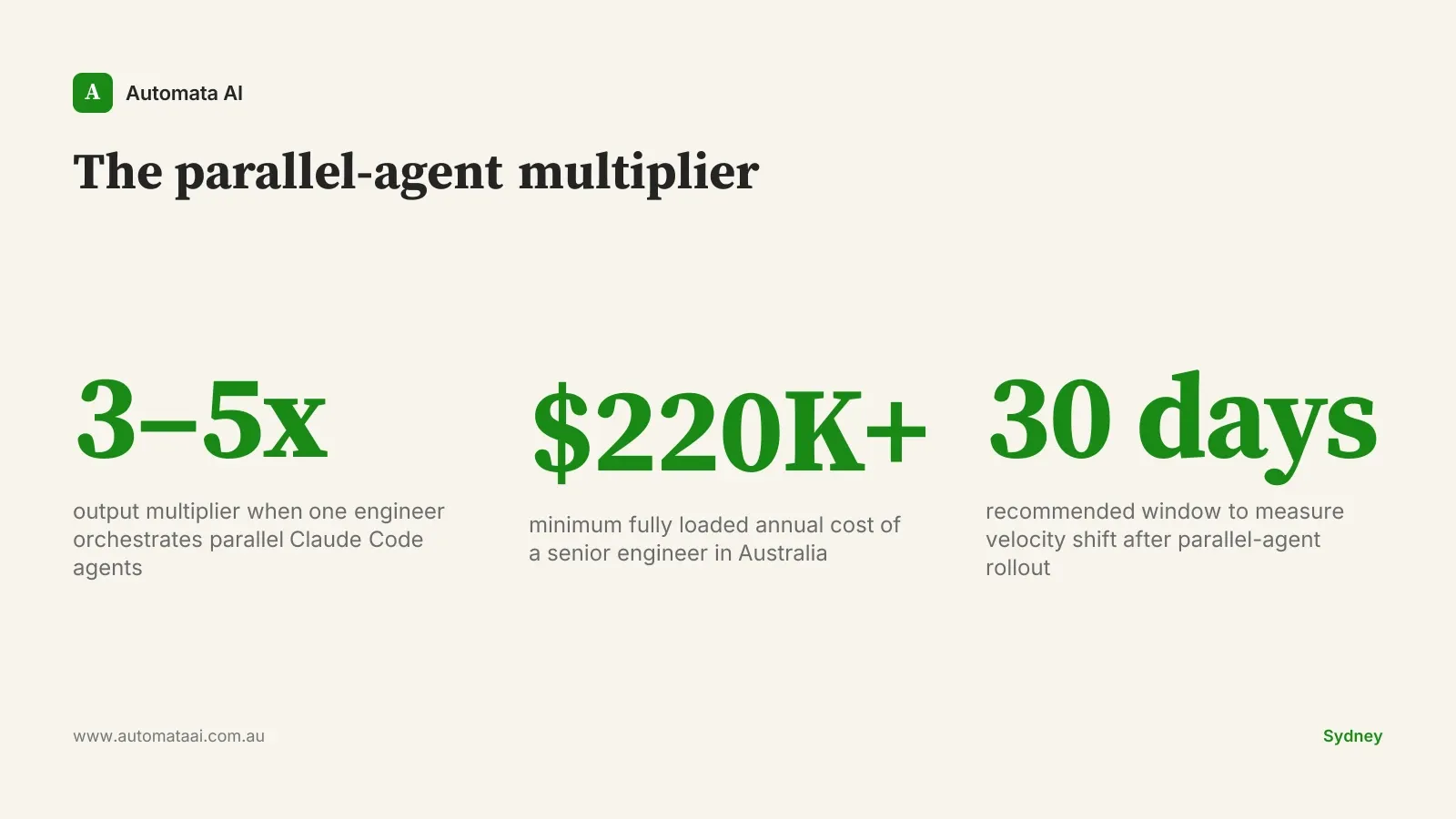
Here's the actual implication. A senior engineer at $220,000 fully loaded (salary, super, benefits, equipment, office overhead) costs roughly $110 per hour at 2,000 working hours per year. If that engineer can steer three Claude Code agents on independent tasks, with each requiring one hour of steering that would otherwise take five hours of human execution, the throughput multiplier sits between 3x and 5x.
That isn't a 1.5x productivity bump. The question stops being how fast Claude writes code and becomes how many agents one senior engineer can orchestrate per day.
For Australian engineering teams, this lands differently. Senior engineers cost $200,000 to $280,000 fully loaded and are genuinely hard to replace in a market where experienced talent outside Sydney and Melbourne is thin. A well-scoped search and onboarding cycle takes four to six months, and the candidate you want often has competing offers. The team that figures out parallel-agent orchestration ships meaningfully more work per headcount. The team that doesn't adds headcount to keep up, and that's assuming the headcount is available.
That's not a staffing opinion. It's the math.
The orchestration discipline is the hard part
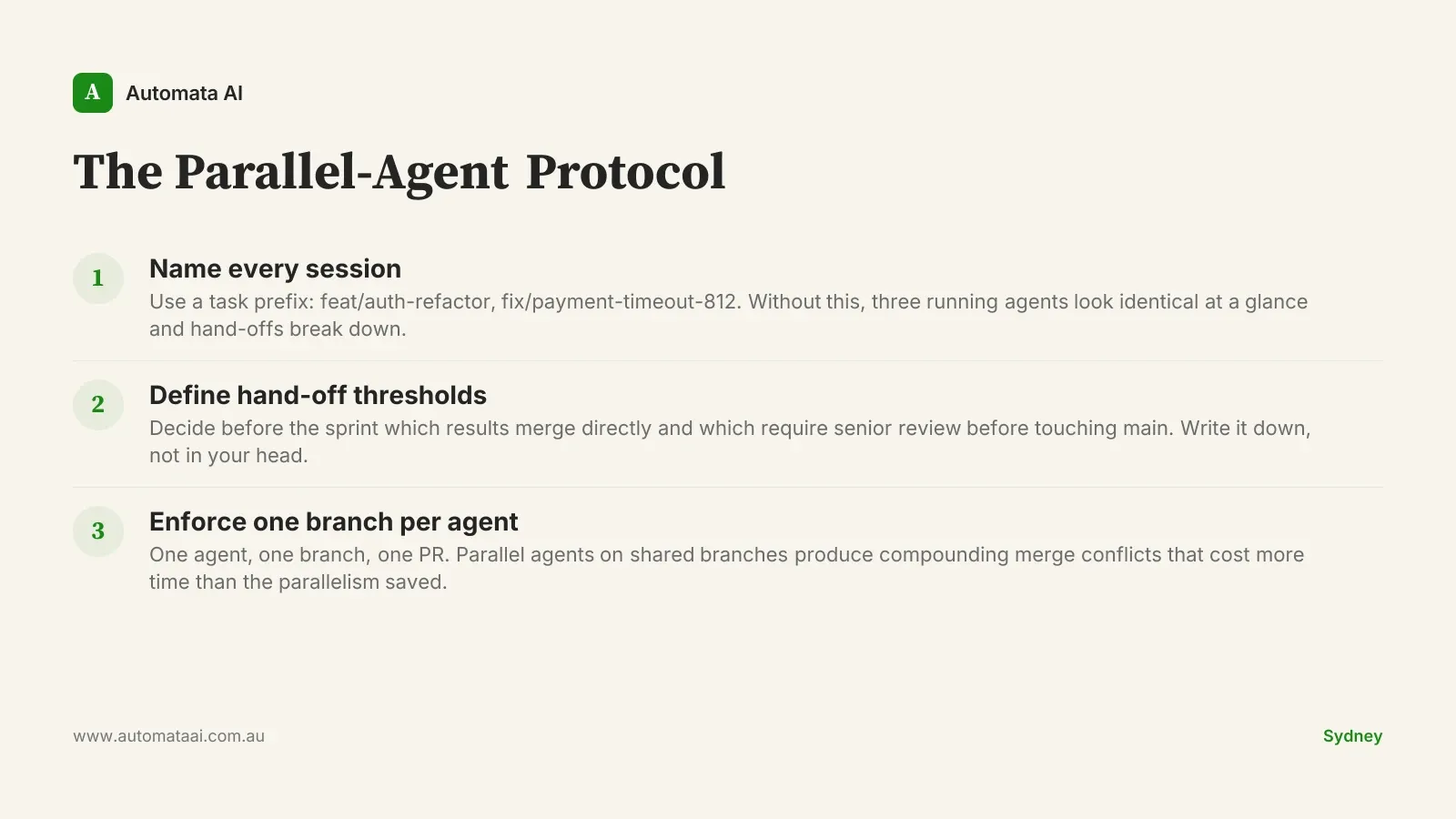
The desktop app is the easy part. Installing a new UI takes ten minutes. Building the habits that let a team run four agents productively takes longer. Three things every team needs before running parallel Claude Code agents at scale:
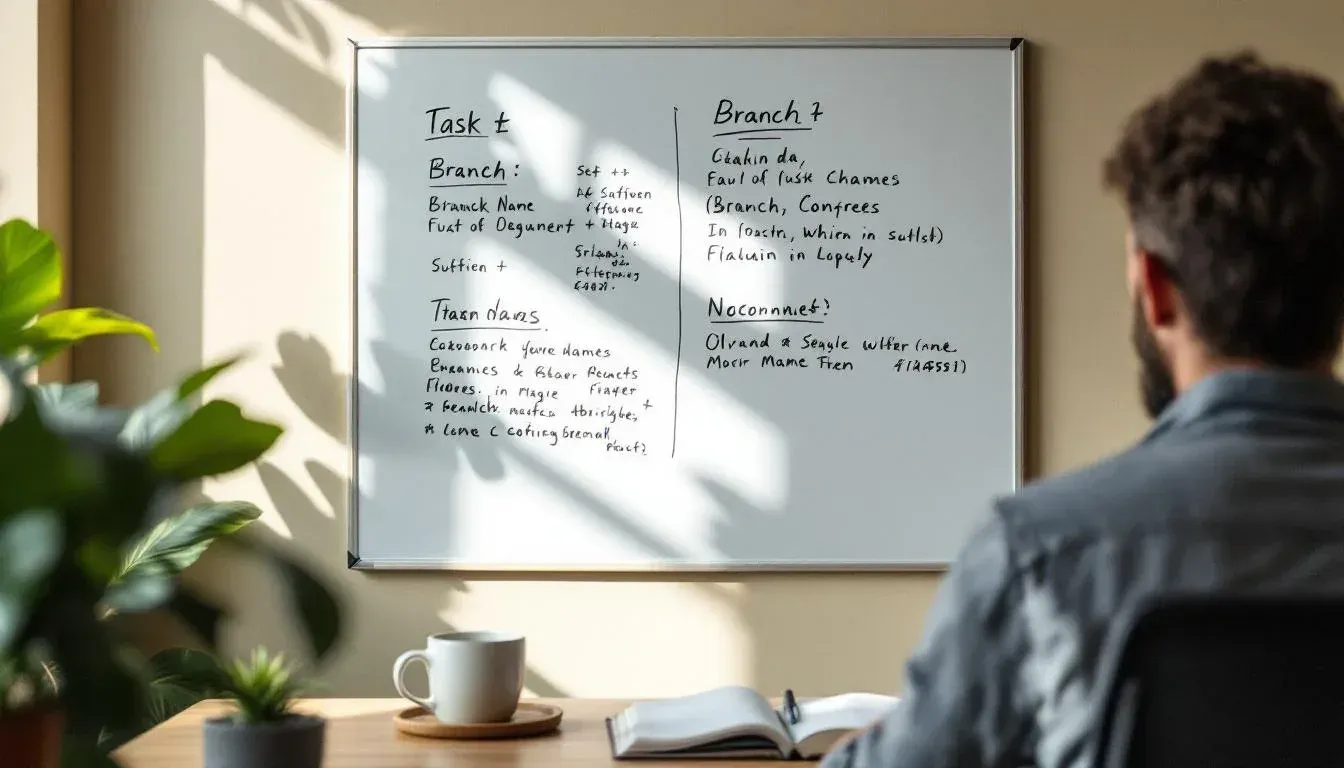
Session naming convention. When five agents are running across two repos, you need to know what each one is doing without opening it. A prefix like feat/auth-refactor or fix/payment-timeout-812 takes ten seconds to set and saves five minutes of orientation per hand-off.
Hand-off rules. Which agent results get merged directly? Which require senior review first? What's the threshold for escalating from agent handles it to engineer takes over? Write this down before the first multi-agent sprint, not after it.
Merge discipline. Parallel agents working on the same codebase will produce conflicting changes. One agent, one branch, one PR prevents Monday morning merge conflicts from compounding.
Without these three, parallelism doesn't compound. It creates rework.
Most teams skip the protocol because the tooling looks intuitive. It is intuitive for one session. At three sessions running simultaneously, intuition runs out.
When parallel agents make it worse, not better
Not every engineering problem benefits from parallelism. Before rolling out the desktop app team-wide, check for these three failure modes:
Tightly coupled codebases. If every change touches three shared modules, running agents in parallel produces three conflicting changes to the same modules. Parallel agents compound output on independent paths. They collide on shared ones.
Ambiguous requirements. An agent that runs 20 minutes on an unclear spec produces 20 minutes of rework. At three agents simultaneously, that's an hour of rework to untangle before you see any usable output. Scope first, then parallelise.
Junior-heavy teams. The desktop app doesn't make orchestration easier for less experienced engineers. Juniors need to understand each agent's output before they can steer the next one. Four sessions when you're still building your mental model of the codebase produces worse results than one session managed well.
The senior engineers who extract the most from Claude Code parallel agents are the ones who've already internalised the codebase well enough to hand off tasks confidently. Orchestration is a senior skill. It doesn't scale down to a team that hasn't done the groundwork.
What to do this week
Install on senior engineers first. They have the codebase context to steer agents well and will develop the patterns the rest of the team can learn from. Juniors will get there faster watching a senior run four sessions than attempting it themselves first.
Write the parallel-agent protocol. Three pages maximum: naming convention, hand-off rules, merge discipline. Do this before the first multi-agent sprint, not as damage control after.
Baseline your velocity metric now. PRs merged per week per senior engineer is the simplest number to track. Measure before rollout. Re-measure at 30 days. If it hasn't moved, the bottleneck is the protocol, not the tooling.
If your team is already running two or three Claude Code sessions and you want to scale the orchestration discipline across the team, our Claude Code Consulting service covers parallel-agent rollout playbooks built for Australian mid-market engineering environments. The AI Readiness Assessment is a useful starting point if you're not sure where the orchestration gaps are.
For teams earlier in the decision, the ROI Calculator can help model the headcount math before committing to a rollout.
The engineering organisations that build orchestration discipline now will carry a structural velocity advantage that's hard to close by headcount alone. That's not a promise about Claude. It's a statement about compound interest.