A senior associate at a mid-tier Sydney firm typically spends eight to twelve hours a week on document review, drafting, and contract redlining. At a fully loaded rate of $650 per hour, that is between $270,000 and $400,000 in annual billing capacity tied up in work a first-year graduate could theoretically do, given enough time.
Most firms accept this as a cost of practice.
A few have not. The firms that have shipped Claude Code workflows in Sydney and Melbourne this year are not replacing lawyers. They are recapturing hours that partners could never invoice.
Three workflow patterns have reached production in Australian law firms in 2026. Each addresses a different cost centre. Each requires a different build investment, and each has a ceiling where the economics stop working.
Pattern 1: Precedent-driven drafting
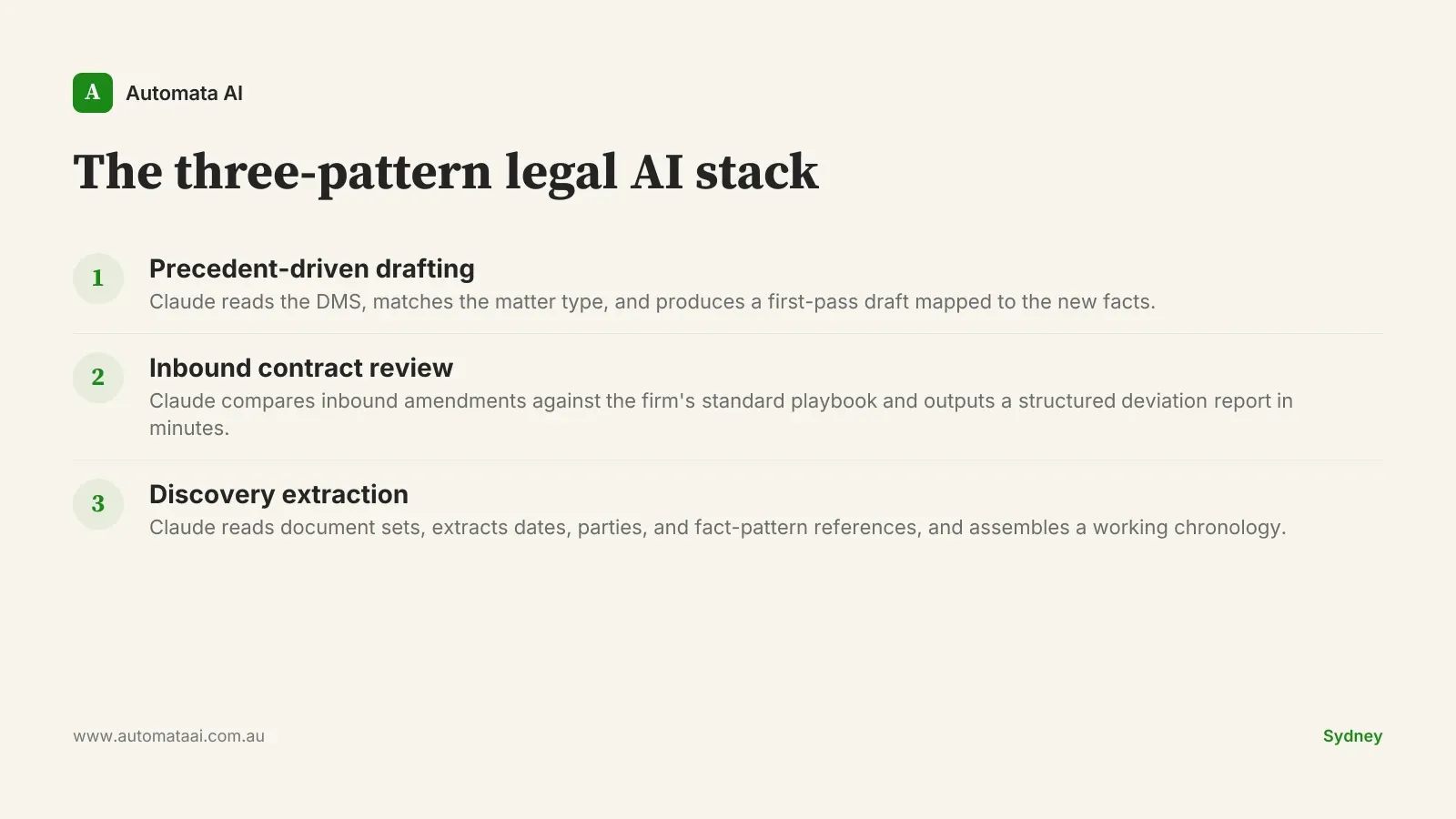
Most Australian law firms manage their precedent banks through a document management system. NetDocuments and iManage are both common in the mid-market. The standard workflow is manual: find the closest past matter, copy the document, adapt it to the new facts, send it for review. The adaptation step is where most unbilled time sits.
MCP server connected to the DMS. Authenticates to NetDocuments or iManage and exposes precedent search by matter type and jurisdiction.
A Claude Skill per document type. Each skill holds the firm's drafting standards, preferred clause variants, and red-line positions for that document class.
A pre-commit hook that flags clause drift. Any clause inserted without a precedent match is flagged before the document goes to review.
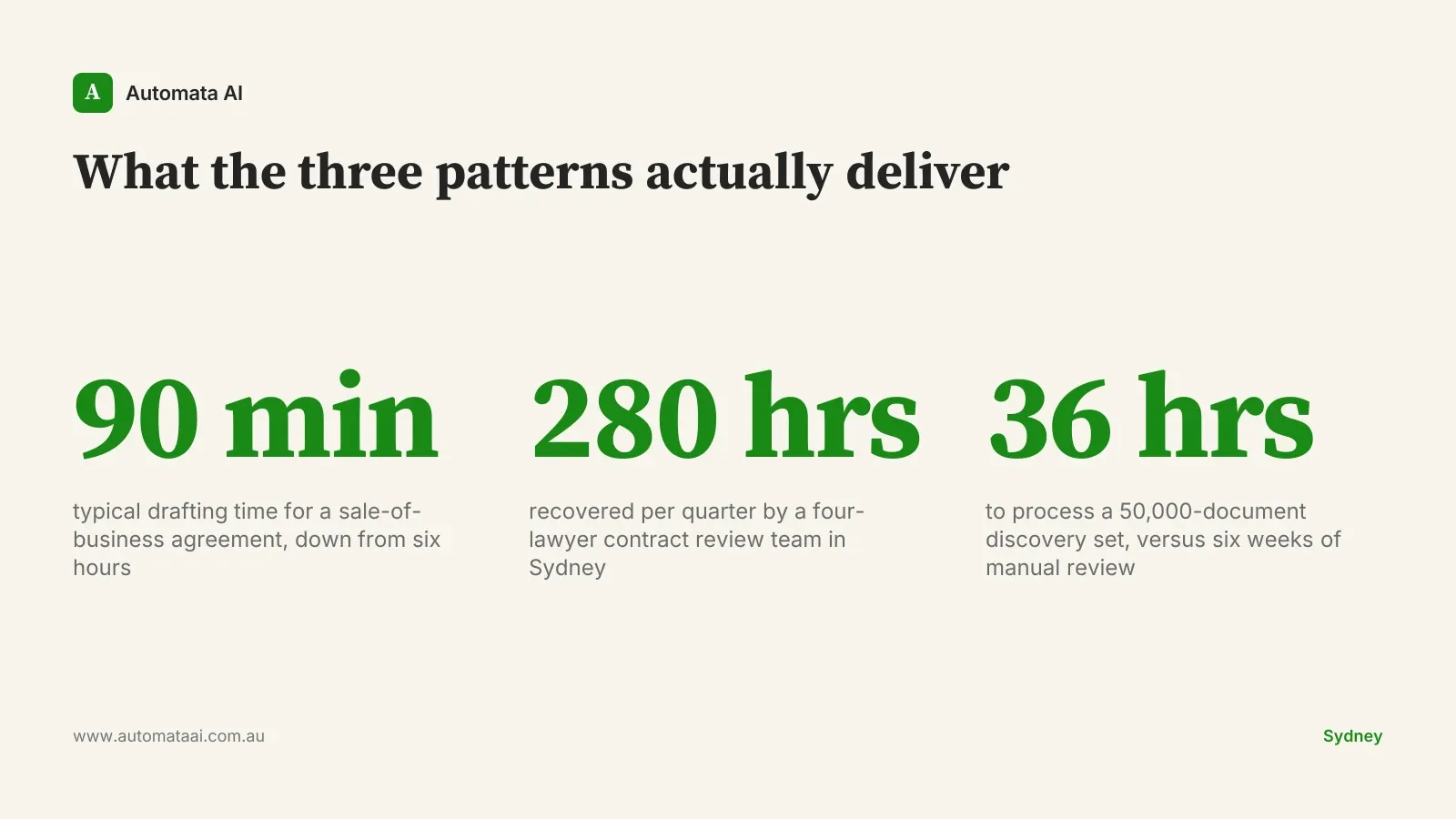
Drafting time on a sale-of-business agreement typically drops from six hours to under ninety minutes. The senior associate still reviews every clause. Build cost for this pattern, covered under our AI Automation Services, sits between $60,000 and $90,000 AUD, with payback inside six months on a team of four or more lawyers.
The mental model that makes this work: Claude handles the precedent match and the structural drafting; the partner or senior associate applies judgment to the substance. That is not a demotion of the lawyer's role. It is a clarification of what the role actually is.
Pattern 2: Inbound contract review
Australian general counsel teams receive contracts with bespoke amendments as a matter of course. Commercial leases, vendor agreements, supply contracts, licensing deals. Manual redline typically takes around an hour per contract. Claude Code reads the inbound document, compares it against the firm's standard clause positions, and produces a structured deviation report in around four minutes.
Each non-standard clause flagged with context. The deviation description names the specific departure from the firm's standard position, not just that a difference exists.
A suggested counter-position from the firm's playbook. Claude draws from the pre-loaded clause library, not from general legal training.
A risk rating using the firm's own classification. High, medium, or low based on the firm's defined criteria, applied consistently across every inbound contract.
A team of four corporate lawyers at a Sydney firm reported recovering 280 hours per quarter within three months of going live. That freed two associates for higher-margin advice work. The consistency point matters too: the same clause gets flagged every time, not only on days when the reviewing lawyer has not been in back-to-back meetings since eight in the morning. To model equivalent savings for your team, the ROI Calculator takes AUD headcount figures and produces a payback timeline in three minutes.
Pattern 3: Discovery extraction for litigation teams
Document review on a 50,000-document discovery set is typically the largest single cost line on a contested commercial matter. Associates review at roughly 40 to 60 documents per hour, putting a 50,000-document set at between 800 and 1,250 associate hours. Claude Code reads each document, extracts dates, parties, and references to a defined fact pattern, and assembles a working chronology. A task that occupies a junior associate for six weeks of twelve-hour days comes back in thirty-six hours.
API spend. Running a 50,000-document set through the pipeline costs between $3,000 and $9,000 AUD, depending on document length and analysis depth.
Build cost. An audit-logged pipeline with proper chain-of-custody controls ranges from $40,000 to $80,000 AUD.
Time recovered. A senior associate billing at $650 per hour spending six weeks on manual review represents over $400,000 in recovered capacity on a single matter.
The reviewability requirement is real. Both the Law Society of NSW and the Victorian Legal Services Board have published guidance requiring documented human oversight for AI-assisted legal work. That guidance is not prescriptive about tools, but it is clear about process: the supervising lawyer must be able to explain what the model did and why the output was accepted. Claude Code's built-in audit trail, paired with logging hooks that capture every model decision and every human override, meets that bar when implemented properly. Practices with discovery matters touching third-party personal information also need to map their pipelines against the Australian Privacy Principles, particularly APP 6 on secondary use. For the broader governance pattern across professional services firms, our professional services AI guide covers the compliance architecture in more detail.
When this is the wrong investment
Not every firm should build all three patterns. A boutique with two partners running three discovery matters a year cannot justify an $80,000 pipeline build. The economics require volume, and they require process stability. If the documents your firm produces do not follow a consistent structure, pattern-matching against a precedent bank will create as many problems as it solves.
Low-volume practices. Fewer than twenty similar documents per month usually produces a payback period over twelve months. That is a hard sell at partnership sign-off.
Highly bespoke work. Complex commercial litigation where every matter is structurally different does not benefit from precedent-pattern matching.
Firms without a governance layer. Deploying Claude Code without a defined human review step and an audit log is not defensible under current Australian law society guidance. Build the governance framework first.
The mid-tier Sydney and Melbourne practices moving fastest on this are not the ones with the largest technology budgets. They are the ones that quantified one specific workflow, modelled the payback, and committed to a build. Pick the pattern that fits your highest-cost repetitive process. Work backwards from the hours.