A senior accountant at a Melbourne practice recently walked me through her week. Ten hours across BAS prep, payroll reconciliation, and audit file builds. Ten hours at $150 billable. Per head. Every week. For work that follows the same rules every time.
For a 40-person firm where eight seniors carry that same load, that is $624,000 a year of recoverable capacity sitting inside well-understood processes. The same pattern shows up across Australian professional services firms. For accounting practices specifically, three workflows appear most consistently: BAS preparation, payroll reconciliation, and audit file builds.
A Claude Skill is a reusable, governed prompt-and-context bundle. The firm's checklist logic is baked in. Any staff accountant can run it; they cannot change the underlying rules. Think of it as the firm's working-paper template, re-expressed for AI-assisted preparation.
BAS preparation: from 2.5 hours to 30 minutes
The BAS workflow varies by client entity type, but the firm's GST classification rules are constant. A Skill that encodes those rules alongside the ATO's current period requirements can pre-fill the bulk of a quarterly BAS before a staff accountant opens the ledger. The client's Xero or MYOB data comes in as a structured extract; the Skill applies the firm's classification logic and flags anything outside the standard patterns.
Build inputs are three things: the firm's working-paper template for each entity type (sole trader, company, trust, partnership), a short prompt encoding the GST classification logic, and a transaction extract from Xero, MYOB, or Reckon. The Skill produces a draft BAS, an exception list for transactions needing manual classification review, and a partner sign-off summary.
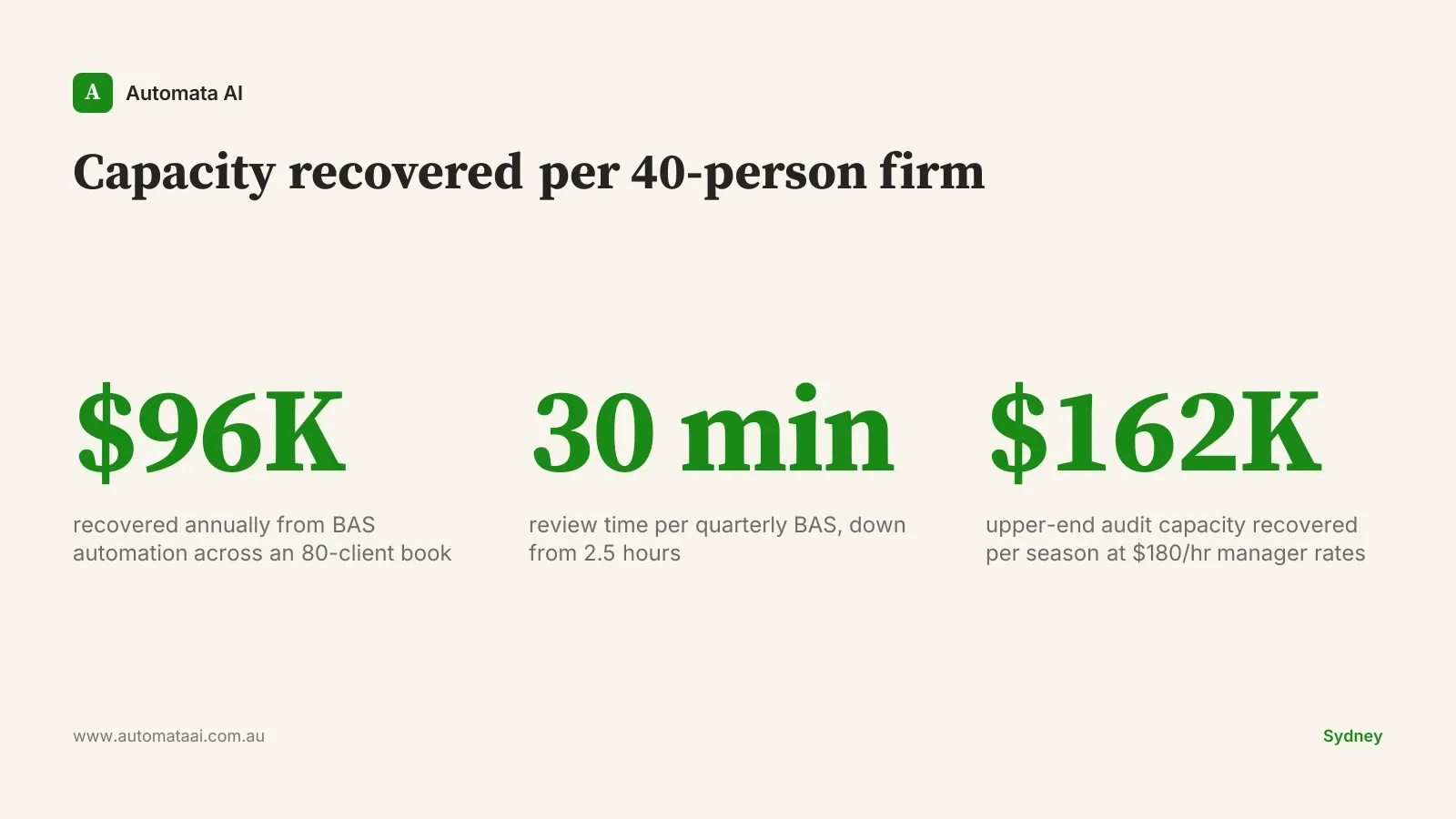
Staff time per quarterly BAS drops from around 2.5 hours to 30 minutes of review. At $150/hr for a senior, that is $300 saved per engagement per quarter. Across 80 clients, that is $96,000 recovered annually from BAS preparation alone.
Payroll reconciliation: catching super gaps before the client does
End-of-month payroll reconciliation checks for variances between the payroll system, the general ledger, and superannuation lodgement. That sounds simple. In practice, a missed super line item for one employee, or a payroll period straddling a month end, creates an hour of back-and-forth per occurrence.
A Skill built for payroll reconciliation compares ledger entries against payroll runs, flags missing or partial super payments, and produces a reconciliation summary in the firm's standard format. Outputs include:
Variance table. Each anomaly listed with a root cause hypothesis and dollar value.
Super lodgement gap report. Flags every employee with a missing or partial super payment.
Draft client email. Ready to send after partner review.
The root cause hypothesis is what separates this from a basic variance report. A basic reconciliation tool flags the discrepancy. The Skill says the super payment for a specific employee is $420 short, consistent with a pro-rated termination that falls outside the standard STP mapping. That specificity means a junior can often resolve the issue without escalating to a senior at all.
Audit prep file builds: 600 to 900 hours recovered per season
For audit-track clients, the prep file build is the heavy admin moment. Senior staff pull the prior year file, map it to the current year trial balance, check for material movement, and flag areas needing manager review. Two to four days of structured document work per engagement.
A Skill that reads the prior year pack and the current year trial balance produces a starter audit file: rolled balances, prior year comparatives, material movement flags, and a prioritised list of areas for manager attention. The structure of an audit pack is stable enough that the Skill applies the same logic consistently across every engagement, regardless of who scoped the prior year file.
A 40-person firm with 20 audit-track clients typically recovers 600 to 900 hours per audit season once the Skill is tuned. At $180/hr for manager time, that is $108,000 to $162,000 of capacity returned to work that actually requires judgement.
When to skip it
Not every accounting workflow belongs in a Skill. Three situations where the numbers don't work:
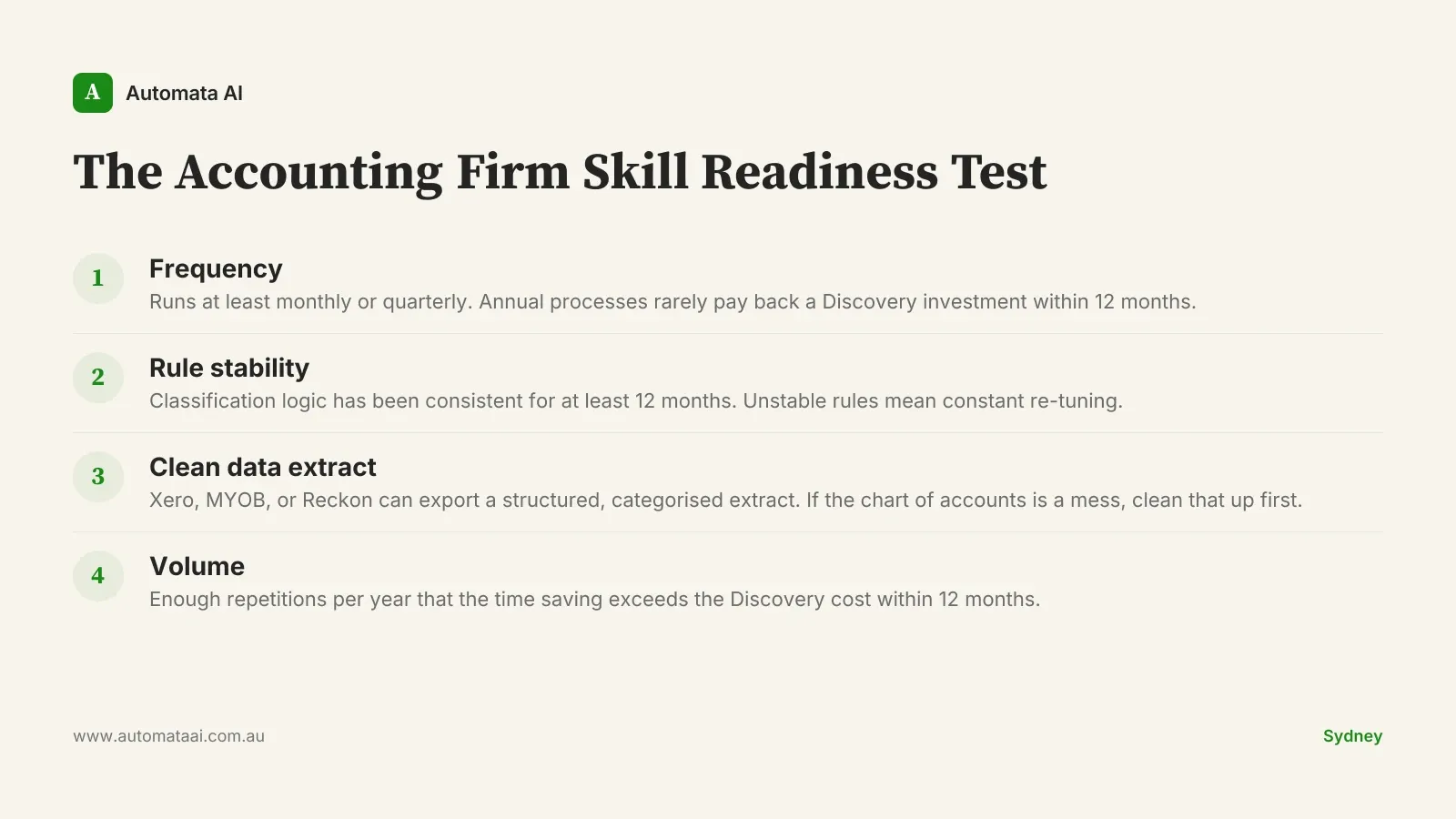
Volume is too low. A process that runs twice a year for 90 minutes doesn't produce enough repetition to recover a $10,000 to $20,000 scoping investment within 12 months.
The rules change every quarter. A Skill built on shifting GST logic needs constant re-tuning. If a major client has unusual input tax credit treatment that evolves, automate after the classification logic stabilises.
The source data is too messy. A Xero file with 18 months of uncategorised transactions and no chart-of-accounts discipline cannot be extracted cleanly. Fix the data problem first.
Most firms have one or two workflows that are ready for a first Skill, and several more that aren't yet. The AI Readiness Assessment is the fastest way to identify which is which before committing to a scoping engagement.
Governance and partner control
The governance question comes up in every scoping conversation. Partners are cautious about AI changing GST classification logic or audit pack templates without their sign-off. That caution is correct.
Skills can be locked at the firm level. A junior runs the Skill; they cannot modify the underlying prompt, the classification rules, or the output template. The control model is identical to what partners have today over working-paper templates. Our AI Automation Services includes a governance configuration step for exactly this reason.
The partner still reviews the output. The Skill's role is to get the draft to 80% so the review focuses on the 20% that requires professional judgement — the exception list, the unusual transactions, the client-specific carve-outs.
Pick one process. Quantify the current time cost per engagement and multiply by client volume. Model the payback against a Discovery engagement at $10,000 to $20,000. For most Australian accounting practices, BAS preparation is where that maths works first. The ROI Calculator runs the numbers for your firm in under three minutes, AUD figures, no signup.