A mid-sized aggregator's top broker settled 14 loans last month. She also spent 38 hours chasing documents, drafting pre-assessments, and assembling the file notes that Best Interests Duty requires.
At $120/hr fully loaded, that's $4,560 in skilled labour on administrative overhead. Per broker. Per month. Mortgage broker Claude automation doesn't touch the advice or the relationship. It addresses the part that runs on copy-paste and PDF.
Where Claude fits in the broker workflow
Four use cases that work in production at Australian aggregators today:
Pre-assessment drafting. Ingest payslips, bank statements, and current rates. Produce a structured pre-assessment in under two minutes. A broker reviewing that draft takes four minutes, not 45.
Policy-fit analysis. Compare the customer profile against current lender policies, cite each policy reference, and rank the top three lender options. The broker validates. The grunt work is done.
Document chase. Track what is missing from a file and draft the follow-up email in the broker's voice. The broker approves and sends.
BID file notes. Assemble the compliance record Best Interests Duty requires, drawn from the customer interaction. The broker attests. Claude prepares the evidence.
None of these involve Claude making a recommendation. The recommendation stays with the broker. That's the frame that matters under the National Consumer Credit Protection Act, and it's the frame ASIC expects when it asks how a recommendation was formed.
The pilot numbers
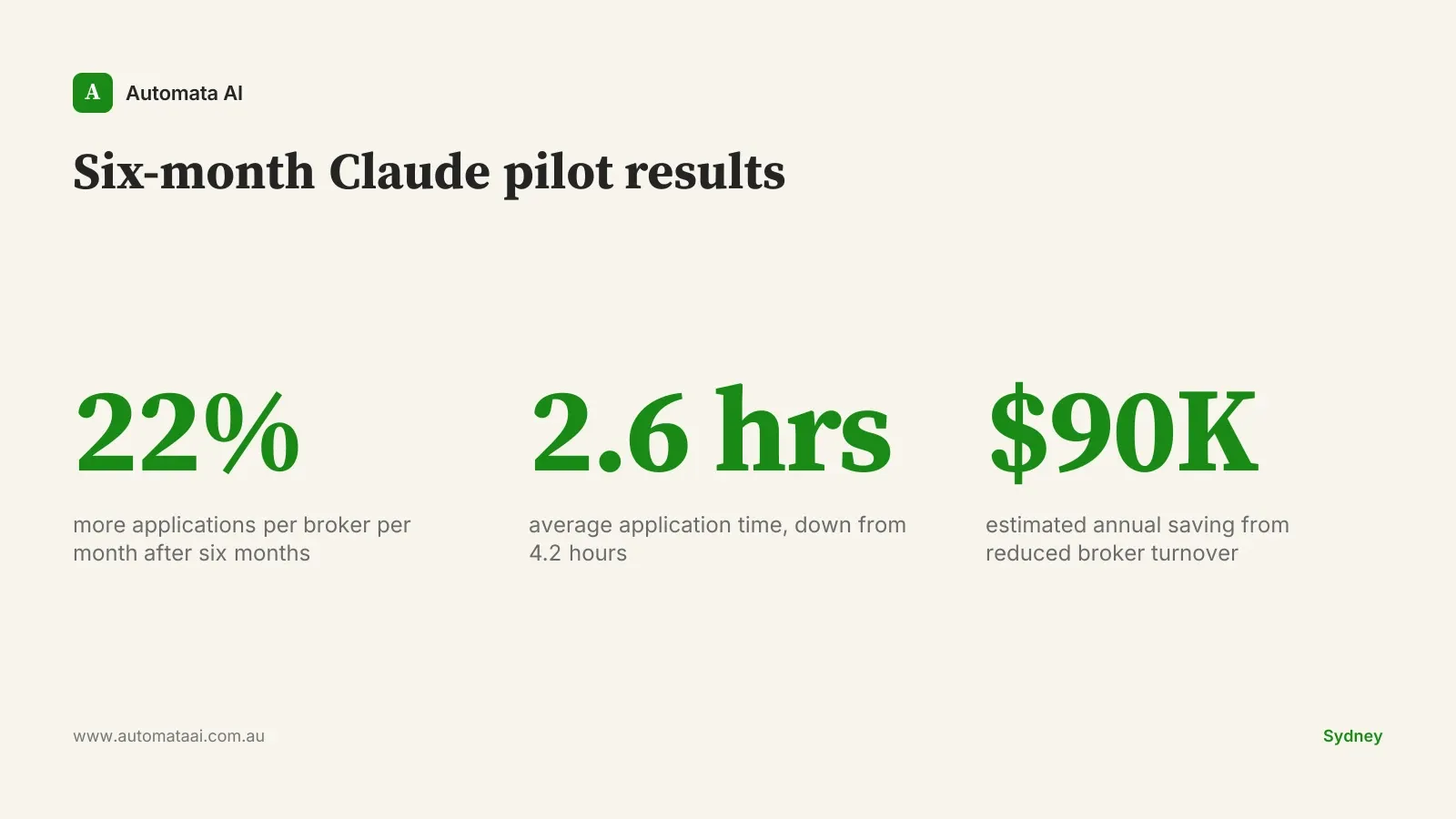
A mid-sized Australian aggregator with 1,200 active brokers ran an 80-broker Claude pilot over six months. Throughput lifted by 22 percent more applications per broker per month. Average application time fell from 4.2 hours to 2.6 hours. At a commission of roughly $1,400 per settled loan, the lift is real money at scale.
A secondary figure came out of the turnover data. Teams using Claude reported lower administrative burden across the board. The aggregator modelled $90,000 per year in reduced replacement and onboarding costs. That number is hard to budget upfront. It shows up clearly in the sixth-month review, by which point the investment case has already closed.
These results reflect a high-volume brokerage. A broker settling seven loans a month gets less lift than one settling twenty-five. To model the payback against your own throughput, run the figures through our ROI Calculator before committing to an integration scope.
The compliance frame for Best Interests Duty
Best Interests Duty under the National Consumer Credit Protection Act is the live obligation for every Australian mortgage broker. ASIC has been clear: the obligation rests with the broker, not with the tools the broker uses.
That shapes how Claude is deployed. Claude drafts; the broker decides. Claude assembles the evidence file; the broker attests. Every Claude action is logged with its source data: the lender policy it referenced, the document it summarised, the customer statement it drew from. A reviewer can verify any artefact in under two minutes.
Brokers who use Claude correctly often end up with better compliance records than those doing it manually. The audit trail is more complete and it was cheaper to produce. For a broader look at how this pattern applies across regulated Australian financial services, see our guide to AI Automation for Financial Services.
When this doesn't suit your aggregator
Not every aggregator should build this now. Three situations where the ROI doesn't stack:
Low-volume brokers. A broker settling fewer than eight loans a month won't generate enough throughput to justify integration time. The numbers don't clear.
Unstable lender policies. In niches where lender policy changes weekly, policy-fit analysis requires constant prompt maintenance. Maintenance cost can exceed the benefit.
No consistent data layer. Claude needs structured inputs. If broker files live in unstructured email chains with no consistent format, fix the data problem first. Integration won't fix that.
The aggregators that get the best results are already running a moderately consistent file format and their brokers are settling at least ten to fifteen loans a month. That's the baseline worth confirming before scoping an integration.
The aggregator rollout that works
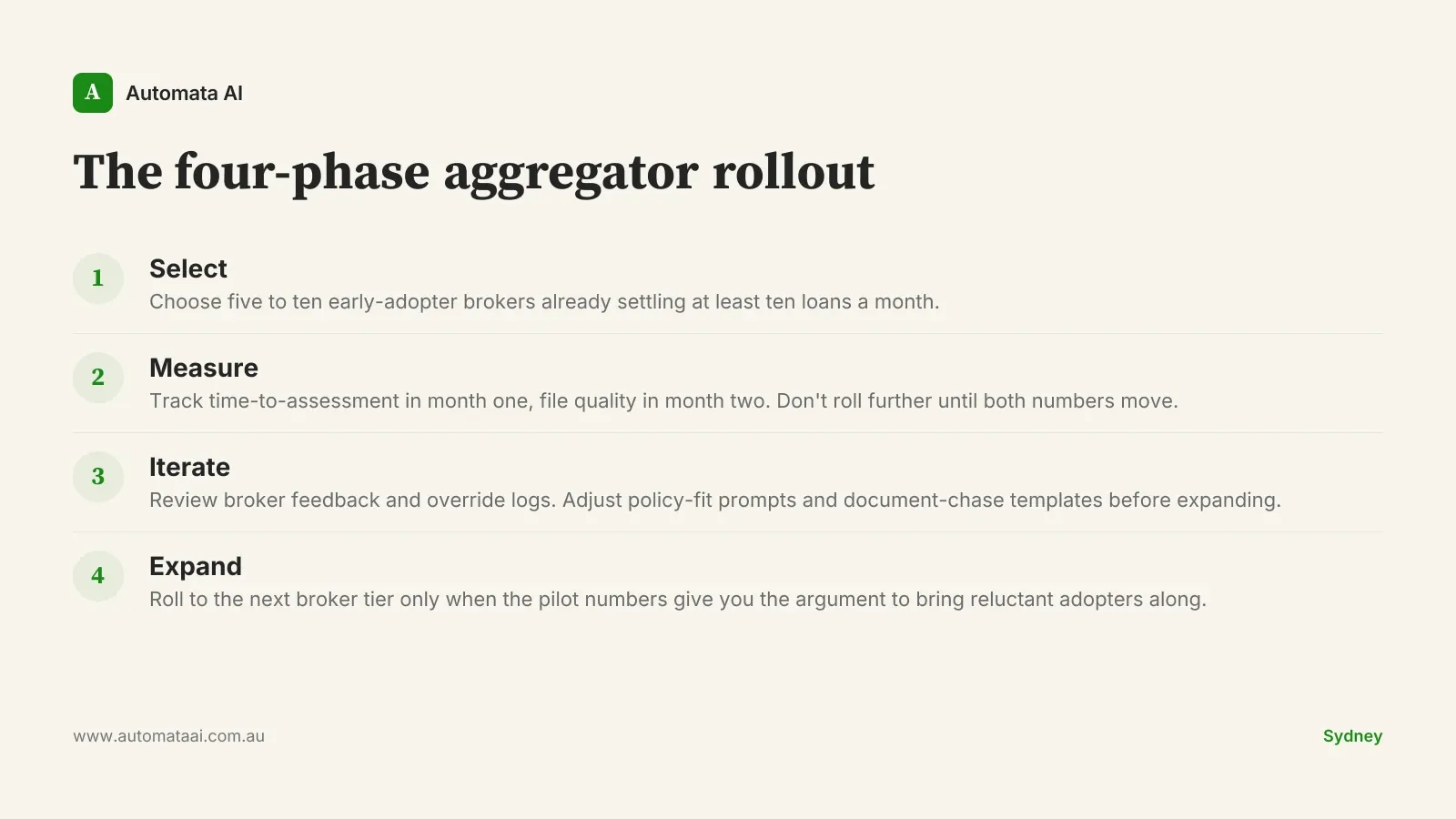
The rollout pattern that produces adoption above 70% is sequential. Pilot with five to ten early-adopter brokers. Spend the first month measuring time-to-assessment. Spend the second month measuring file quality. Roll to the next tier only after both numbers move.
Aggregators that push straight to all 1,200 brokers see adoption below 20%. They also lose the evidence base they need to bring reluctant brokers along. The time saved in month one is the argument you use in month three.
We call this the four-phase aggregator rollout: Select, Measure, Iterate, Expand. Each phase runs four to six weeks. The Measure phase is the one teams want to skip when they're excited about the results. Don't. It's the phase that gives you the argument for the next one.
The work split that governs every phase is the same: drafting, cross-referencing, document tracking, and file note assembly move to Claude. The recommendation, attestation, advice conversation, and any regulator-facing communication stay with the broker. To map this against your current workflow before committing scope, our AI Readiness Assessment covers the process in a single session.
The administrative overhead of Australian mortgage broking won't compress itself. Pick five pilot brokers. Run the first month on pre-assessment time alone. See what the numbers say. If they move, the case makes itself.