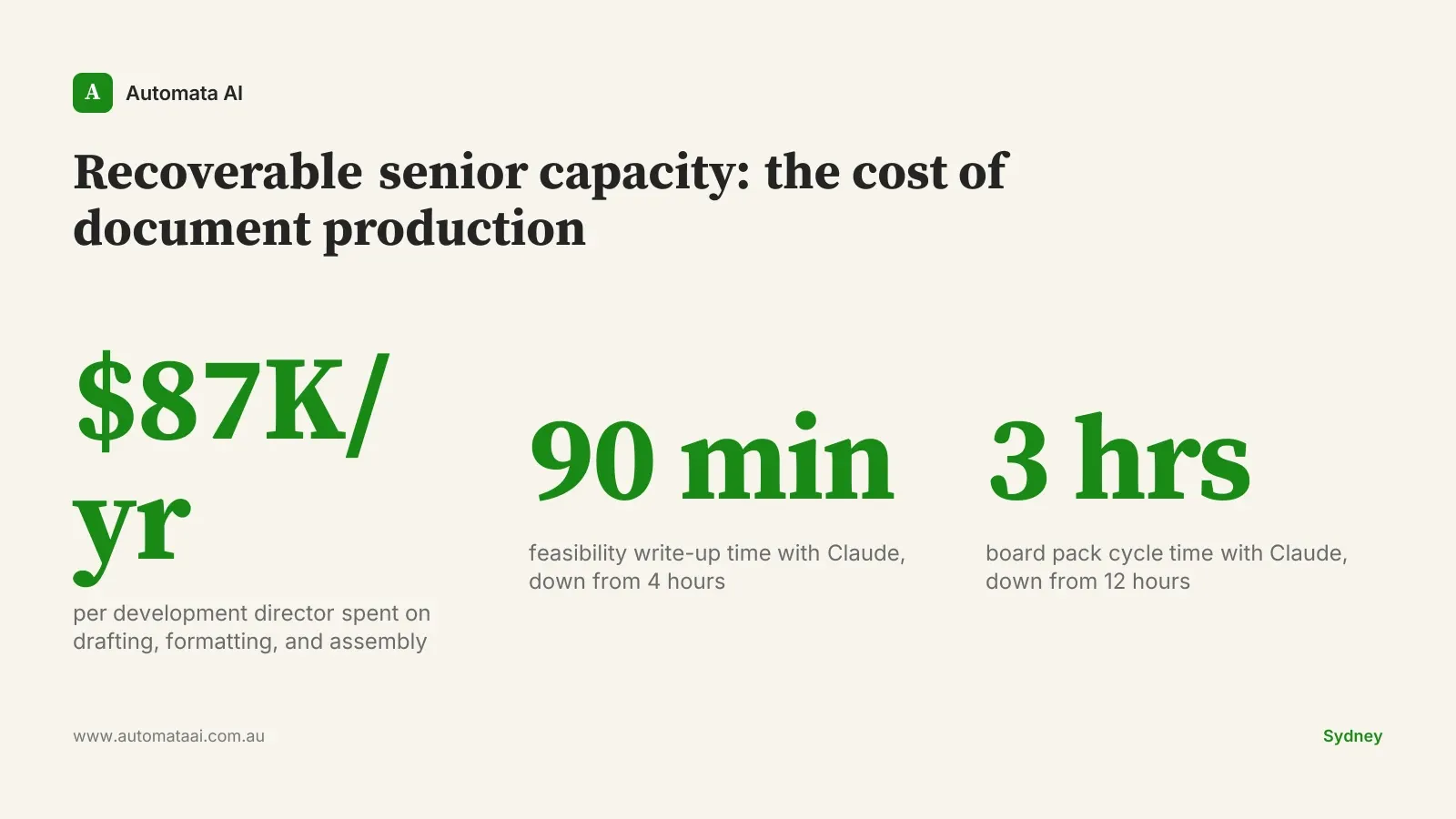
A development director sitting at $290,000 fully loaded costs around $140 an hour. When 30 percent of their week runs to feasibility write-ups, DA cover letters, and board pack assembly, that is $87,000 a year spent on work that does not need their judgement. It needs their words.
For a five-director Sydney or Melbourne development firm, that is over $400,000 a year of senior capacity absorbed by document production. The business case for changing that does not need a spreadsheet.
Claude cannot read a site, value a deal, or approve an IRR. It can write around one.
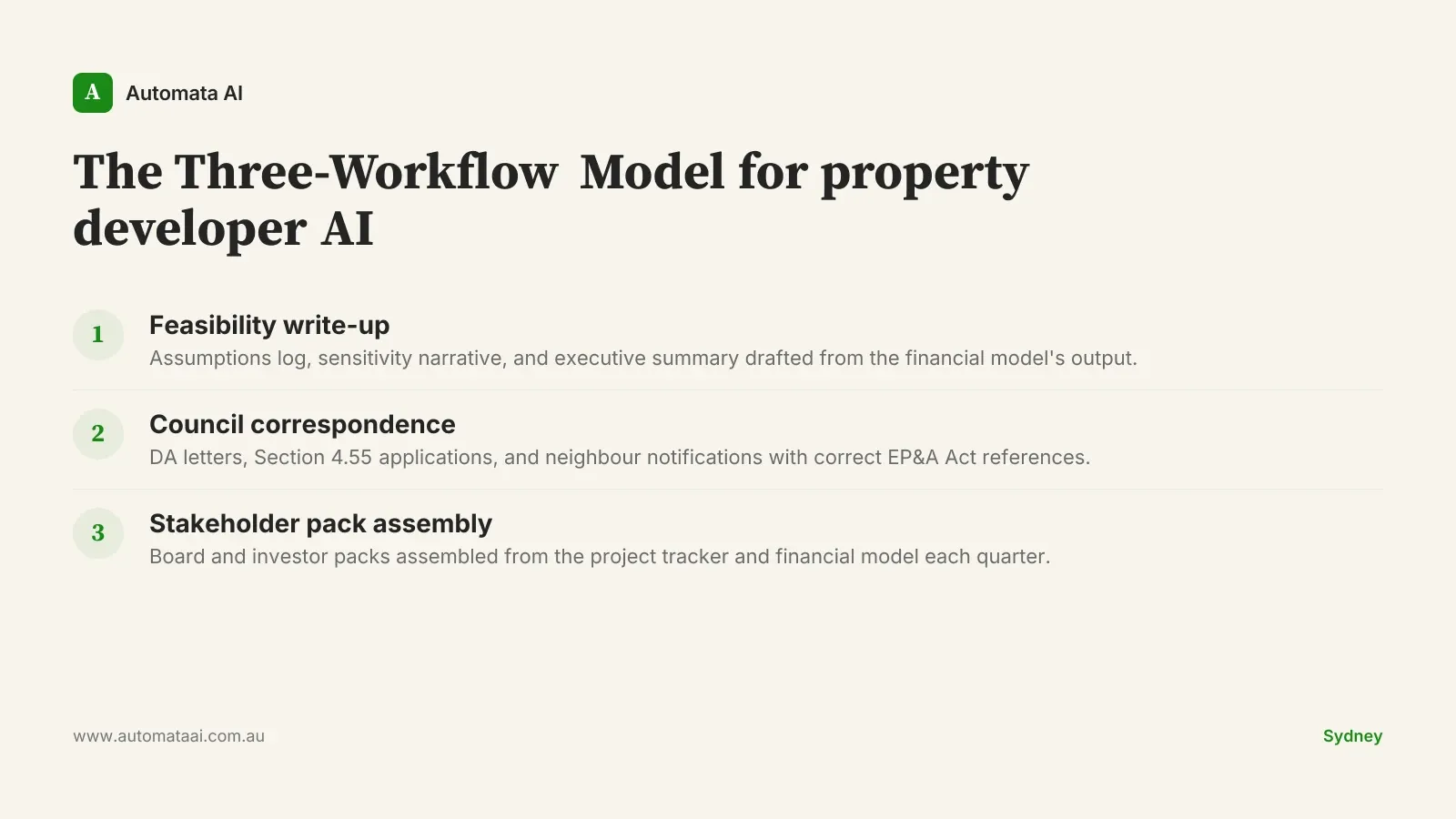
Three workflows capture most of that recoverable capacity. We call them the Three-Workflow Model for property developer AI automation: feasibility write-ups, council and stakeholder correspondence, and board pack assembly. Each follows the same pattern: stable template, variable inputs, senior time absorbed. Each is a reasonable starting point for a mid-tier Australian property firm.
Feasibility modelling: writing around the numbers
The Excel model does the maths. It calculates the IRR across acquisition cost, construction cost, GST, holding costs, and sales revenue. What it does not produce is the assumptions log, the sensitivity narrative, or the executive summary that goes to the financier or the board. That writing is templated, time-consuming, and absorbs a development director's best hours on every project.
A Claude workflow takes the model's assumption tab in a stable export format, the firm's executive summary template, and the two or three sensitivities the director wants stress-tested. It returns a one-page draft with the headline IRR, the sensitivity outcomes, and the director's recommended decision in rough form. The director reviews it, edits the judgement calls, and sends it. Time per feasibility write-up drops from around four hours to ninety minutes. At $140 an hour, that is $350 recovered per project, before counting the projects that move faster because the write-up is not a bottleneck.
Council and stakeholder correspondence
Australian developments generate a constant stream of formal letters: DA cover letters, Section 4.55 modification applications, neighbour notifications, and stakeholder updates calibrated to the audience. Each follows a stable structure, whether mandated or conventional, but must be filled with the specific facts of the project. That combination of stable template and variable project inputs is the optimal starting point for AI-assisted drafting, and it applies across the full range of Australian property and real estate workflows.
DA cover letters. Project description, consultant team, and the statutory context drafted from the project record.
Section 4.55 modification applications. Change rationale written directly from the project file, with the relevant EP&A Act reference in the correct position.
Neighbour notifications. Plain English summaries with the correct statutory references and the timeframes the Act requires.
Stakeholder updates. Tone and detail level calibrated to the audience: residents, council planners, and investors read very different versions of the same project update.
The statutory references are not cosmetic. Australian planning law runs on specifics: the EP&A Act, the relevant SEPP, the council's own DCP. A workflow built from generic AI templates or US-origin prompts will get these wrong. Getting them wrong means a letter leaves the building under the development director's signature that a council planner or a solicitor will notice. The workflow needs to encode the actual council templates, not approximate them.
Board and investor pack assembly
For quarterly board meetings and investor reviews, the development team assembles a pack covering current projects, pipeline, financial position, and risk register. The content already exists. It lives in the project tracker, the financial models, the construction programme. The work is re-typing it into a consistent format and adding the narrative that connects it. A workflow that pulls directly from the project tracker and financial model can produce a draft pack in under an hour. The director reviews, adjusts, and signs off. Time per board cycle: from around 12 hours to about 3 hours.
At $140 an hour and four board cycles a year, that recovers around $5,000 per director annually on this task alone. Across a five-director firm: $25,000 a year. Not the headline number from feasibility modelling, but it is steady, predictable, and almost entirely automatable once the workflow is built.
When this is the wrong move
DA objection responses are a different matter. When you are defending a contested scheme against neighbour objections or a council planner pushing back, the challenge is strategic: which arguments to lead with, which to concede, which facts to foreground. That is not a writing task. The same applies to planning appeals, briefings to elected officials, and correspondence where the framing matters as much as the content. Claude can produce a draft, but the director is doing substantial revision, not light review.
Complex feasibility models with staged subdivisions, mixed-tenure schemes, or grant funding components also need more director involvement in the assumptions, not less. The workflow can still draft around the model. But the write-up requires more intervention than a standard residential or commercial scheme, and the more intervention required, the lower the time saving.
The output is bespoke every time. If the document does not follow a repeatable structure, templating will not help.
The stakes are legal or reputational. High-stakes correspondence needs a solicitor to review before it leaves the building, regardless of who drafted it.
The process changes constantly. If council requirements shift twice a year, the workflow requires constant maintenance to remain accurate.
Building for Australian planning law, not against it
The detail-heaviness of Australian planning law is not a reason to avoid this. It is a reason to build the workflow correctly. Sydney's SEPP, Melbourne's planning scheme, Brisbane's City Plan, and the EP&A Act each have specific requirements. A council in inner-west Sydney will have different DCP requirements to a growth-corridor LGA in south-east Queensland. A workflow that encodes the right Act references, the council's actual pro-forma templates, and the local planning controls is a time-saver. One that imports generic prompts from US-built AI tools is a liability, and the liability shows up in the letter the director signs.
That distinction drives how we scope these engagements. Our AI Automation Services are built for Australian regulatory contexts, not adapted from generic templates. The setup investment is higher, but the output the director actually signs is correct.
Pick one process to start. Feasibility write-ups are usually the simplest entry point: high frequency, stable template, clear inputs, measurable time saving. Run the numbers through our ROI Calculator and see where the payback lands. If it is under three months, build it. Then extend the same pattern to the letters and the board packs.