Twelve tabs. That's how many a Sydney marketing analyst typically has open when they sit down to research a content topic. SERPs, competitor pages, Reddit threads, Google Search Console, Ahrefs, and whatever else looked relevant at 9 am. Three hours later, there's a brief, and the afternoon is gone.
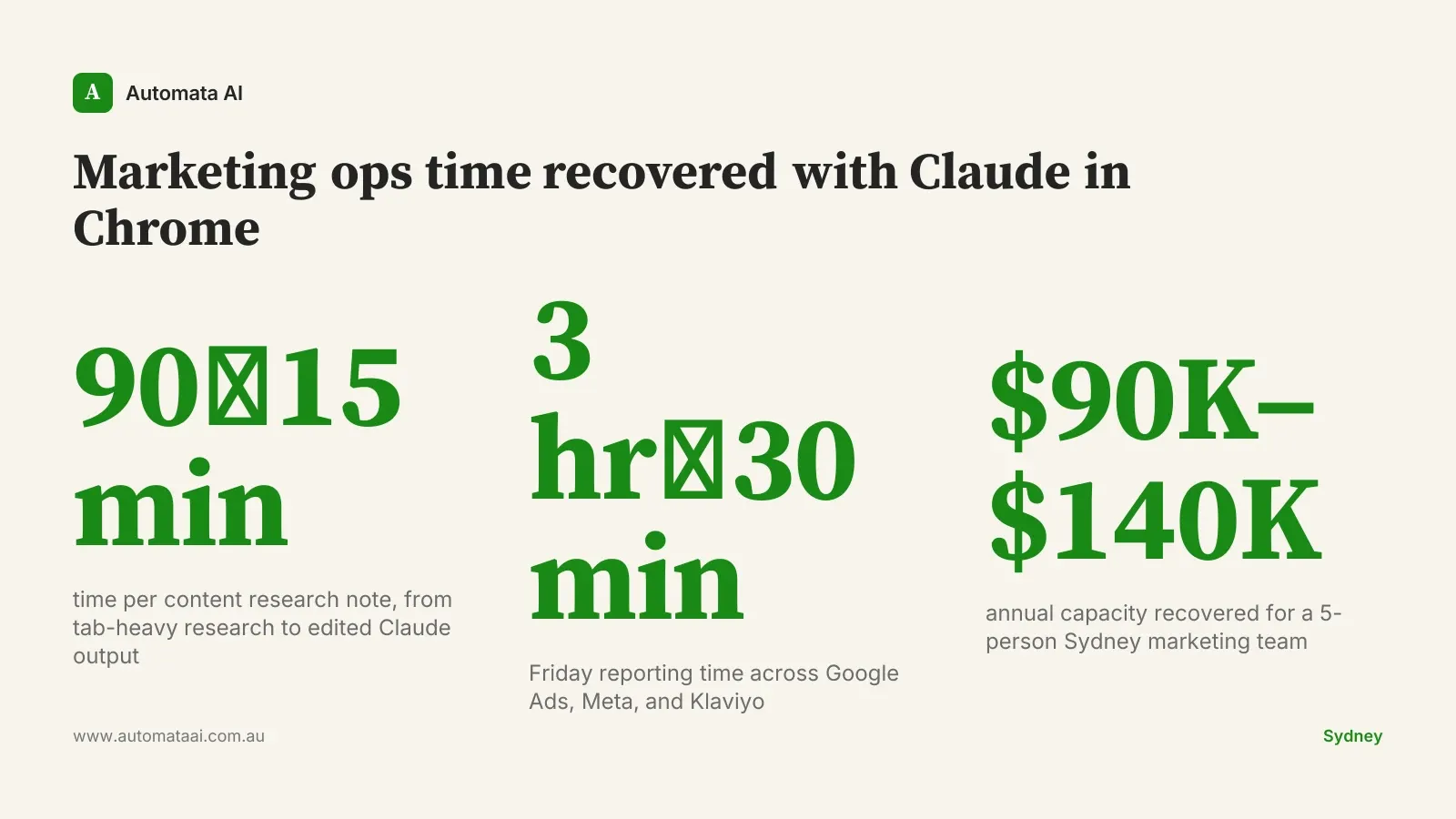
Claude in Chrome is a browser extension that reads the active page and acts on instructions. For a 5-person marketing team with fully loaded labour around $700,000 per year, it changes the economics of four specific workflows. The capacity recovered across those four tasks runs to $90,000–$140,000 per year, based on mid-market team structures common to Sydney and Melbourne marketing operations.
The payback isn't a gut feeling. You can model it in the ROI Calculator. The source of the savings is specific: manual research, ad QA, brief drafting, and report assembly. Each task is repetitive, web-based, and time-stamped. Measurable. And measurable makes it automatable.
Task 1: SEO research without tab pinball
The research note a senior analyst writes in 90 minutes typically consolidates five or six sources. It looks thorough. But most of that 90 minutes is navigation: opening tabs, reading long pages for the one paragraph that matters, copying notes into a doc, then reformatting the patchwork into something the brief template will accept.
Claude in Chrome reads the active tab. A SERP, a competitor page, an Ahrefs export. The analyst gives a short instruction and edits the result. The research still happens. The tab pinball does not.
Title and meta description. Tuned to the page intent Claude read, not a generic template.
Competitor angle summary. What the top-ranking pages are doing well and where the gaps are.
Keyword priority list. Based on the SERP shape, not an export the analyst interprets manually.
Draft outline. Structured to the team's brief format so nothing needs reformatting downstream.
Time per research note: from 90 minutes to about 15 minutes of editing. At $100/hr fully loaded for a mid-level analyst, that's $12.50 recovered per note. A team producing 40 content briefs per month recovers $72,000 per year from this single task.
Task 2: Ad copy QA against ACCC requirements
Australian marketing teams running Google Ads or Meta Ads carry compliance obligations that differ from teams in other markets. The ACCC enforces rules on price comparisons, savings claims, and was-now pricing disclosures under the Australian Consumer Law. Add the platform's own character limits and a team brand guide, and any single ad has five potential failure modes. A rejected ad after internal approval wastes the production time twice.
Character limit violations. Headline, description, and primary text checked against current platform specifications.
Brand voice deviations. Tone, banned phrases, and claim language caught before the brand manager reviews it.
ACCC disclosure issues. Price comparison, savings claims, and was-now framing that doesn't meet Australian Consumer Law requirements.
Tracking parameter issues. UTMs that are malformed or inconsistent with the team's attribution schema.
The analyst reviews the flags, not the entire ad from scratch. One pass, one source of truth.
Task 3: Brief drafting from a Slack message
"Can we get a quick landing page for the new product?" arrives on a Friday afternoon. It has no audience definition, no goal, no success metric, no timeline, and no detail about what makes the product different. The marketer either schedules a discovery meeting for next week or writes the brief themselves with half the context they need.
Claude in Chrome reads the existing brief template, the product page, and any linked context the stakeholder attached. It produces a starter brief: audience, goal, key messages, success metric, channels, and a draft headline. The marketer fills the gaps and sends a brief instead of a meeting invite.
This doesn't replace a sharp brief writer. It replaces the 40 minutes a sharp brief writer spends staring at a blank template before the real thinking starts.
Task 4: The Friday reporting tax
Weekly performance reporting pulled from Google Ads, Meta, and Klaviyo into a stakeholder-friendly format is, in practice, mostly transcription. The numbers exist. The format exists. The narrative follows a template. The marketer's job is moving figures from one interface into another, then writing a paragraph to explain what happened.
Claude in Chrome reads each platform tab, extracts the metrics the team tracks, and drafts the weekly update in the team's standard format. The marketer reviews, adjusts the narrative where needed, and sends.
Friday afternoon reporting time: from 3 hours to about 30 minutes. Across 48 working Fridays, that's 120 hours returned per year. At $100/hr loaded, that's $12,000 from one weekly task.
When this doesn't pay back in a week
Not every marketing team recovers $140,000 in year one. The economics are volume-dependent. If your team produces two briefs a month and runs one campaign at a time, the aggregate savings are real but not large enough to justify building new workflows around. The threshold matters.
Your brand guide exists only in people's heads. Claude in Chrome checks copy against documented standards. Without documentation, there's nothing to check against.
The team is fewer than three people. At two people, building AI workflows competes directly with doing the work.
Volume is too low. Under 20 briefs a month, under five active campaigns, the math doesn't work. The threshold sits around $50,000 in recoverable capacity before the investment makes sense at mid-market scale.
The AI Readiness Assessment is designed to tell you which side of that threshold you're on before you commit budget.
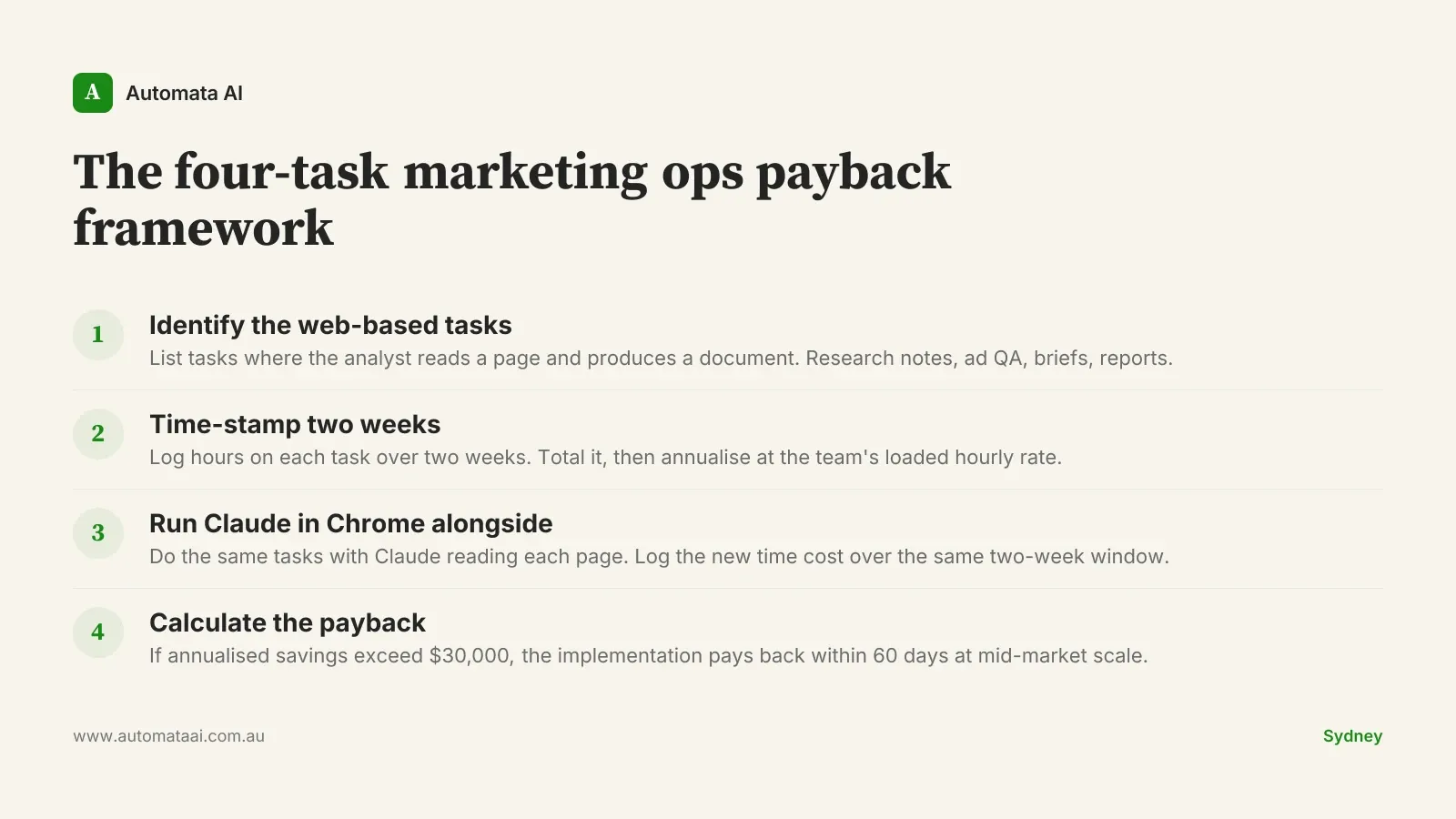
The four-task marketing ops payback framework
The four tasks above follow a pattern: high-frequency, web-based, and output-constrained. The analyst isn't exercising judgment in any of them. They're moving information from one format to another, at a pace constrained by tab navigation and copy-paste. That's where Claude in Chrome consistently delivers.
The pattern holds across other functions too. When a task can be described as "read this page and produce this document in this format," the time cost is compressible. The $90,000–$140,000 figure above comes from applying that logic to just four tasks. Across a full marketing operations function, the number is larger.
If your team fits the profile: 5 to 15 people, multiple active campaigns, more than 20 content assets a month. The payback period sits under 60 days. Our AI Automation Services include marketing operations as a deployment track, with workflows built for Australian teams already on Google and Meta platforms.
Pick one task from the four above. Time it over two weeks. If the current cost annualises past $30,000, the business case is there.