Six teams, six versions of the same git-commit Skill. One of them works reliably. Nobody knows which one.
That's the conversation I have most often with platform engineers at mid-market Australian software companies. They've shipped Claude Code to their developers. Adoption is good. Engineers are using it. But every team is building the same patterns independently, sharing nothing, standardising on nothing, and quietly accumulating a pile of Skill debt that will become someone's weekend project to untangle. The problem isn't adoption. The problem is distribution.
The four-pillar marketplace pattern
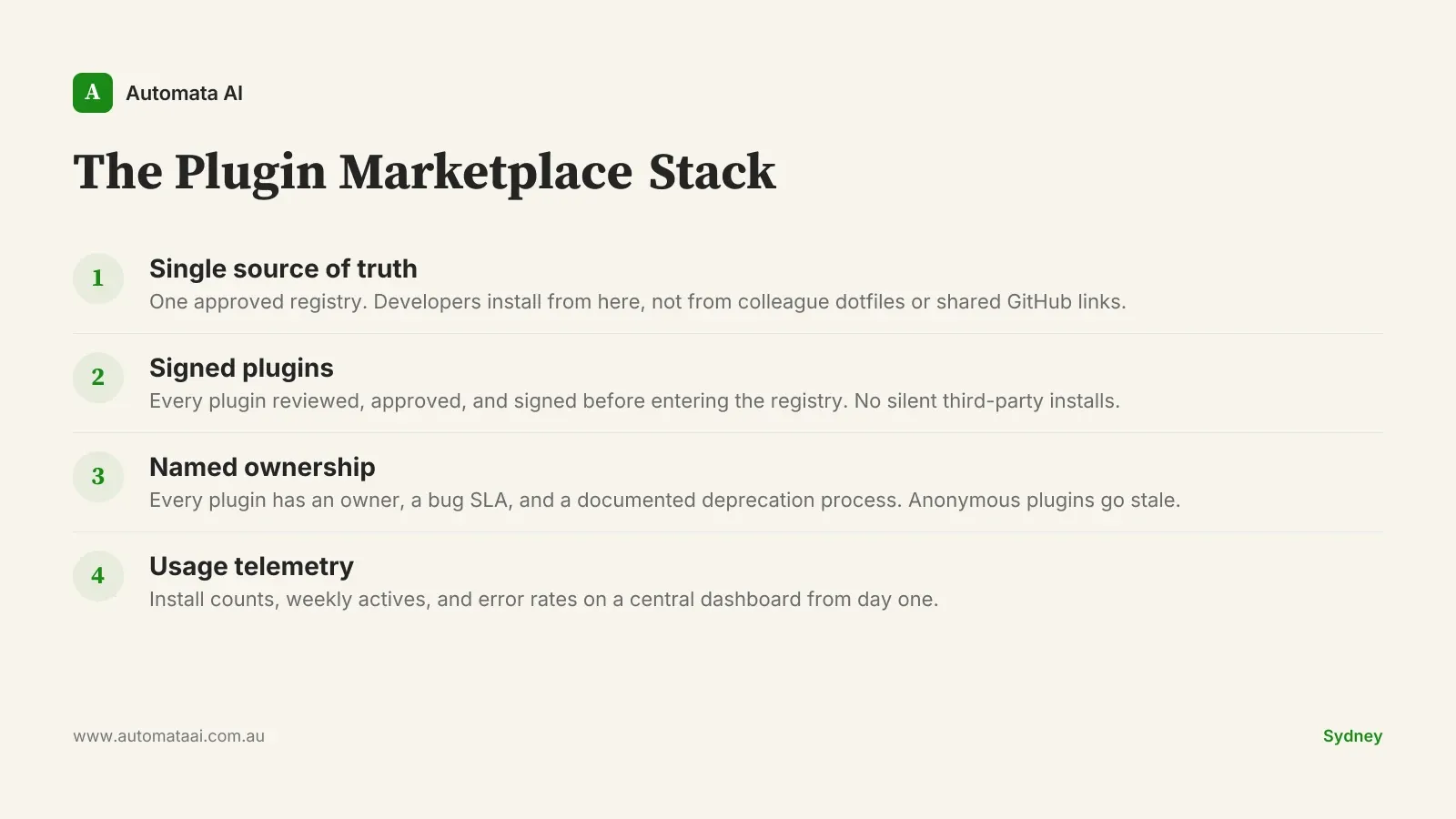
A private plugin marketplace fixes this. Not a shared Slack channel with links to GitHub repos. An actual marketplace with signed plugins, ownership records, usage telemetry, and a deprecation policy that gets enforced. We call this the Plugin Marketplace Stack. The infrastructure is the same four pieces whether you're running 40 engineers or 400.
A single source of truth. One organisationally-blessed registry, hosted in a private repo or a vendor marketplace. Developers install from here, not from a colleague's dotfiles.
Signed plugins. Every plugin in the registry is reviewed, approved, and signed. Developers can't silently install a third-party MCP the security team hasn't seen.
A clear ownership model. Every plugin has a named owner, a response-time SLA for bug reports, and a documented deprecation process. Anonymous plugins go stale within months.
Telemetry. Install counts, weekly active usage, and error rates flowing to a central dashboard. Without this, you're maintaining blind.
What the marketplace earns you
A new engineer's first day is one Claude Code install plus the marketplace URL, not three days of asking colleagues which Skill folder to clone. That onboarding improvement alone is worth $3,000–$5,000 per new hire at fully loaded rates, and it scales linearly with headcount growth. The AI Readiness Assessment covers the broader readiness picture if you want to model the full onboarding gap.
The security argument is quieter but more important. When a vulnerability surfaces in a third-party MCP, an organisation without a marketplace remediates it team by team, over weeks. An organisation with a marketplace patches the registry and it's done for everyone. For Australian engineering platforms handling customer data under the Privacy Act (1988), that difference can be the gap between a controlled response and a reportable incident. One patch point beats twenty.
Plugin owners see actual usage data, so they fix the right things first. The Skill used 40 times a day by 30 engineers gets attention. The Skill installed by three people in January and never opened since gets retired.
The hiring signal is real. Engineers talk. A platform that can honestly say it has 22 active plugins, 88 percent weekly active usage, and a deprecation queue that actually moves is a different kind of organisation than one where every developer builds their own setup from scratch.
The cost frame
A typical Australian engineering platform of 200 engineers spends around $180,000 on the marketplace build and the first six plugins. That's six to eight weeks of platform-team time at fully loaded rates, plus tooling. The investment returns approximately $1.4 million in engineering capacity annually through standardised tooling, based on reduced Skill duplication, faster onboarding, and lower security-incident response costs. Run the exact figures through the ROI Calculator if you want an AUD projection for your specific headcount and wage structure.
If your projected annual savings are below $50,000, don't bother. At that scale, the maintenance overhead of a proper marketplace exceeds the coordination gains. A shared repo with a naming convention gets you most of the benefit at a fraction of the cost.
Ship the marketplace empty
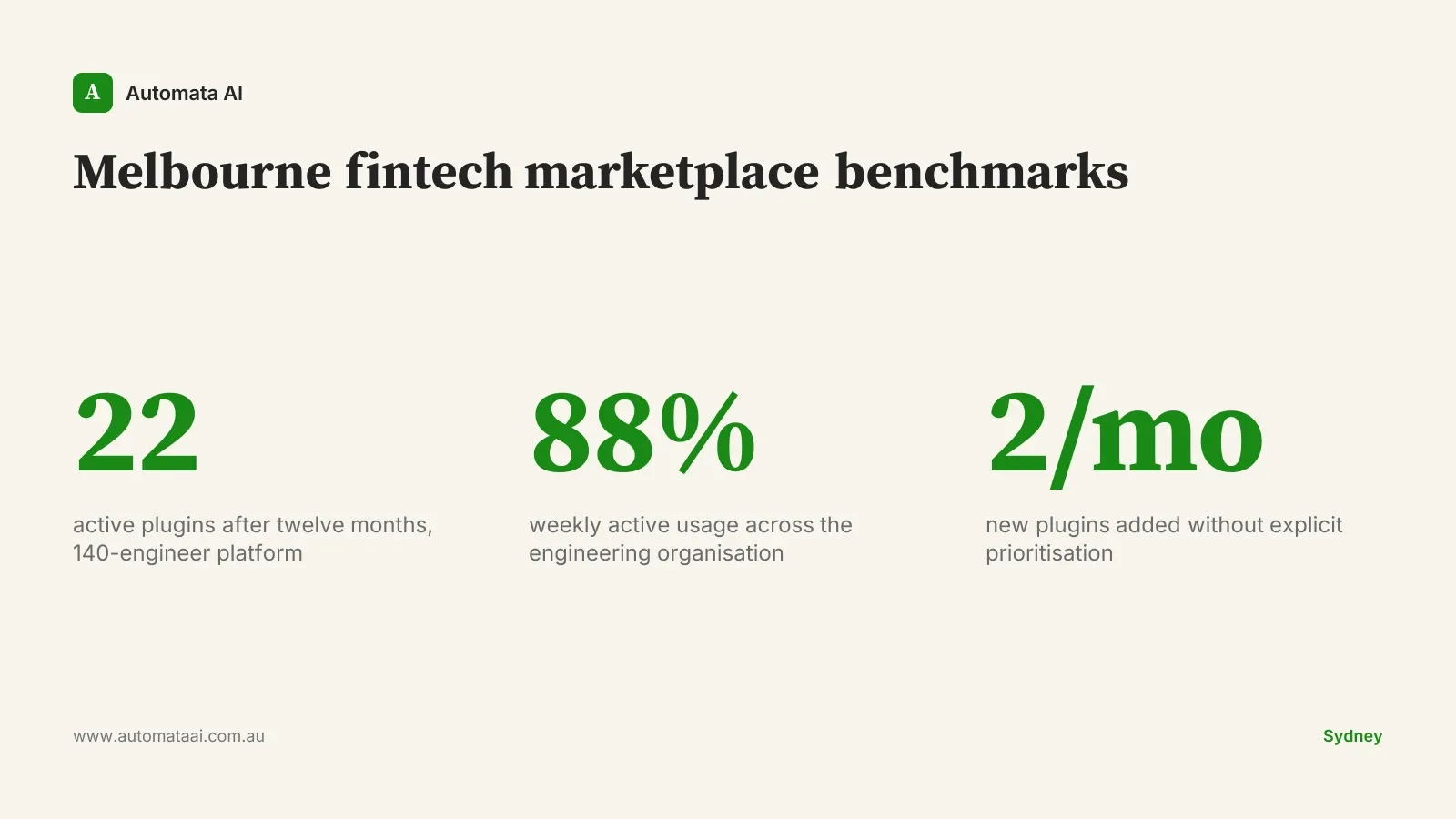
The most common mistake is shipping the plugins and the marketplace simultaneously. Don't. The infrastructure work is the long pole: authentication, signing, telemetry pipeline, CLI integration, documentation standards. It takes longer than expected. Once it's live, plugins arrive naturally. Every team has a Skill they want to share and a reason why their version is better than the one their colleagues built. The cadence without explicit prioritisation is roughly two new plugins a month for the first six months.
A Melbourne fintech running this pattern across 140 engineers now has 22 active plugins, 88 percent weekly active usage, and a deprecation queue that clears each quarter. The first three months were quiet. Month four, the rate accelerated.
When not to build this
The marketplace earns its keep at scale. Not at every scale.
Under 50 engineers. The governance overhead, including ownership records, telemetry infrastructure, and deprecation reviews, exceeds the coordination savings. A shared repo with a naming convention gets you 80 percent of the benefit.
Adoption still in progress. If your developers are still learning Claude Code basics, adding a marketplace layer creates friction at exactly the wrong moment. Get to critical mass on adoption first.
No named owner. An ownerless marketplace decays faster than no marketplace. If there's no platform team and no SLA commitment on the registry, defer until there is.
The marketplace is a platform product, not a delivery project. It needs a named owner, a quarterly review cycle, and the willingness to retire things. Our AI Automation Services team can establish the pattern and hand it over once the governance model is running.
What measurement looks like in practice
Three numbers on a shared dashboard from day one: plugin install count, weekly active usage rate, and error rate per plugin. These three tell you whether the marketplace is working and which plugins to prioritise.
A Sydney engineering platform team reports around $120,000 in additional annual savings surfaced by the dashboard alone. The data exposed two plugins installed by 60 engineers and never used after day one. Removing them cut maintenance overhead that nobody had been tracking.
The second discipline is a quarterly review. Plugins that earned their keep stay. Plugins that didn't get retired or transferred to the teams that actually use them. The review takes about two hours. Teams that run it treat their Claude Code tooling like a product with a lifecycle, not a project with a delivery date.
That shift in mindset is the one that compounds. The platform teams that got here early are already two years ahead of the ones still building the same Skill six different ways.