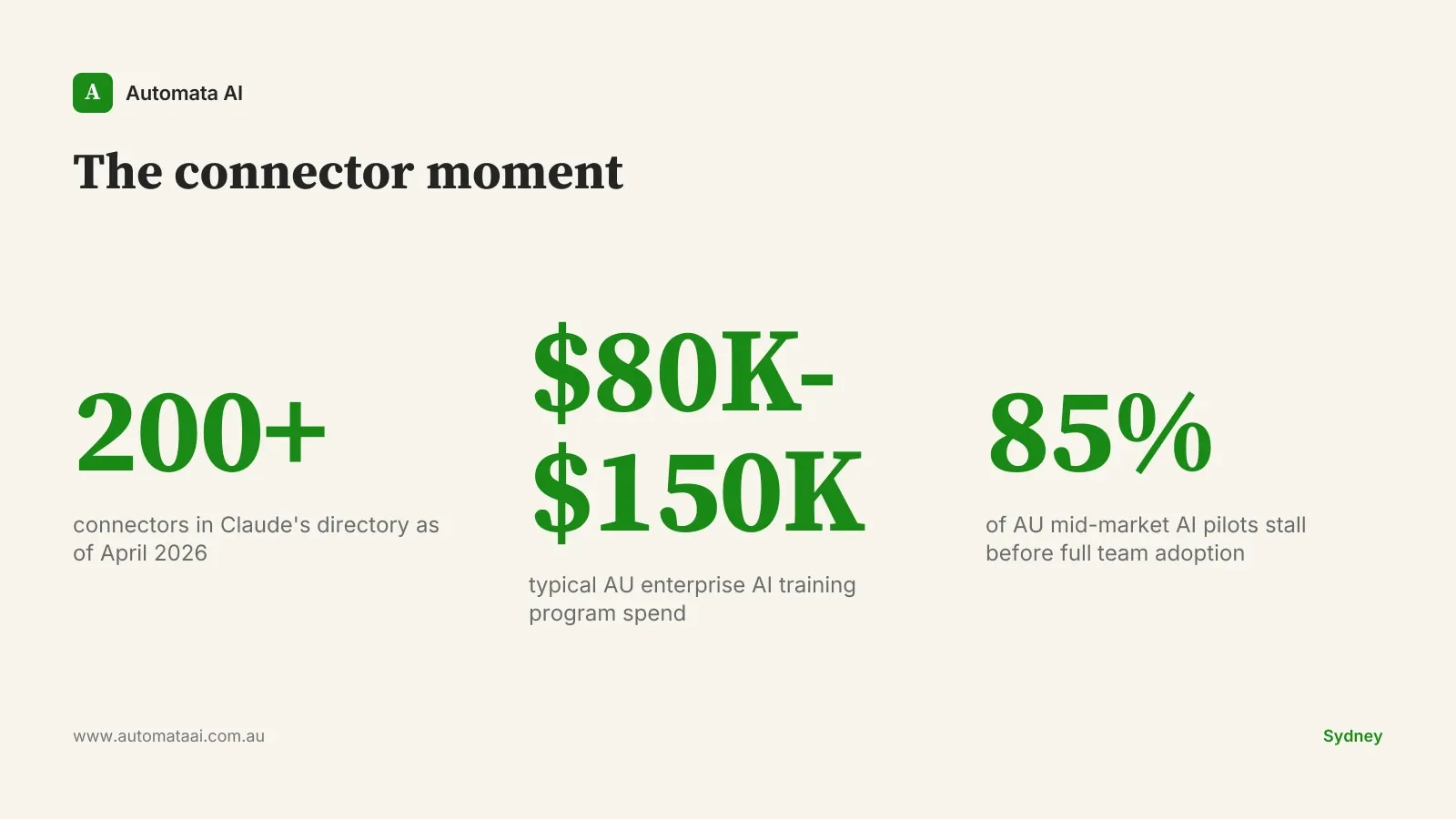
On 23 April, Anthropic added AllTrails, Spotify, Booking.com, Instacart, Resy, and eight other consumer apps to Claude's connector directory. The total count crossed 200.
Most enterprise AI teams in Sydney and Melbourne didn't notice.
They should have. This isn't a consumer product update. It's a structural shift in how Claude sits in a person's daily life, and it has direct implications for how Australian businesses manage AI adoption, connector governance, and platform strategy.
The work-life divide in Claude's connector library just collapsed
Until this year, Claude's connector ecosystem was weighted toward enterprise tools. Slack, Linear, Notion, GitHub, Salesforce, Asana. The kind of software a corporate IT team could evaluate and whitelist without much debate.
The April wave changed that. Consumer apps now share the same surface as enterprise tooling. On a narrow IT governance reading, that looks like consumer creep into a work product.
It isn't. It's the moment Claude crosses from a tool people switch to for specific AI tasks into a platform people actually live on. Once your employees are using Claude to book a restaurant, plan a hiking trip, check their Spotify playlists, or sort their TurboTax on a Sunday afternoon, they are a fundamentally different category of user when they sit down at their desk in Sydney on Monday morning — they're not learning a new tool. They already know it. They already have opinions about how it works.
The cold-start friction in enterprise AI adoption is real. Getting employees to actually use a new work tool typically requires training, internal champions, and weeks of repeated nudges. When the tool is already embedded in someone's personal routine, most of that friction disappears before the IT team has written the first training slide.
What a 200-connector directory makes possible in a single conversation
Anthropic's own example is worth internalising. A product manager pulls a query from Amplitude, uses Claude to draft a summary, generates a Canva deck, and drops the Asana task link into Slack. One conversation. No context-switching. No copy-paste across six tabs.
With consumer connectors added to the same surface, the same logic extends further. Book the team off-site. Find a Resy reservation for 10 near the Melbourne CBD for Thursday evening. Add it to the shared calendar. Send the Slack confirmation to the team. What Anthropic has built is not a business tool with a few consumer add-ons. The boundaries between work orchestration and daily coordination have collapsed into a single Claude conversation.
That's a different product than the one most Australian IT policies were written for.
Three implications for Australian enterprise teams
Adoption velocity changes. The typical Australian enterprise spends $80,000 to $150,000 on formal AI training programs: change management workshops, prompt engineering sessions, internal champion programs. That budget was designed to solve a cold-start problem. When your employees already use Claude personally, most of it is overhead before a single slide is written. Consumer familiarity is worth more than a two-day workshop. If you haven't modelled the savings yet, start with our ROI Calculator before committing to the next training cycle.
Connector governance becomes a genuine planning question. Most Australian IT teams have approached connectors through the lens of SSO, data residency, and obligations under APRA or the Privacy Act. Few have developed a formal policy for consumer connectors within an enterprise plan. The distinction matters: a consumer connector that pulls booking history or food delivery preferences creates a different data governance question than Salesforce or Linear. That gap in most AU enterprise connector policies is now live.
The competitive gap between Claude and ChatGPT is widening. ChatGPT's plugin ecosystem peaked around 2023 and stagnated. Claude's connector directory has expanded aggressively over the past twelve months. For Australian enterprises currently evaluating or renewing their strategic AI platform, this trajectory matters more than a single product comparison.
When connector strategy can wait
Not every Australian business needs a connector governance policy this quarter.
If your organisation is on a free or Teams plan without enterprise-grade administrative controls, the whitelist question is moot. You don't have the administrative surface to enforce a policy, and connector governance layered onto a plan without admin controls is theatre. The enterprise tier evaluation comes first.
If you operate under APRA CPS 230, the Australian Privacy Principles, or in a sector with strict data residency requirements, several consumer connectors will never clear your legal and risk functions regardless of how the policy is written. That is not a connector strategy failure. It's the compliance function doing its job. Build that constraint into the policy from the outset rather than drafting a permissive framework and then creating exceptions when compliance pushes back three months later.
And if your team isn't meaningfully using Claude yet, a connector audit is premature. Governance on top of poor adoption creates compliance overhead with no ROI. The adoption foundation needs to come first. The AI Readiness Assessment is designed to map exactly where that foundation is solid and where it isn't.
The connector governance checklist for Australian IT leaders
If you're on Claude Enterprise and haven't reviewed your connector policy since the April update, four steps cover the minimum ground.
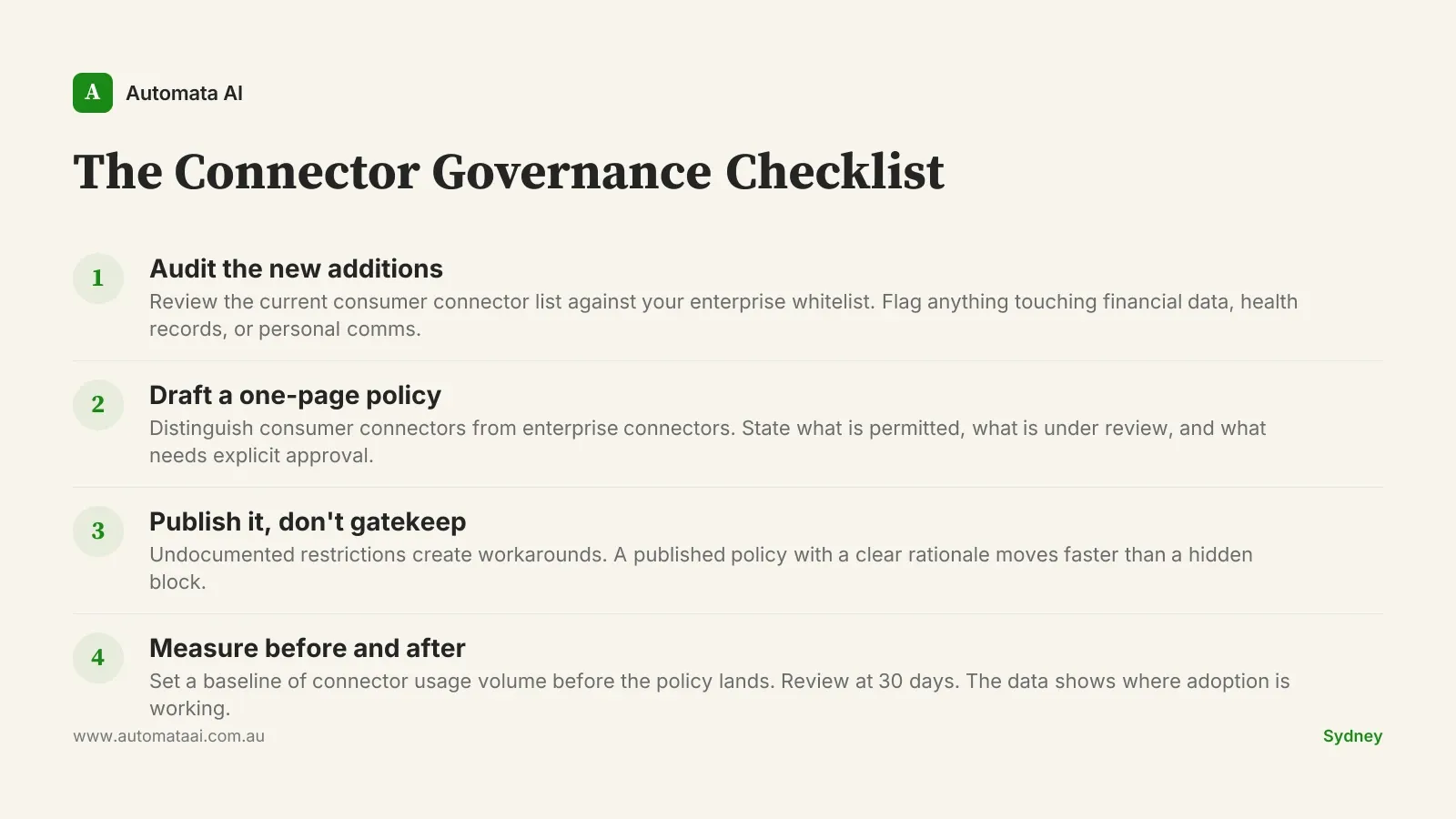
Audit the new additions. Pull the current consumer connector list from Claude's integration settings and compare it against your existing whitelist. Flag anything that touches financial data, health records, or personal communications.
Draft a one-page policy. Consumer and enterprise connectors warrant different governance treatment. State which consumer connectors are permitted, which are under review, and which require explicit approval from the risk or legal function.
Publish it, don't gatekeep silently. Undocumented restrictions create workarounds. Employees who don't know what's allowed will test the limits. A published policy with a clear rationale drives informed adoption faster than a hidden block.
Measure before and after. Set a baseline of connector usage volume before the policy lands. Review it at 30 days. The data will tell you where adoption is working and where friction is creating avoidance.
This is the Connector Governance Checklist. It's the minimum governance surface for any Australian organisation running Claude at scale, regardless of industry or headcount.
The businesses that move on this now won't be retrofitting governance onto a platform already embedded in their team's daily routine. That work is harder, and it's always done under pressure. The connector landscape will keep expanding. Building a governance posture now, while the directory is new and the volume is manageable, is the right time to do it. If you need help building a connector strategy and governance framework tailored to the Australian mid-market, our AI Automation Services cover exactly that.