Six months ago your team started building the agent. Not using it. Building the infrastructure around it: sandboxed execution, checkpointing, credential management, scoped permissions, end-to-end tracing, orchestration harness, error recovery, model-upgrade handling. That's the list before your team writes a single line of business logic that a user will ever see.
You haven't shipped a feature yet.
The agent infrastructure tax
Building a production agent from scratch is two projects running at the same time. The first is the actual agent: the business logic, the tools, the domain-specific behaviour that creates value. The second is everything the agent needs to not collapse under production load. Most teams only planned for the first project.
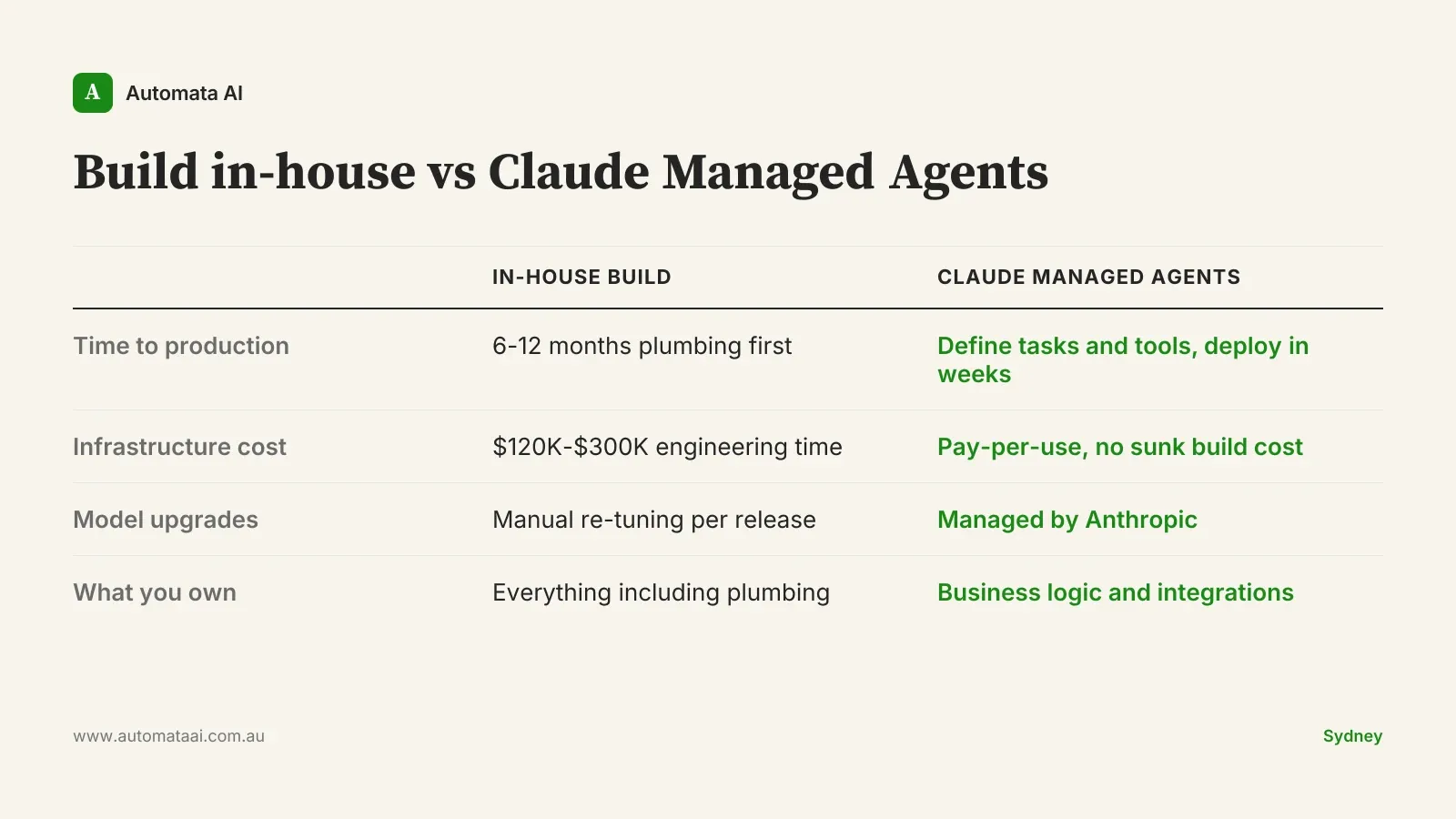
That second project has a price tag. For Australian enterprise teams, a realistic cost of building agent infrastructure properly is $120,000 to $300,000 in engineering time. That's six to twelve months of two or three senior engineers at $150 to $200 per hour fully loaded. You can model what that looks like for your own process in our ROI Calculator.
Most teams don't price this correctly at the start. They either ship something fragile and discover the gaps under production load. A tool call that hallucinates on edge cases. An orchestration loop that fails silently. Credentials that expire without recovery. Or they spend two quarters on plumbing and start losing credibility with the stakeholders who approved the investment.
What Anthropic shipped on 8 April
Claude Managed Agents is a suite of composable APIs that shifts where the infrastructure responsibility sits. You define what the agent does: the tasks, the tools, the guardrails. Anthropic runs the harness: the sandboxing, the credential plumbing, the orchestration, the tracing, the model-upgrade resilience. The agent runs on Claude Platform infrastructure.
What stays with you is the user experience, the business logic, and the integrations specific to your domain. The parts that differentiate your product from any other team that could build the same thing.
Most Australian enterprise teams aren't building agent infrastructure. They're postponing the product. Six months of plumbing is six months of not learning what users actually need from the agent. Managed Agents is the announcement that makes that postponement optional.
The build-vs-buy breakdown for Australian teams
Not every team should make the same call. The right answer depends on your regulatory footprint, your engineering capacity, and whether you're building differentiated value in the infrastructure layer at all.
Banks and APRA-regulated financial services. The compliance and data-residency constraints under APRA CPS 230 are real. Most regulated entities will keep core agent infrastructure in-house for production workloads. The practical move is to pilot Managed Agents on non-regulated internal use cases first, then apply what you learn to your bespoke build. We cover the compliance scaffolding in our overview of financial services agent deployments.
Mid-market enterprise (50 to 500 engineers). Strongest fit. The months not spent building infrastructure go directly into features that move the business. This is the group where Managed Agents pays for itself fastest.
Smaller teams and startups. Managed Agents is the only sensible path. You don't have the infrastructure talent to build this properly, and you shouldn't try to acquire it. Build product, not plumbing.
The model-upgrade tax nobody talks about
The biggest hidden cost in production agents isn't the initial build. It's what happens every time a new model releases. And it happens on Anthropic's schedule, not yours.
Every new Claude version means re-tuning prompts, re-validating tool calls, auditing the behaviours that shifted. For teams in Sydney and Melbourne that have already been through an Opus upgrade cycle, this is familiar territory. What was supposed to be a capability improvement turns into two to four weeks of stabilisation work before you can confidently run the new model in production.
Managed Agents handles model migrations as a managed concern. Anthropic tunes the upgrade path. You get the capability improvement without the stabilisation sprint. For teams that have already paid this tax once, that alone may justify the switch.
When Managed Agents is the wrong call
If your agent touches data governed by Australian Privacy Principles or APRA CPS 230, you need to understand exactly where that data flows before you commit. This isn't an argument against Managed Agents. It's an argument for doing the due diligence before you're six months in and rearchitecting.
If your agent requires genuinely custom orchestration behaviour, the managed layer may constrain you. Managed infrastructure trades configurability for convenience. For roughly 80% of production agent use cases, that trade is worth it. For the 20% with unusual coordination requirements across multiple models or external systems with strict latency bounds, it may not be.
If the process you're automating generates under $80,000 AUD per year in savings, the infrastructure question is a distraction. Assess the process economics first. Our AI Readiness Assessment includes a process-scoring section that takes about fifteen minutes.
Before you commit to either path
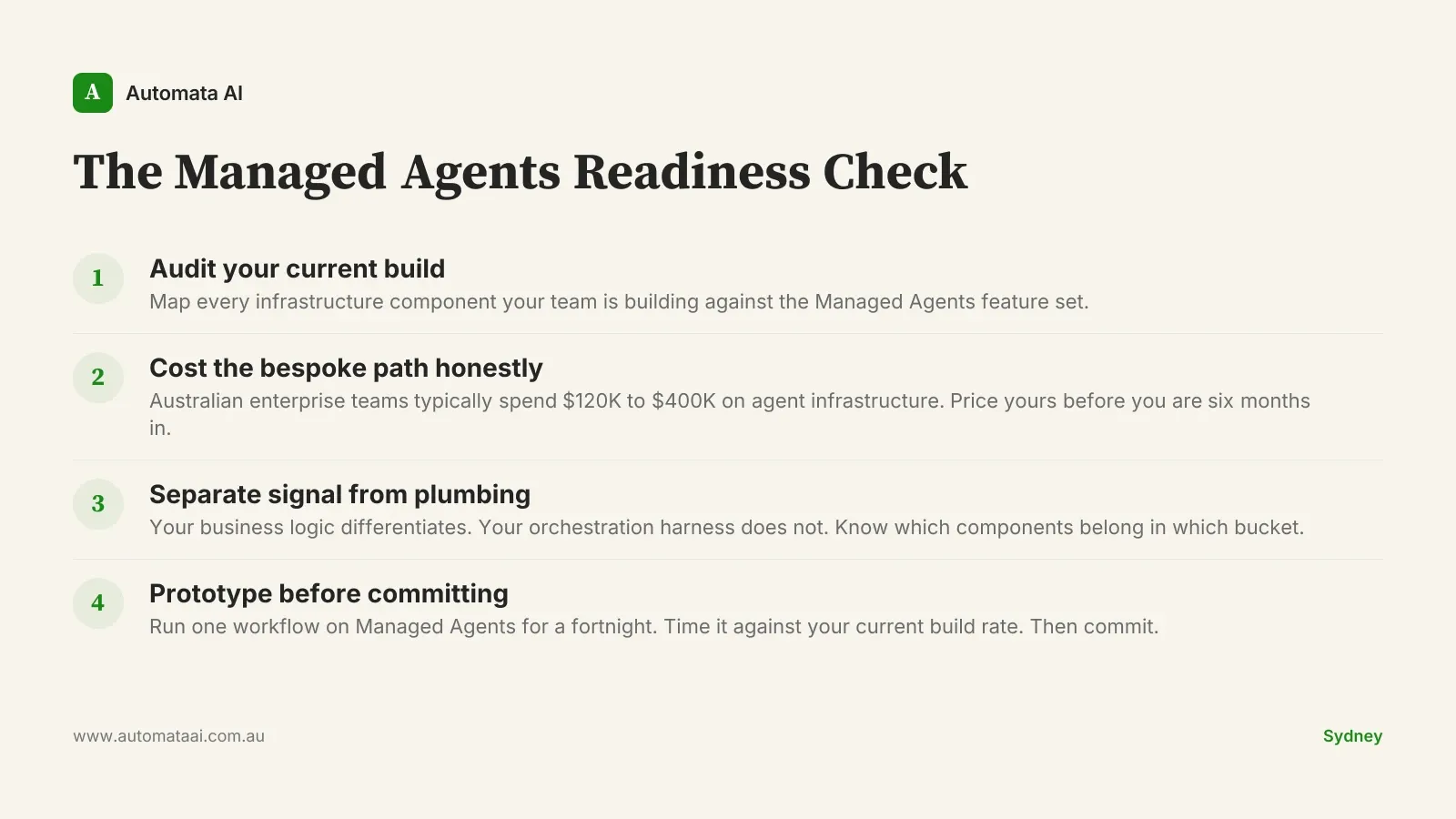
The practical sequence is the same regardless of which direction you go: audit what you're building, price it honestly, identify the parts that are actually differentiating, and run a time-boxed prototype before you lock in.
Audit the current build. Map every infrastructure component your team is building against the Managed Agents feature set.
Cost the bespoke path honestly. Typical Australian enterprise spend lands between $120,000 and $400,000. If your current estimate is under $50,000, you're probably underestimating.
Identify what's differentiating. The business logic is differentiating. The orchestration harness is not.
Prototype before committing. Run one workflow on Managed Agents for a fortnight. Time it against your current build rate. Then commit to a path.
The teams that win aren't the ones with the most sophisticated infrastructure. They're the ones that shipped something useful first and iterated. If you're six months into building plumbing and haven't shipped a feature, that's the signal. Our AI automation services are built around exactly this kind of structural reset. We help Australian teams identify what's differentiating and get the rest off their plate.