A Sydney product founder spent $7,200 on a one-pager earlier this year. Brief, two revisions, three weeks of calendar, and a freelancer who interpreted the concept four different ways before landing close enough.
On 17 April, Anthropic Labs shipped Claude Design as a research preview, rolling out across Claude Pro, Max, Team and Enterprise. That one-pager is now a ten-minute conversation.
What Claude Design actually does
Describe what you need: a one-pager, a feature prototype, a sales slide deck, a piece of campaign collateral. Claude builds a first version. You refine through conversation, inline comments, or direct edits to the output. It is powered by Opus 4.7, Anthropic's most capable vision model, which means it understands layout, hierarchy, and composition, not just text. The loop is faster than a brief to a freelancer and faster than waiting for a design team with a full sprint queue.
The most interesting feature is custom sliders. Claude doesn't expose generic controls shared across every design task. It builds parameter-tweaking UI calibrated to the specific piece you're making. Working on a one-pager for a financial services client? The slider controls might cover information density, formality of language, and prominence of a key figure. Working on a campaign social? Different controls entirely. Each slider is generated for this design problem, not for design problems in general.
Three audiences, ranked by impact
The biggest payoffs land furthest from the design function.
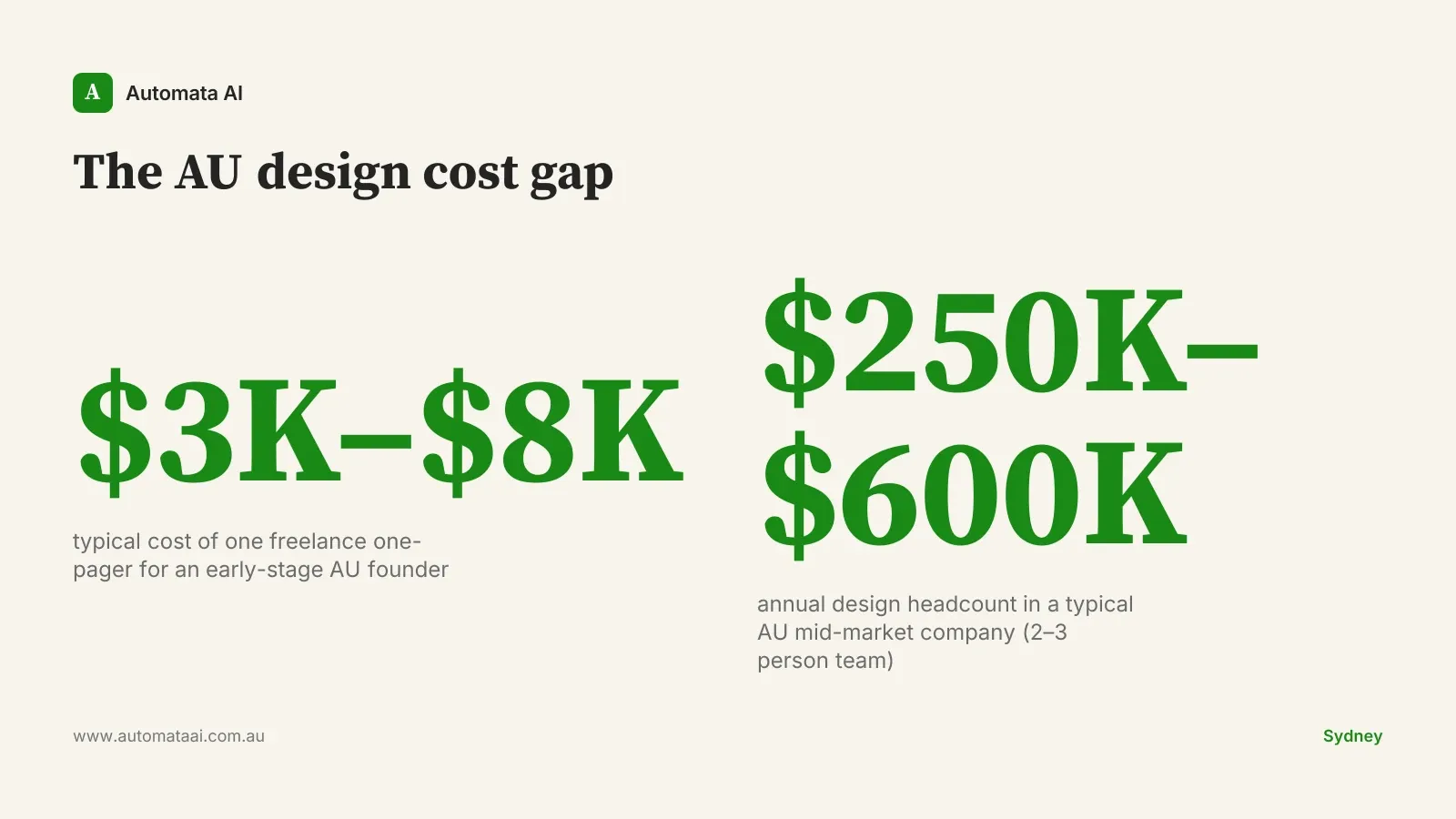
Founders and PMs without design backgrounds. Biggest impact by a distance. Previously, not being able to sketch an idea meant commissioning a freelancer: $3,000–$8,000 per one-pager, a brief, two rounds of revisions, and three weeks of calendar for Sydney founders who needed something testable. Claude Design makes that a conversation instead. The brief-and-wait loop collapses. You can iterate six times before the end of the day.
Marketing teams in AU mid-market. One-pagers, internal slide decks, social graphics, sales-enablement collateral. Most mid-market marketing functions in Australia share design resources with product or outsource entirely. Collateral that should take a morning takes a week because the design queue is always full. Claude Design is the capacity they have been working without.
Designers themselves. The honest take: designers ration exploration because time demands it. You prototype two directions, not ten, because the sprint doesn't allow ten. Claude Design dissolves that constraint. A designer who used to explore two or three directions in a sprint can now explore ten, kill eight, and present the two that actually work. Whether this reads as augmentation or threat depends entirely on how the business responds to the change, not on the tool.
When Claude Design won't save you
Three scenarios where it doesn't move the needle. Worth knowing before you grant company-wide access.
Brand-critical output at launch. Claude Design gets you to 70% quickly. A senior brand designer working on a product-launch identity or an ASX annual report needs to reach 100% on dimensions Claude Design doesn't control: brand stewardship, legal review, and the accumulated context of how a company has presented itself for a decade. That judgment isn't in the model.
Regulated financial services collateral. PDSes, FSGs, and disclosure documents subject to ASIC's formatting requirements need legal sign-off on both content and layout. Claude Design can draft a structure; it cannot guarantee compliance-ready output. Don't confuse a fast first draft with a reviewable document.
Teams without a defined visual language. Claude Design accelerates whatever design direction already exists in your business. If that direction isn't defined, it will accelerate inconsistency. Fix the brand foundations before you scale access across teams.
The Three-Week Design Pilot
The fastest way to test whether Claude Design shortens your design cycle is to run it against three real deliverables across three different cohorts. Not a demo, not a sandbox. Real output, measured against your current process.
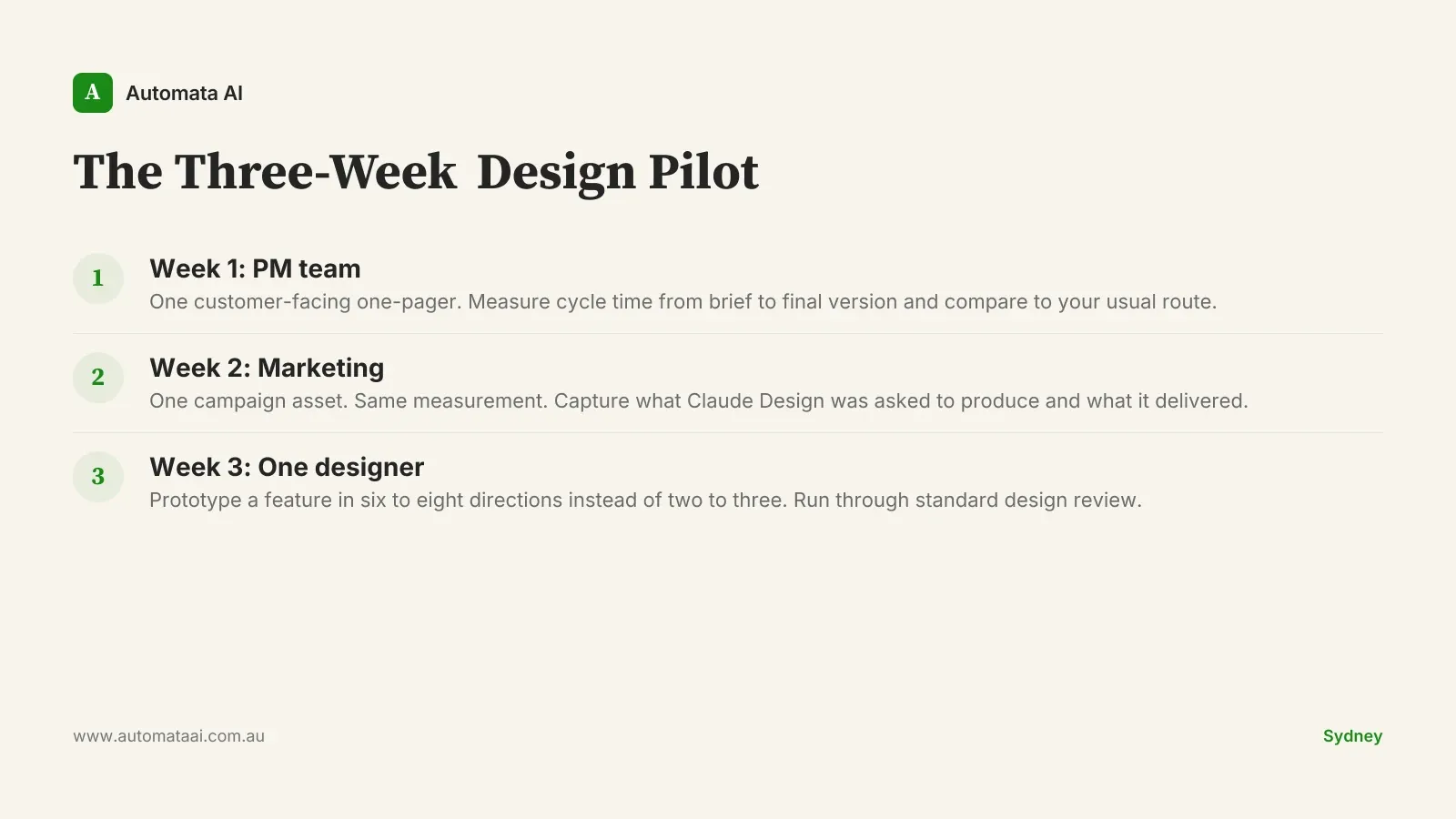
Week 1. Give one PM access and one real deliverable: a customer-facing one-pager. Measure cycle time from brief to final version. Compare to how long it usually takes.
Week 2. Give marketing access. One campaign asset, same measurement. Capture what Claude Design was asked to do and what it actually produced.
Week 3. Give one designer access. Ask them to prototype a product feature in six to eight directions instead of their usual two or three. Run the output through standard design review.
Three weeks gives you real data from three different cohorts rather than an opinion about what AI tools can do in theory. The data becomes a planning input: which teams get full access next, what guardrails the rollout needs, and whether Claude Design is expanding your design output or simply shifting who does it. That distinction matters more than whether the tool impressed anyone in the demo.
The design gap in Australian mid-market
Australian businesses chronically under-invest in design relative to engineering and sales. A typical mid-market company (50 to 500 employees) carries $250,000–$600,000 in annualised design headcount cost for a team of two or three. Those people are almost always the bottleneck. The design-to-engineering handoff is the slowest part of most Australian product cycles: PMs wait for mocks, engineers wait for specs, and marketing is always third in the sprint queue.
Claude Design doesn't replace that team. But it puts design capacity in front of the people who actually need it: the PMs who can't draft a wireframe, the founders who can't produce a credible one-pager, the marketing managers producing weekly collateral on a shoestring. Our AI Automation Services include role-by-role rollout playbooks for exactly this kind of adoption. The change management work that turns 'access granted' into 'measurably shipping faster' is where most pilots quietly stall.
To model the payback against your current design costs, the ROI Calculator takes three minutes with AUD figures. No signup. Covers fully loaded headcount, freelancer spend, and the time value of your current brief-and-revise loop.
The AI Readiness Assessment we run with AU businesses consistently surfaces the design-to-engineering handoff as one of the three most expensive bottlenecks in the product cycle. Not because design is the weak link, but because design-gated work compounds across every team downstream. Claude Design, used properly by the right teams, is the most direct fix Anthropic Labs has shipped for that problem. Run the three-week pilot. Measure the cycle time honestly. The data will tell you what your intuition won't.