Every Melbourne mid-market retailer running a customer service team knows the Christmas problem. You hire casuals in November, train them in December, lose them in January, and spend the next ten months paying a team sized for the peak when the median was the reality.
That gap between what you need at peak and what makes sense at steady state is exactly what Claude customer service automation is designed to fill. Not to replace your team. To hold the line while your team focuses on the interactions that actually need a human.
What a Claude customer service workflow handles
At the first-touch level, the workload that moves to Claude is the repeatable stuff: order status, returns policy, store hours, product availability, click-and-collect eligibility. These are questions with documented answers. Claude reads the policy, checks the system, responds in the retailer's voice. A well-configured implementation handles 55–65 percent of first-touch volume without a human in the loop. For a retailer handling 250,000 interactions a year, that is 137,000–162,000 queries resolved without staff time.
Order and delivery status. Connected to your OMS, Claude gives accurate ETAs without a rep manually tracking it down.
Returns and exchange policy. Standard policy questions resolved at first touch, with a clear escalation path when the situation is an edge case.
Store hours and location queries. Routed from web chat, email, or phone IVR with no rep involvement.
Outbound proactive communication. Delay notices, backorder updates, and post-purchase follow-up. Claude drafts in brand voice; the team approves before send.
Escalations that reach a human agent come with a briefing note: what the customer asked, what Claude said, what Claude could not resolve, and a recommended next step. The agent picks up an already-briefed conversation, not a cold queue item.
The cost frame for a Melbourne retailer
A mid-market Melbourne retailer handling around 250,000 customer interactions a year typically spends $1.3–$1.5 million on customer service, including peak-season casuals and team lead overhead. A Claude-augmented workflow handling 60 percent of first-touch interactions brings that to roughly $700,000 in steady state.
The build is approximately $180,000 to implement, covering integration with your OMS, helpdesk, and returns platform, plus the brand voice calibration work described below. Annualised running cost is around $80,000 a year. Payback at those numbers is around eight months. Model your own figures in our ROI Calculator before you commit to a scope.
The three-layer routing model
The build that works uses what we call the three-layer routing model. Every incoming customer interaction is assessed at intake and routed to one of three layers based on query type, customer history, and policy complexity. The routing logic is explicit — no fuzzy matching, no black box. The retailer's ops team can read the rules and audit the outcomes.
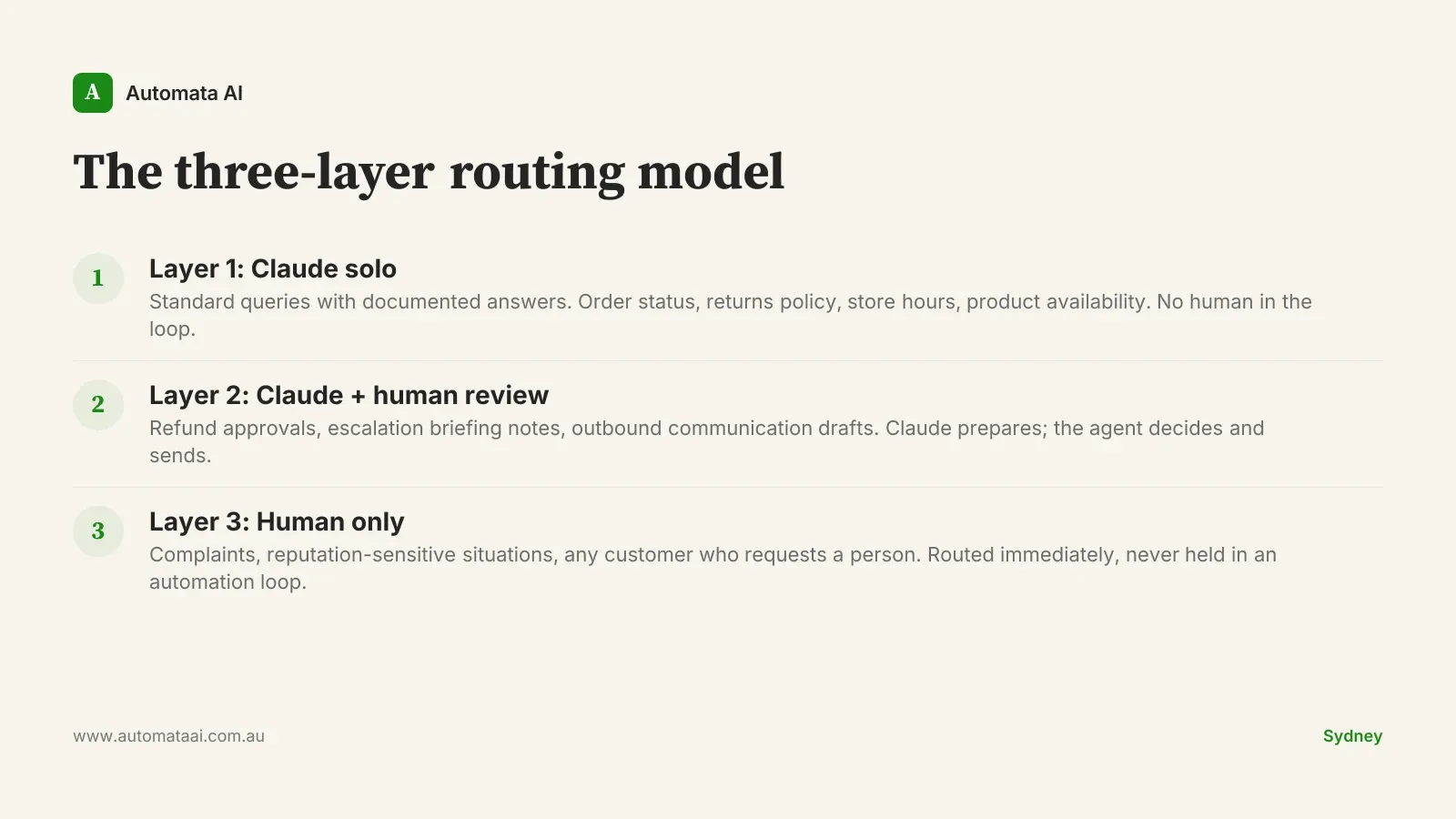
The split is not arbitrary. Refunds and complaint resolution stay human-supervised not because Claude cannot draft a response, but because those interactions carry brand risk. A $45 refund decision made wrong costs more in reputation than it saves in labour.
The brand voice problem
The hardest part of a retail customer service build is not the integration. It's the voice.
Generic Claude responses sound like a generic chatbot. If your brand has a specific tone, warm but efficient or direct and no-nonsense, the system needs a carefully tuned voice layer that captures your language patterns, your policy exceptions, and what your team would never say. This is around two weeks of deliberate work. It is the difference between a workflow customers tolerate and one they do not notice.
A Brisbane mid-market retailer that shipped this pattern reported an 11-point lift in customer satisfaction over six months, despite reducing customer service headcount by 35 percent. The lift came from response speed and consistency. Customers do not mind automation when the response is accurate and fast. They mind when it is slow, wrong, or obviously canned.
When this is the wrong build
Claude customer service automation is not the right investment for every retailer.
Interaction volume under 30,000 per year. Below that threshold, the build cost does not pay back in a defensible timeframe. A well-structured FAQ page or templated helpdesk macros is the right call.
Policies that are not documented. If your returns policy lives in the heads of three senior reps and has informal exceptions, Claude will automate the inconsistency. Document first, automate second.
Complaints as the majority of volume. Automation helps with first-touch resolution. If most of your contacts are already escalated complaints, the bottleneck is upstream, in product quality, fulfilment, or delivery. Not in customer service staffing.
If you are not sure which bucket you are in, our AI Readiness Assessment takes around two hours and gives you an honest read before you commit to a build.
The rollout sequence that matters
Retailers that get adoption above 70 percent share one habit: they roll out sequentially. Pilot one channel, email first or web chat first, over six to eight weeks. Measure response quality, edit rate, and team satisfaction. Promote to the next channel only after the numbers move. Retailers that launch across all channels at once report adoption below 25 percent, and typically revert to the manual process within three months.
Australian retailers collecting customer interaction data through these workflows need to review their Privacy Act (1988) obligations before go-live. Customer contact data feeding a Claude workflow is personal information under the Australian Privacy Principles. Data retention policies and access controls need to be in place before the first interaction, not after.
There is also an implicit cost that rarely makes it into the business case: staff turnover. Customer service teams spending most of their day on identical repetitive queries have high attrition. Teams that use Claude for the routine and focus on the complex tend to stay. Based on our AI Automation Services engagements, the annualised turnover saving is roughly $80,000–$100,000 for a ten-person team. That number is hard to model before the build. It shows up clearly after.
Pick the highest-volume question type your team handles. Quantify how many times a week, at what fully loaded labour cost. If the answer is over $150,000 a year, the business case for automation almost writes itself.