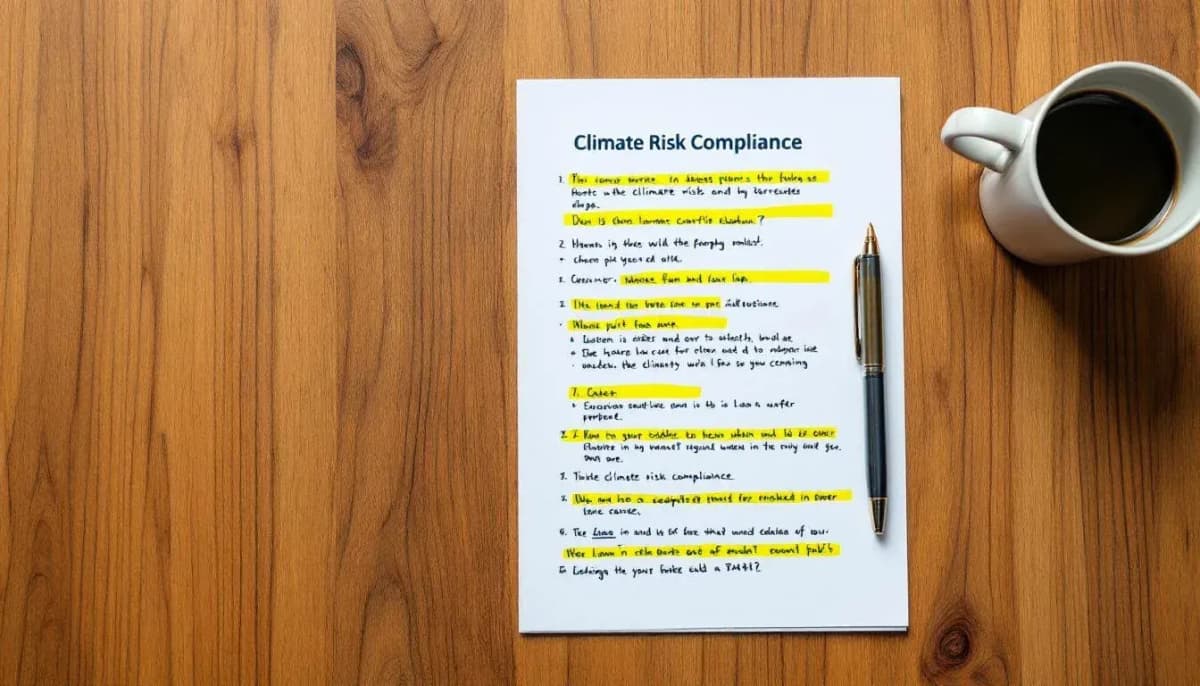
The ASX disclosure calendar doesn't care that your ESG team is three people.
TCFD-aligned climate disclosures, modern slavery statements, and scope 3 emissions narratives all land in the same six-week window. Written from scratch each year, cross-checked against prior-year disclosures, formatted to AASB S2 standards, by the same small team that is also managing the external auditor. This is the structural condition of ESG reporting for Australian mid-market mining companies right now. Claude doesn't fix the structural condition. It absorbs enough of the drafting load that the same team can handle it without breaking.
The Real Cost of Manual ESG Drafting
The problem is sequence. Climate risk data arrives in spreadsheets from the operations team. Scope 3 category data comes from procurement, formatted differently every year. The scenario analysis has to be interpreted, structured into a narrative, cross-checked against the prior disclosure cycle, and written to the specific language requirements of AASB S2. A senior ESG analyst at $150 to $220 per hour fully loaded typically spends five to six weeks on the TCFD section alone, and most of that time is document handling rather than analysis.
The analyst who could be building out your physical risk models is instead transcribing assumptions into a disclosure template.
The ESG Drafting Split
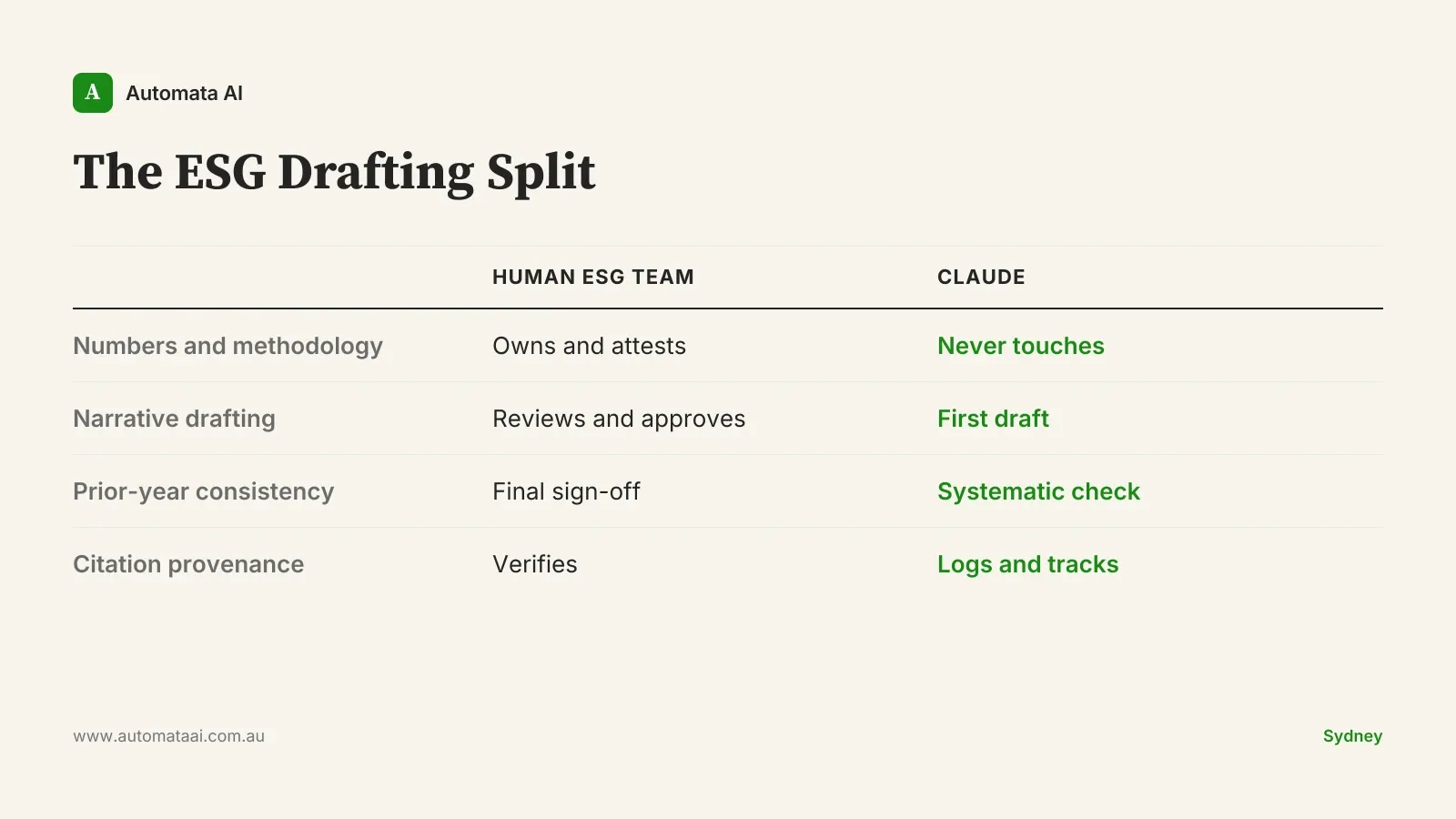
The workflow that holds up for Australian mining companies follows a consistent division. Call it the ESG drafting split. The principle is not complicated: numbers, methodology, and final attestations stay entirely with the qualified ESG team. Everything involving first-draft generation, summarising, cross-referencing, and consistency checking moves to Claude. The qualified human reviews every Claude output before it enters the published report.
Numbers and methodology. The analyst owns every figure, every assumption, and every scope 3 category decision. Claude never calculates.
First-draft generation. TCFD scenario analysis sections, modern slavery narratives, and scope 3 methodology explanations are all drafted by Claude from structured data the analyst has already verified.
Prior-year consistency checking. Claude cross-checks the current draft against the prior-year disclosure, surfaces material changes, and flags any inconsistencies. A task that previously took two days of side-by-side manual review.
Citation tracking. Every section Claude generates includes a reference to the source document it drew from. The audit trail is built during drafting, not reconstructed afterward.
The ESG team reviews each Claude-generated section before it enters the published report. In practice this takes around two minutes per artefact. The provenance chain is intact throughout. Every figure in the final report traces back to a source document the analyst verified before the drafting started.
The Cost Frame
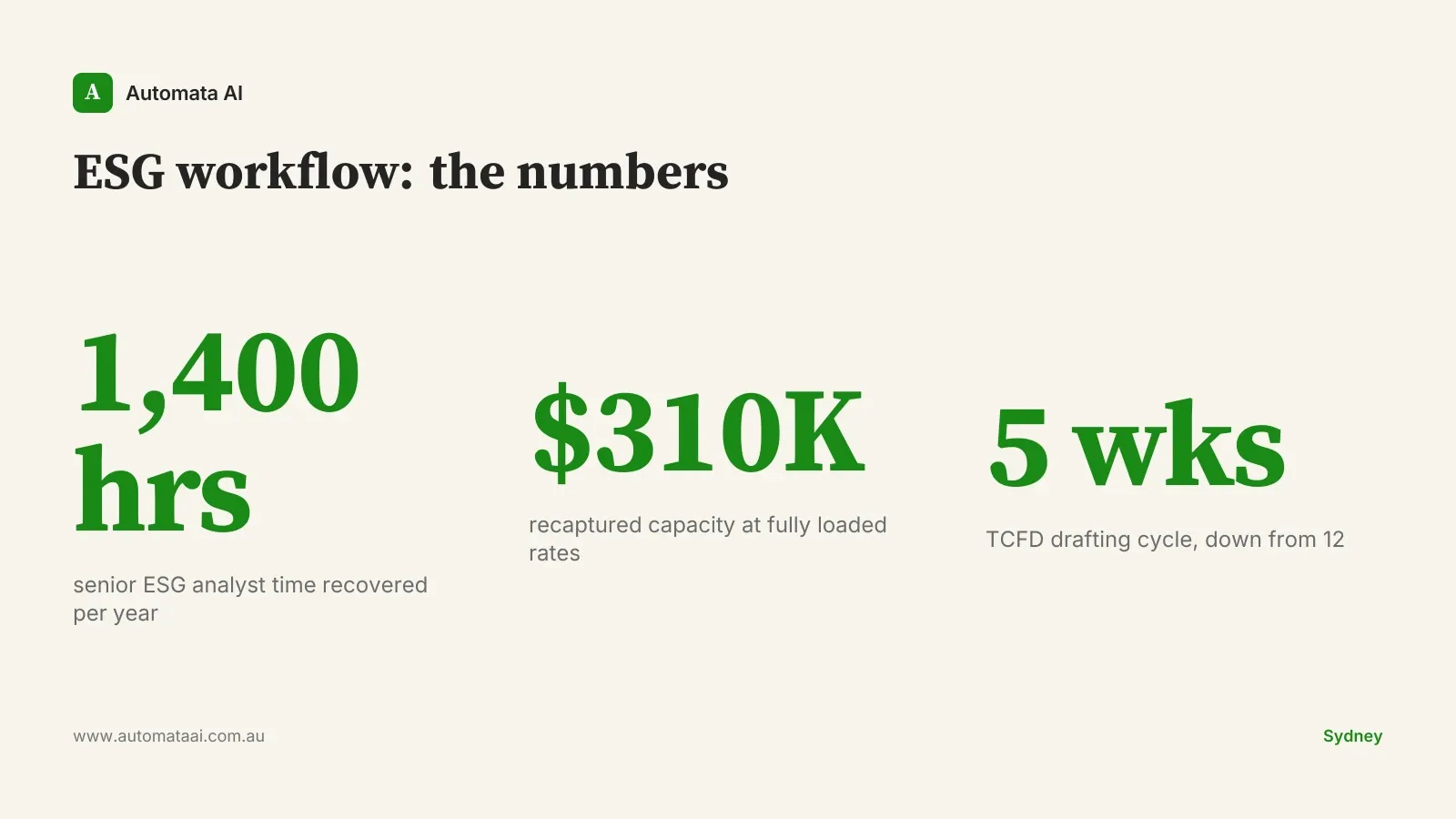
A mid-tier ASX-listed mining company running this workflow recovered around 1,400 hours of senior ESG analyst time per year. At fully loaded rates including superannuation, overhead, and benefits, that is roughly $310,000 in recaptured capacity. The build cost around $140,000. Payback sits inside the first annual reporting cycle. To model the specific figures for your operation, the ROI Calculator runs AUD numbers and takes about three minutes.
The TCFD section shows the time shift most clearly. Pre-workflow, the drafting cycle ran around 12 weeks from data receipt to sign-off. With Claude in place, it runs around five weeks. The seven weeks recovered go directly into deeper scenario modelling. That is the work that actually moves investor confidence, and it is the work no amount of efficient document handling can substitute for.
There is a second savings figure that rarely appears in the business case. ESG teams using Claude for documentation overhead report measurably lower analyst turnover. The work feels different when drafting is no longer the dominant activity of a reporting season. Rough estimate on reduced recruitment and onboarding costs across a typical mid-sized mining ESG function: around $90,000 per year.
The Audit Trail Advantage
This is the argument most Australian mining companies underweight when they evaluate the workflow.
A typical pre-Claude TCFD section is drafted by one analyst, reviewed by a colleague, and cross-checked against the prior year by whoever can remember what changed. When the external auditor asks why the physical risk scenario assumptions shifted between FY24 and FY25, the answer depends on the analyst who drafted it still being employed and able to recall the rationale. That is a fragile chain for a document that will receive external assurance.
Claude-assisted workflows change the evidence shape. Every action is logged. Each sentence in the published report traces back to a source document. The consistency check against prior-year disclosures is systematic rather than recalled from memory. An external auditor can follow the provenance of any paragraph without scheduling an interview. If you are preparing for your first external assurance under AASB S2, the AI Readiness Assessment outlines the governance controls that make this workflow auditor-ready.
Under the Australian Sustainability Reporting Standards and AASB S2, the audit trail requirement is explicit, and external assurance is becoming the default expectation for ASX-listed companies. The Claude-assisted workflow often produces a stronger evidence trail than the manual process it replaces. Not because it is more sophisticated. Because it is systematic.
When This Doesn't Apply
Not every Australian mining company should build this. If your ESG obligations are below the mandatory reporting threshold, meaning a basic annual report with no TCFD requirement and modern slavery turnover below $100 million, the investment doesn't stack up. The workflow earns its return when a senior analyst is spending more than 400 hours a year on documentation that could be delegated.
The data governance piece matters more than most buyers expect. Claude drafts confidently from structured inputs, but if your scope 3 data arrives inconsistently formatted or from multiple unreconciled sources, the workflow needs a data normalisation layer built upstream before Claude is introduced. Skip this step and you get confident-sounding drafts with poor source fidelity. That is worse than the manual process, because it is harder to catch.
And if your ESG team is still working out the right methodology, still debating which physical risk scenarios to use and what transition assumptions to embed, the workflow is premature. Claude amplifies the quality of your methodology. It does not substitute for one. Get the methodology settled first, then build.
The Window Is Now
Australian mining companies are roughly three years into AASB S2 compliance becoming a genuine obligation rather than a voluntary framework. The companies building their ESG workflows during this period are the ones that will absorb the full disclosure load without scaling headcount. The companies that wait will be hiring into a tight analyst market to do work a well-designed workflow could handle.
Pick the reporting section that costs your team the most hours per year. Quantify it. Multiply by the fully loaded rate. If the recaptured value exceeds $100,000, the build warrants a serious look. The AI automation services page outlines what a typical build involves and the expected timeline to first value.