Your electricians are good. They finish jobs cleanly, they pass inspections, and customers call them back. But at 8pm, one of them is still on their phone writing up a job sheet from memory because they ran three more jobs without stopping.
That's not a staffing problem. That's a documentation overhead that looks like one.
The paperwork tax on Australian trades businesses
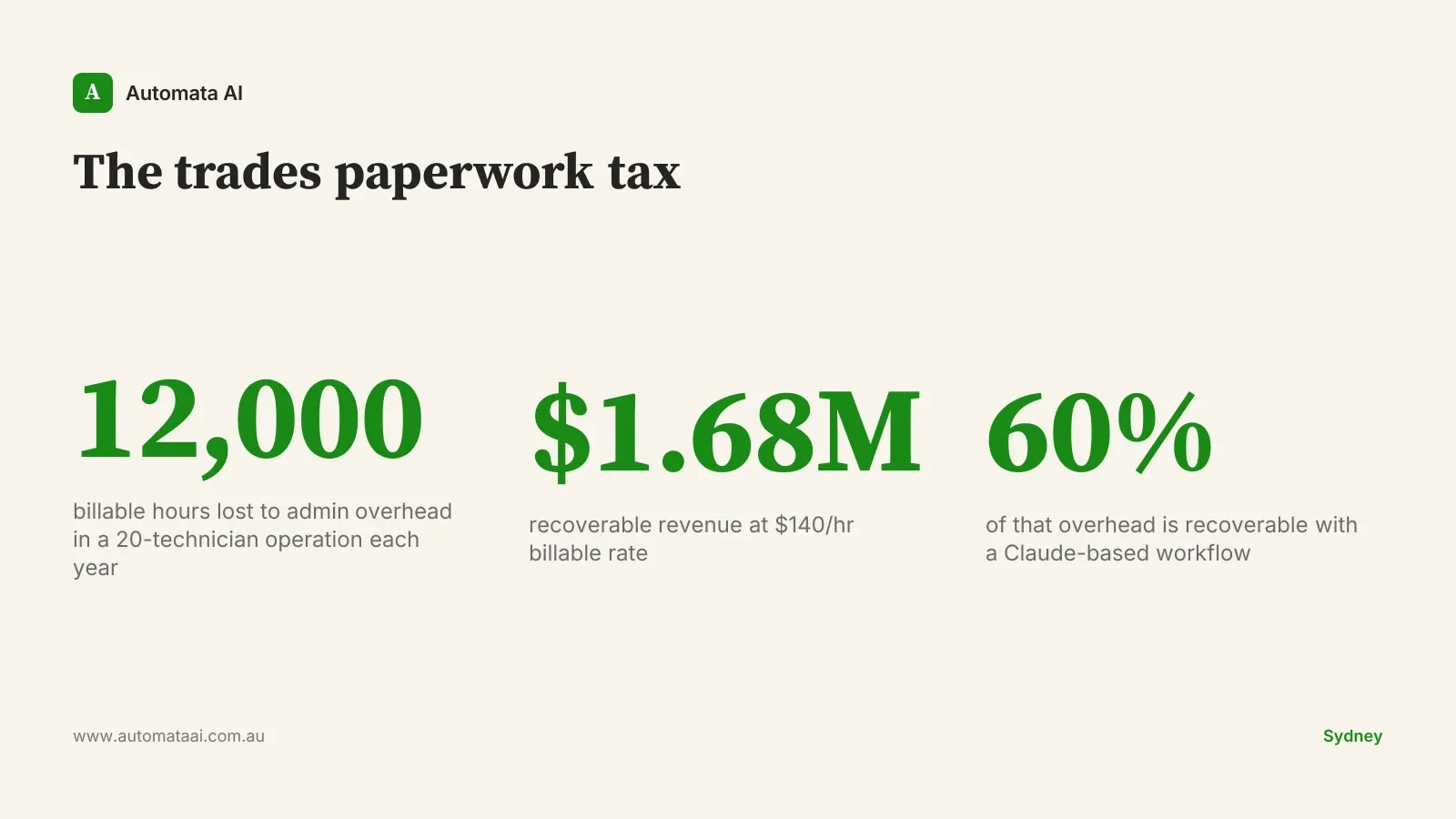
A 20-technician electrical contractor in Sydney loses roughly 12,000 billable hours a year to admin overhead. Job sheets, quote drafts, compliance certificates, invoices. Each document takes 15 to 40 minutes on average, and for most technicians that work happens after hours because there is no gap in the schedule during the day. At an average billable rate of $140 an hour, that is $1.68 million a year in recoverable revenue spread across paperwork queues and personal time.
Most of that time is spent recreating information the technician already captured on site. The materials used, the work completed, the hours logged. The gap isn't knowledge. It's transcription. That's the right problem to give Claude.
Use our ROI Calculator to model the specific numbers for your team size and billing rate. The payback math for field service automation typically lands inside six months.
Where Claude fits in a trades workflow
Four tasks absorb most of the administrative overhead, and each maps cleanly to what Claude does well: job sheet drafting, quote generation, invoice production, and compliance certificate prep. These are not novel or complex document types. They are structured, repetitive, and full of information the technician already captured on site in some form.
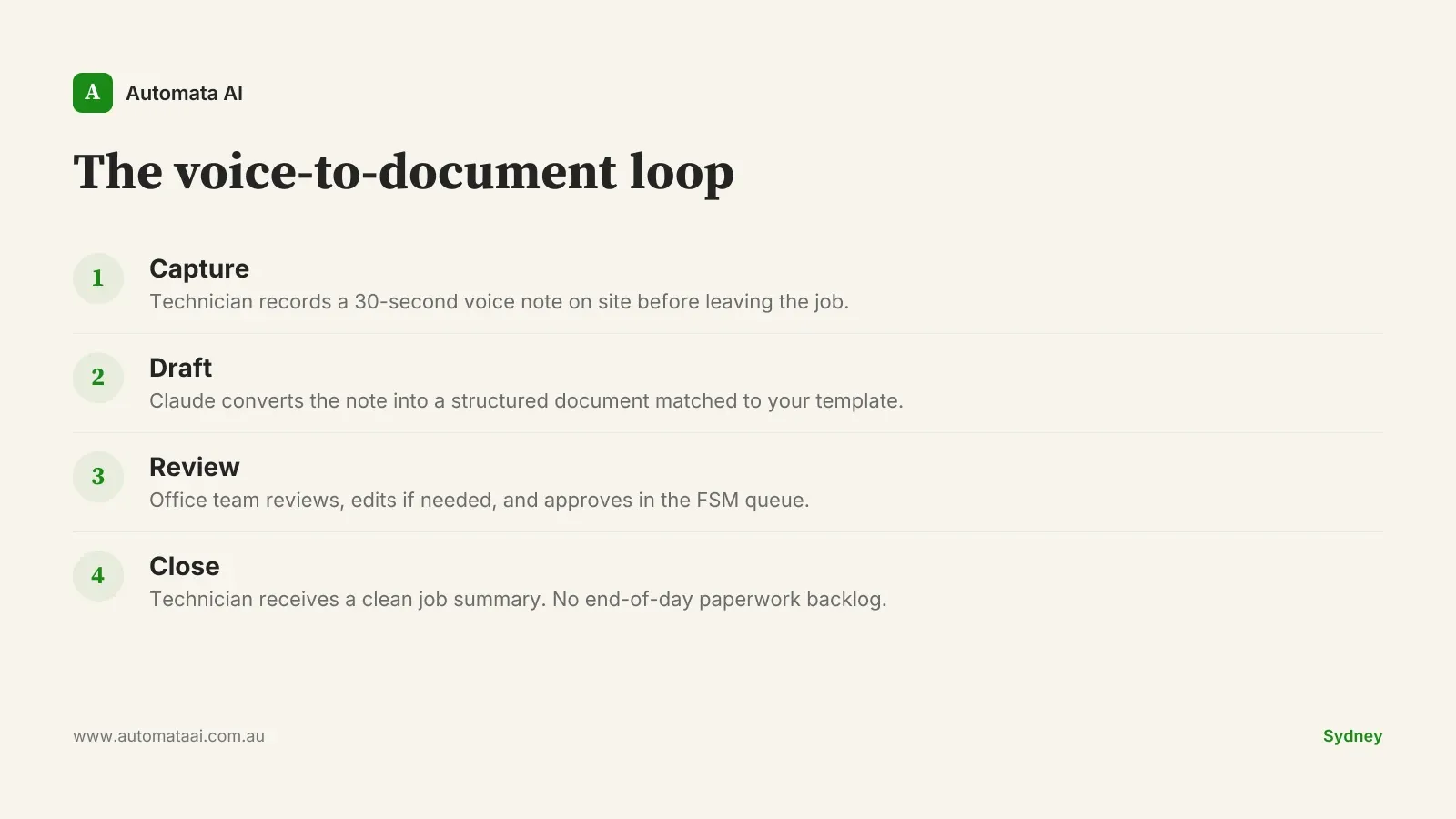
Job sheet drafting. The technician records a 30-second voice note on site. Claude converts it into a structured job sheet matched to the company's template, with materials listed, work described, and time recorded. The office reviews before it enters the system of record.
Quote generation. Claude cross-references the technician's notes against the parts catalogue and labour rates, produces a draft quote, and flags items that need office sign-off before send.
Invoice production. When the job is marked complete, Claude pulls the line items directly from the approved job sheet. No re-entry, no approximation from memory.
Compliance certificate prep. For licensed electrical and plumbing work, Claude pre-populates the certificate from the job sheet data. The certifying technician reviews the field values and signs. The attestation stays human; the transcription doesn't.
The voice-to-document loop
The workflow runs against the existing field service management system. ServiceM8, Simpro, Fergus, or equivalent. Voice notes upload from the technician's phone automatically as they leave a job site. Claude drafts the structured document, applies the company's formatting rules, and routes the result to the office review queue. Most reviews take under two minutes per document. The technician receives a clean job summary at end of day rather than a backlog of partially-completed forms they need to reconstruct from memory.
Most trades businesses don't have a labour shortage. They have a documentation overhead that makes it feel like one.
Every document in the workflow carries a reference back to the source data. The original voice note, the draft, the human edits, and the final approved version. If a compliance question comes up six months later, the audit trail is complete and traceable.
When not to build this
This pattern works well for operations above roughly ten technicians, where the volume of documentation justifies the build cost. Below that threshold, the ROI is present but the implementation overhead takes a disproportionate share of the first year's benefit. The build for a workflow of this scope typically runs $60,000 to $120,000.
Very low job volume. A sole trader doing 20 jobs a month won't recover enough hours to justify the setup. Manual tools or off-the-shelf field service software are a better fit.
Highly variable job types. If every job is genuinely unique, the voice-note templates will need constant adjustment. This pattern suits businesses with repeatable job categories: maintenance, inspections, standard installations.
Compliance sign-off inseparable from drafting. Some certificate types under Australian electrical licensing require the certifier to personally complete the document as part of the attesting act. Claude can pre-populate supporting data; the regulatory boundary determines where its role ends.
The rollout discipline
The technology is the easier half. Trades businesses that pilot over six to eight weeks with one team, measure draft quality and reviewer time, and promote based on those numbers hit adoption above 70 percent within six months. Businesses that roll out across the whole operation at once report adoption closer to 25 percent. The training debt and the change management debt land simultaneously, and neither gets dealt with properly.
A Sydney plumbing business that shipped this pattern reported technicians spending 38 percent less time on paperwork after three months. The recovered time went into additional billable jobs. That ratio holds consistently: the hours don't disappear into extended breaks, they go back onto the schedule.
There is also a staff retention benefit that rarely makes it into the initial business case. When documentation overhead is no longer the dominant part of the working day, the role feels different. Trades businesses using this pattern consistently report lower turnover in the first year post-deployment. For a 20-person team, that benefit is worth roughly $90,000 annually once recruitment and onboarding costs are included.
The AI automation services Automata AI builds for trades businesses start with a discovery engagement at $10,000 to $20,000. That two-week sprint maps the specific workflow, identifies the compliance constraints, and models the return before a dollar goes into the build.
Pick the highest-volume document your technicians produce every week. Estimate the time it takes per job, multiply by job count, and convert at your billing rate. For most operations above ten technicians, that figure is large enough to start the conversation. An AI Readiness Assessment gives you a clear view of where the boundary sits before you commit to a build.