Three days before close, the variance column has 80 rows. The AASB 16 lease note needs to be drafted. Two intercompany accounts haven't reconciled, and the AP controller is still chasing three suppliers. The numbers will be right by deadline. The commentary, disclosures, and emails usually won't be.
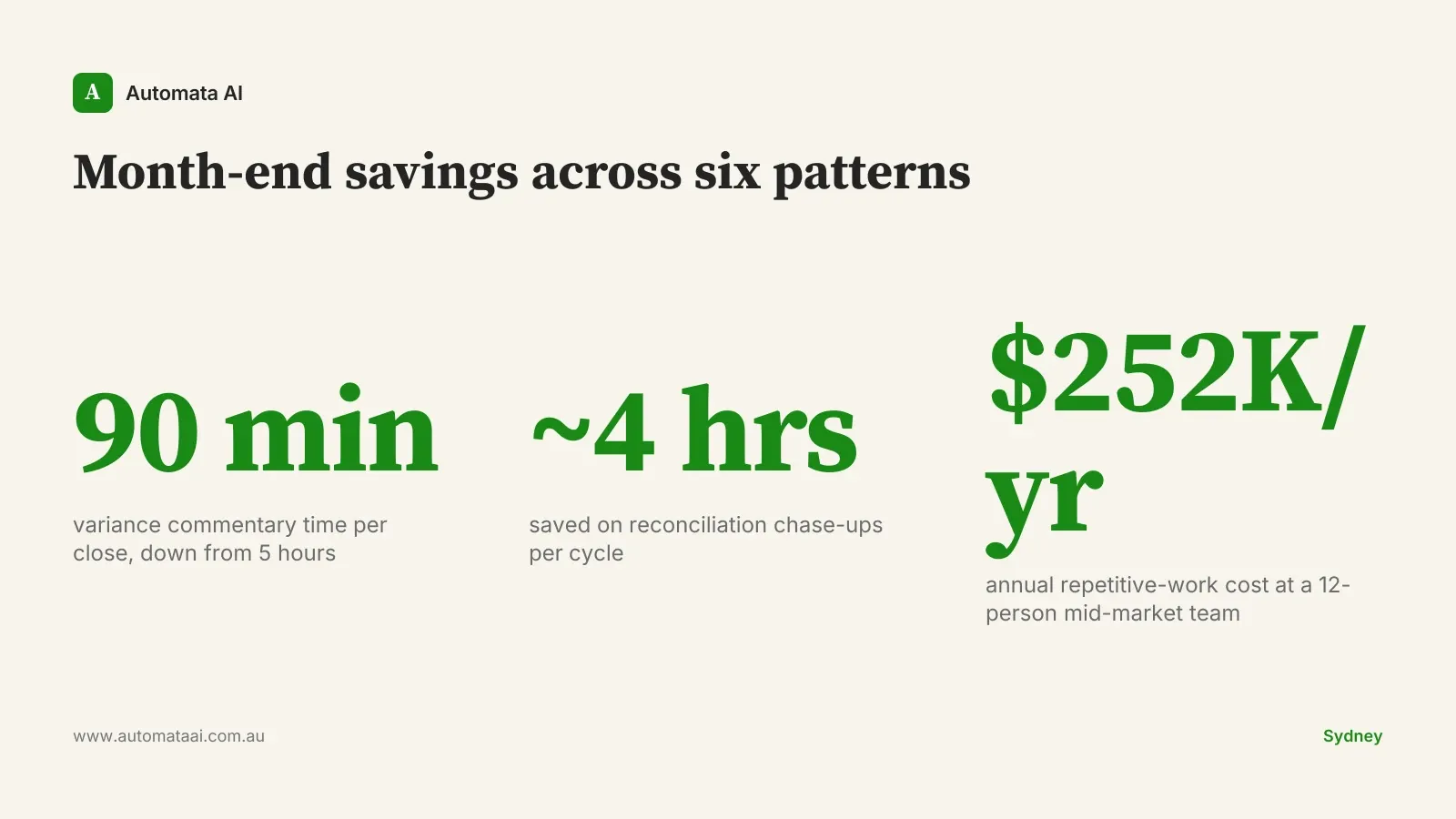
For a 12-person finance team at an Australian mid-market company, month-end close costs $28,000–$35,000 in fully-loaded labour each cycle. Roughly 60 percent of that is repetitive: variance commentary, AASB footnotes, reconciliation chase emails. At $17,000–$21,000 per month, that's up to $252,000 per year in work that doesn't require a senior accountant's judgment — it requires a senior accountant's time.
Claude in Excel sits inside the workbook. It reads the formulas, the variance columns, the reconciliation schedules. The data doesn't leave the file. The analyst reviews each draft, adjusts where needed, and signs off. The team doesn't need a new system — they need their existing system to stop requiring so much manual writing.
The six-pattern month-end framework
Below are the six patterns covering the highest-volume manual work in a typical Australian mid-market close. Not every team will use all six. Start with the pattern that costs the most hours, then add others once the first is stable.
1. Variance commentary
A finance analyst reviews monthly variance against budget across 80 GL accounts. Claude scans the variance column, identifies every account breaching the materiality threshold, and drafts a commentary line per breach. Three inputs make this work: the variance threshold by account class (operating, capital, intercompany), the team's standard commentary format (cause, impact, action, owner), and a short lookup of recurring causes the team has already classified. Each draft includes the account name, the variance amount, the cause category, and a suggested action line.
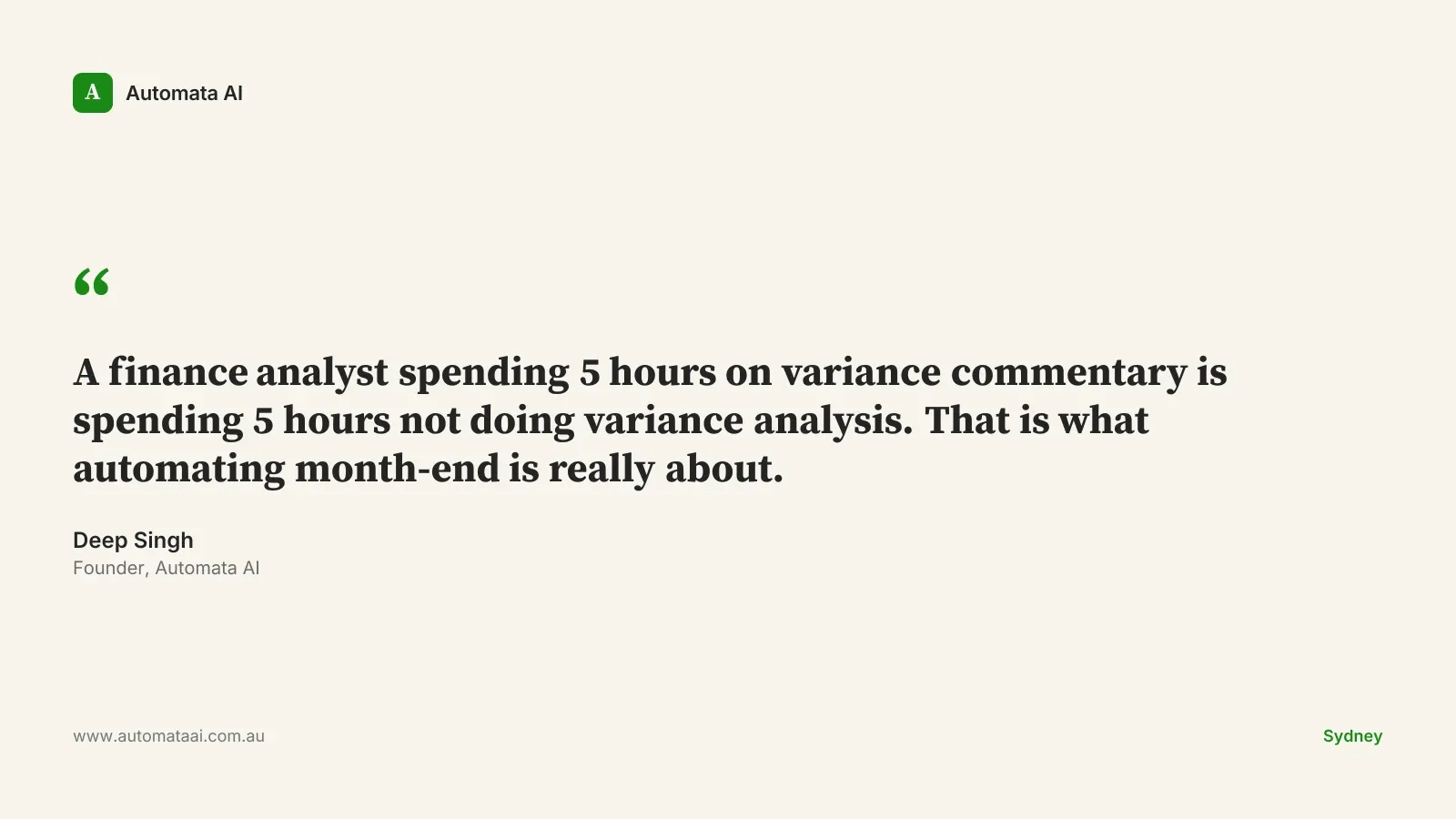
Time on variance commentary typically drops from 5 hours to around 90 minutes per cycle. The analyst reads, adjusts, and approves. Writing from scratch is no longer part of the job.
2. AASB note drafting
Half-year and annual AASB notes follow a stable structure from one period to the next. Claude reads the supporting working paper, applies the note template the team uses, and produces a draft paragraph. The most common uses are AASB 16 lease note disclosures, AASB 9 expected credit loss commentary, related-party transaction descriptions, and critical accounting estimate language. This pattern is most valuable for listed entities and financial services companies with formal disclosure requirements. For the broader context on AI in that sector, see our AI for Australian financial services guide.
The senior accountant still owns the technical sign-off. Claude does the typing. For a team running four AASB notes per reporting period, that's typically 3 hours returned to review and judgment.
3. Reconciliation chase-ups
Intercompany and bank reconciliations carry a long tail of small open items, typically 15 to 40 per close in a mid-market entity. Claude reads the reconciliation worksheet, groups open items by counterparty and likely cause, and drafts a chase email per group. The AP or AR controller reviews and sends. On a typical Australian mid-market close, this recovers around 4 hours of admin time per cycle.
4. Accrual logic checks
Claude reads the accrual schedule, compares it against the expense subledger, and flags any line that either has no supporting expense in the next period or shows an expense without a corresponding accrual reversal. The output is a flagged list for the accountant to review, not a set of auto-corrections.
One miscoded accrual found before close costs nothing to fix. One found by the auditor costs the firm real money and the finance team's credibility. This is where the most defensive value in the framework sits.
5. Board pack narrative
The difficulty with board pack narrative isn't understanding the numbers. The finance team already knows those. It's the translation layer: taking a movement in operating expenses and turning it into a sentence the audit committee chair can absorb in a two-hour board meeting. Claude reads the financial statements, the prior month's commentary, and any notes the CFO has flagged, then produces a first draft. A task that typically takes two hours completes in around 40 minutes.
6. Prepayment and provision schedule reviews
Prepayment schedules accumulate stale items quietly. A vendor paid six months ago, fully amortised, can still appear in the schedule without triggering any formula alert. Claude reads the schedule, flags items that have run past their amortisation end date or carry no supporting invoice reference, and produces a triage list. This pattern is underused. Most teams run a prepayment review once at year-end because that's when the auditor asks. Running it monthly keeps the schedule clean and means no last-minute scramble when the auditor requests support for a line item that cleared four months ago.
When not to run these patterns
Not every Australian finance team should deploy this immediately. Three situations where the payback math doesn't hold:
Team is fewer than five people. Below that headcount, the same analyst doing the repetitive work is also the one who would configure and maintain these patterns. The setup cost isn't recovered in year one.
Close is already running in four days or fewer. If the commentary burden is already light, run the payback numbers in our ROI Calculator before committing.
Data classification hasn't been reviewed. If your organisation handles data under the Australian Privacy Principles or operates under APRA CPS 230, confirm what data Claude in Excel accesses before rollout. The in-workbook design limits exposure, but it is not a substitute for a proper data handling review.
Operating discipline
Three rules keep this clean in an Australian finance context:
Claude drafts; the analyst approves. Never reversed. The system reduces typing time; it does not make accounting decisions.
Source data stays in the workbook. No exports of client-coded or sensitive financial data to external services.
A change log records each Claude-assisted action. The audit file should show what was AI-drafted and who signed off. Australian auditors are beginning to ask for this.
Finance teams that get this right don't just close faster. Their analysts have headspace for the work that requires actual judgment: variance analysis instead of variance commentary, risk flagging instead of chase emails. Pick one pattern, quantify what it costs your team per month, and run the numbers through our AI Readiness Assessment to build a defensible business case. For teams running patterns one through three, a 90-day payback is typical.