Sunday night. A senior agent at a Sydney boutique has six listings to write before the Monday morning meeting. She knows the properties, she has the specs, she knows the suburb. The copy takes three hours.
At a fully loaded cost of around $120 per hour for a senior agent, that writing work — six listings per week across fifty trading weeks — comes to roughly $108,000 per agent per year, spent almost entirely on tasks that follow a repeatable template. Add the shared admin salary of $65,000 per agent and the total marketing-and-admin bill lands near $245,000 per agent per year. A 30 percent reduction on the writing portion returns over $35,000.
Three specific workflows sit inside that cost: listing copy generation, REI compliance letters, and agent-to-vendor reports. Each is repetitive, time-bound, and tied to compliance risk if done inconsistently. For agencies mapping where AI fits in the sector overall, our Australian real estate industry guide covers the broader landscape. Here, the focus is on three Skills that are ready to build.
Listing copy: from 45 minutes to 8 minutes per property
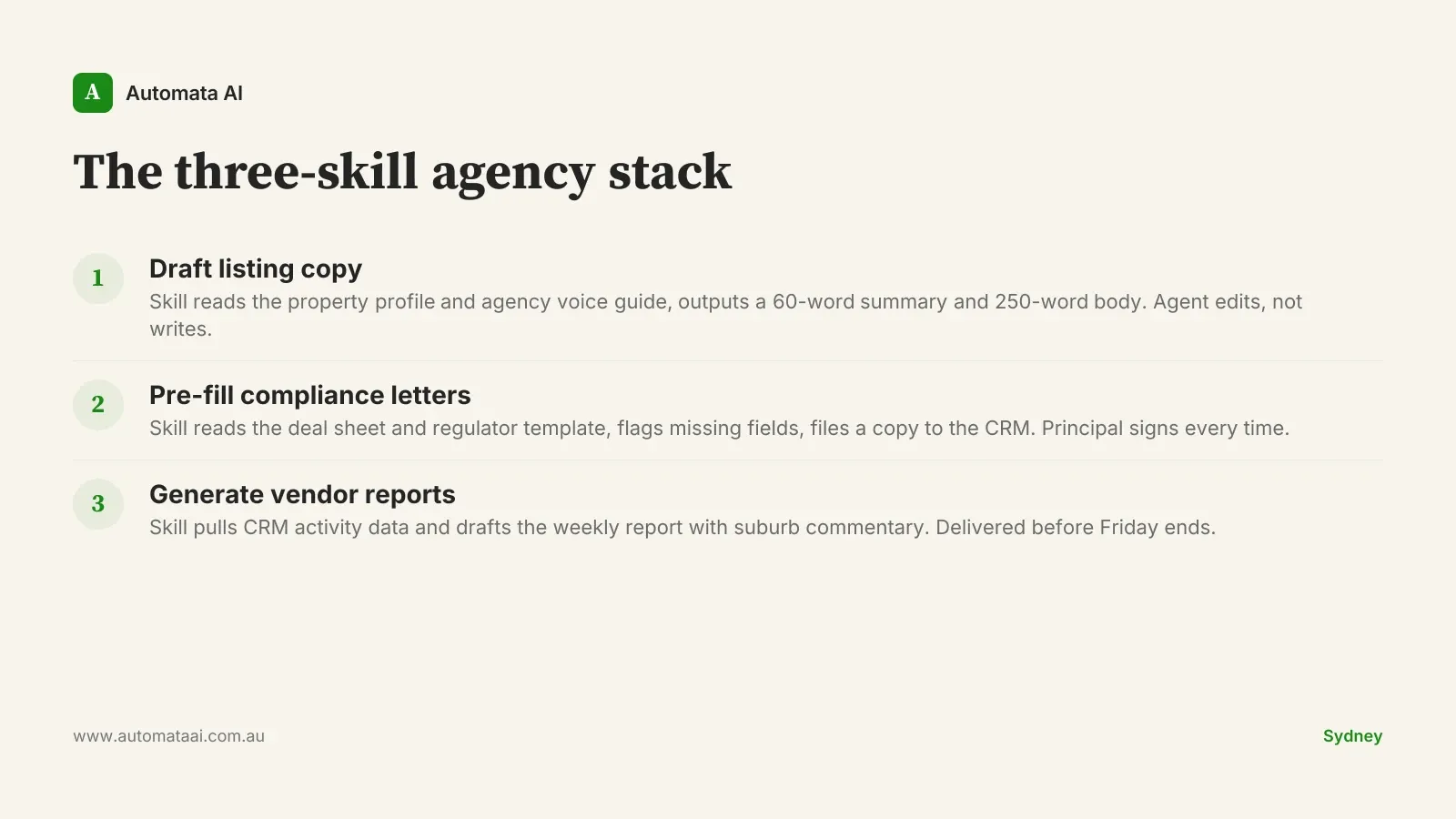
A Skill configured for listing copy reads a property profile (bedrooms, bathrooms, parking, suburb, orientation, standout features) and drafts a 60-word headline summary and a 250-word descriptive body in the agency's house voice. It draws from a voice guide the principal sets, a curated database of each suburb's selling points, and the standard disclaimers required by REINSW or REIV.
Agency voice guide. Three to five approved listings and the agency's preferred phrasing patterns, set by the principal.
Suburb selling points database. A curated set of features, landmarks, and market context the principal controls and updates.
Compliance footer. The standard REINSW or REIV disclaimers, locked and uneditable by the individual agent.
The agent's job becomes review and refinement, not drafting from blank. Time per listing drops from 45 minutes to around 8 minutes of editing. For agencies wanting to model that saving across a full team, the ROI Calculator runs AUD figures across volume, hourly rate, and current time-per-task in under three minutes.
Compliance letters: correct format, every time
Australian real estate agencies generate dozens of regulated letters per week. Agency agreement renewals. Vendor disclosure statements. Conjunction agreements. Each has a REINSW or REIV template that is largely stable. The variables are the facts specific to each deal.
A Skill configured for compliance letters reads the property record, the deal sheet, and the relevant regulator template. It produces a pre-filled draft, flags any field that requires the agent's personal knowledge or legal judgment, and files a copy automatically to the property record in the CRM.
Pre-filled letter. Correct REINSW or REIV format with deal-specific fields populated from the property record.
Missing-field flag. Any blank requiring agent judgment is surfaced before the letter goes to the principal for signing.
Automatic CRM filing. The draft copies to the property record without a separate manual step.
The principal signs every letter. The Skill removes the typing.
Vendor reports: consistent communication instead of rushed copy
Most agencies do vendor reports badly. The reason is simple: it is Friday afternoon, the agent has inspections on Saturday morning, and writing a considered weekly update for twelve active vendors is three hours they do not have. The result is a templated three-liner that tells the vendor nothing, or a missed send entirely.
A Skill configured for vendor reports pulls activity data from the CRM: enquiries logged, inspections held, offers received, days on market. It drafts the weekly report in the agency's standard template and appends a short market commentary paragraph calibrated to the suburb, drawn from the same database the listing Skill uses.
The vendor receives a well-written report every week. The agent approves and sends in three minutes. The principal can confirm, from the CRM audit trail, that every vendor in the network is being communicated with, every week, in the correct format.
When this stack is the wrong move
Not every agency should build this out. There are three conditions where the setup cost outweighs the return.
Your CRM has no structured data. If activity is recorded in free-text notes or spreadsheets outside the system, the vendor report Skill cannot pull anything meaningful. Fix the data model first.
Your network has fewer than six active agents. The setup cost for a configured Claude Skill (voice guide, suburb database, template integration) runs between $10,000 and $20,000. Under six agents, the per-agent payback period stretches past two years. An AI Readiness Assessment will tell you quickly whether you are at that threshold.
Your agency voice guide does not exist. A Skill is only as good as the examples it is trained on. If the principal cannot point to three to five approved listings that represent the house style, the Skill will produce generic output. Define the voice before automating it.
The ROI calculation is not automatic. It depends on volume, on how well the CRM is maintained, and on whether the principal has the appetite to define standards before deploying them. If those things are in place, the case builds itself. If they are not, the Skill surfaces the underlying operational gap without fixing it.
The control point that makes network-wide rollout safe
The reason this works across a 30-agent network is not the AI. It is the permission structure. The principal configures each Skill and locks the templates. An agent can edit the listing copy the Skill drafts. An agent cannot edit the compliance disclaimer or the REINSW format it draws from. That distinction is what separates a helpful writing tool from a liability at scale.
Each of the three Skills runs on the same logic: the AI drafts, the agent refines, the principal controls the guardrails. The full range of service tiers for a Skills rollout across real estate and other sectors is outlined on the AI Automation Services page.
The agencies that produce the most consistent, best-presented copy over the next three years will not be the ones with the most talented writers on the team. They will be the ones that stopped treating writing as a manual task. The senior agent who spent Sunday night on listing copy does not have to.