The CFO of a mid-tier Australian iron ore producer can tell you the ore grade in every active pit to four decimal places. Ask the same CFO how many senior hours went into last quarter's sustainability report, and you will get a silence. Then a guess. Then a promise to check with someone.
That gap is where the business case for Claude in mining back-office lives.
The five workstreams where hours disappear
The Five-Workstream Audit is a mapping exercise we run with mid-tier producers before any commercial conversation. It produces a defensible count of senior staff time locked in structured writing, broken into five categories that appear consistently across Australian mining operations above $500M revenue. The numbers below come from aggregated engagement data across iron ore and gold producers in Western Australia and Queensland.
ESG and sustainability reporting. Around 1,400 senior analyst hours per year for a mid-tier producer. ASX-listed companies are now producing 80-page-plus sustainability reports, mostly assembled by hand from disparate internal data sources.
Geological and resource reporting. Around 4,800 geologist hours per year across monthly cycles. The JORC Code requires rigorous disclosure; the underlying writing is done almost entirely manually.
Equipment maintenance documentation. Around 6,000 reliability engineer hours per year across a fleet of 40 to 80 heavy vehicles and fixed plant. Every fault, every repair, every root cause analysis needs a written record.
Procurement and supplier compliance. Around 3,200 procurement hours per year covering supplier audits, contract variations, and regulatory compliance documentation.
HSE incident report drafting. Around 1,800 safety officer hours per year. Every recordable incident generates a report. Every near-miss triggers a review.
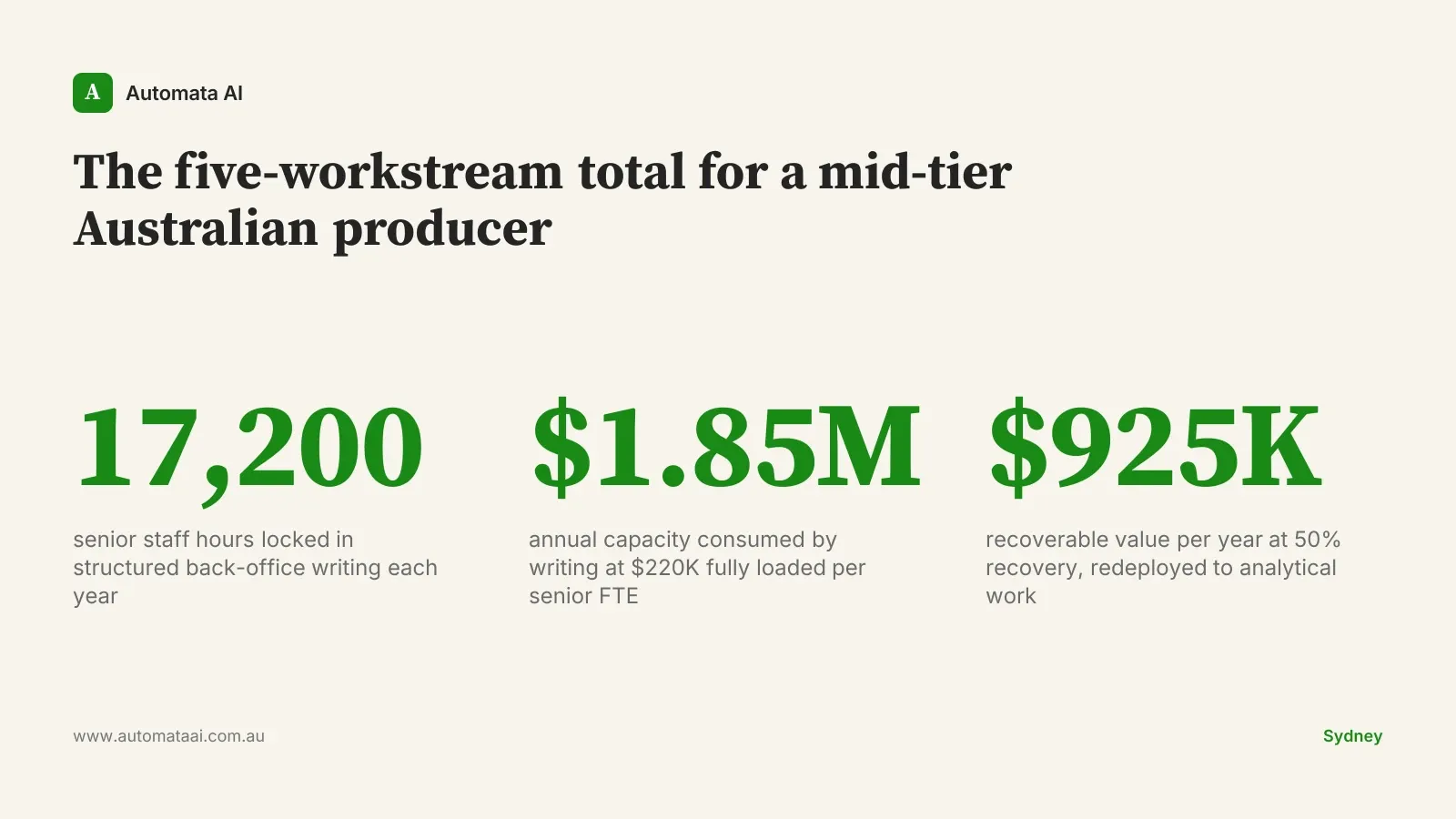
For a typical mid-tier iron ore producer, the five-workstream total is around 17,200 hours of recoverable senior staff time per year. At fully loaded rates of approximately $220,000 per senior FTE, that is $1.85 million of annual capacity consumed by writing.
What a 50 percent recovery actually means
Production pilots across these workstreams consistently show a 40 to 60 percent reduction in writing time when Claude is properly integrated into the reporting workflow, not dropped in as a chatbot alongside existing processes. At 50 percent, that is 8,600 hours returned to the business. Most of that goes into the work the organisation hired these people to do in the first place.
The recovered value is around $925,000 a year. That number is recoverable capacity, not a cash saving. The difference matters to how you present it. No one is being made redundant. The ESG analyst who spent 60 percent of her time formatting and drafting now spends 60 percent of her time on materiality assessment and stakeholder engagement. The safety officer who wrote incident reports for 20 hours a week now has time for the hazard identification reviews he has been deferring for two years.
The hours are not interchangeable across disciplines. Geologist time goes back into geological interpretation, not procurement. When you model the value, model it against the specific work each group has been deferring, not against a generic productivity multiplier.
The build cost and the break-even
A multi-domain Claude rollout across all five workstreams (custom prompts, workflow integration, validation steps, and training) is covered under our AI Automation Services and costs around $850,000 in year one. Steady-state costs from year two are approximately $260,000 per year, covering model usage, maintenance, and ongoing configuration work.
The break-even point is around 11 months at 50 percent recovery. The four-year NPV, discounted at 12 percent — consistent with how Australian mining project evaluations are typically run — is approximately $2.1 million. Model your own numbers in the ROI Calculator before presenting to the board. It takes three minutes and produces AUD output you can table directly.
When this case doesn't hold
Not every operation should be building this now, and the three conditions below are not edge cases. Two of them apply to the majority of Australian mining operations we speak with in the first commercial conversation.
Below-threshold operations. If the five-workstream total across your operation is under 8,000 hours, the year-one ROI is thin. A single-workstream pilot is the better starting point.
Shifting reporting requirements. If your ESG framework is in transition (and for many ASX producers it is, as the Australian Sustainability Reporting Standards bed in), automate after the new requirements stabilise, not before.
No baseline data. The business case depends on knowing your current state. If you cannot produce a defensible hour count for any of the five workstreams, the audit step must come before any commercial conversation.
The third point is the one most organisations underestimate. A business case built on estimated hours sourced from a vendor will be rejected by the operations leadership team, regardless of how well the financial model is constructed. Australian mining is conservative for good reason. The audit discipline is not optional.
How to defend the case to a sceptical board
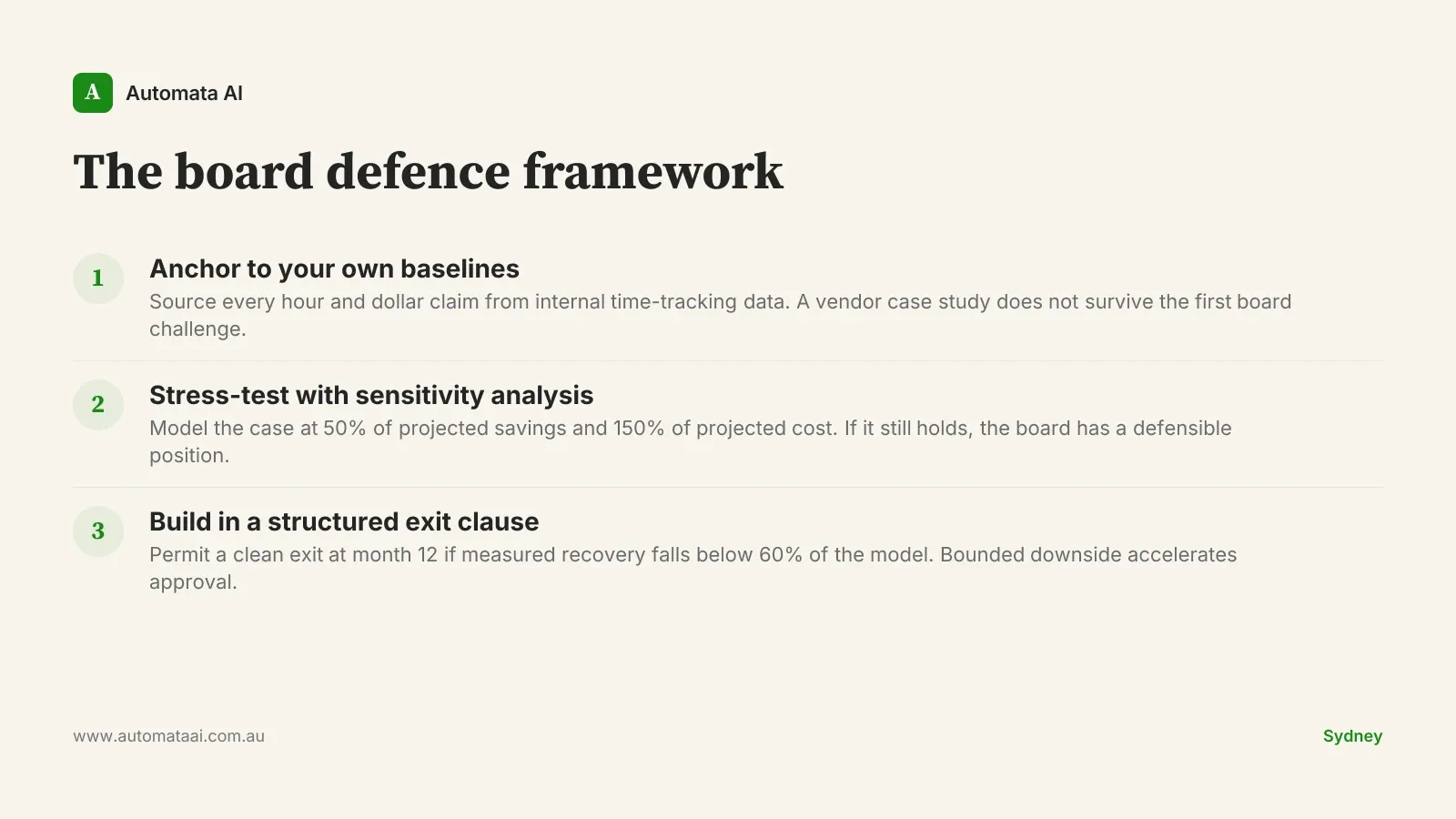
Boards in the Australian resources sector have seen AI vendor presentations since 2017. Every one of those decks promised productivity gains, usually anchored to a US case study with numbers that do not translate to the Australian mid-market. Most of the projects they funded delivered ambiguous results or were quietly closed before the next annual review. The frame you need is not productivity. It is recoverable capacity with measurable baselines anchored to your own operation.
Anchor every number in the business case to a baseline from your own operations. A claim that 'we recovered 11,000 hours in year one' sourced from internal time-tracking data survives board scrutiny. The same figure sourced from a case study at a different company does not. Before you present, use the AI Readiness Assessment to validate your baseline methodology. It is the step most organisations skip and the step that most often determines whether the board approval lands.
Sensitivity analysis is the second discipline. Present the case at 50 percent of assumed savings and 150 percent of assumed cost. If the board sees the case holds at that haircut, the conversation changes character. The third discipline is a structured exit clause: if measured recovery falls below 60 percent of the model at month 12, the contract permits a clean exit. That clause is rarely invoked. It is almost always the reason the approval comes through.
Pick one workstream. Run the Five-Workstream Audit on that single category first. If the hours stack up and the break-even is under 18 months, the case for the full rollout builds from there.