The presentation went well. The pilot results were solid. The CFO said "interesting" and asked for a business case.
"Interesting" isn't a no. It's a request for numbers the board can defend. The difference between a retailer that ships Claude across the business and one that shelves it in a presentation is usually one document: a cross-functional build-up that survives a sceptical audit.
The four workstreams that produce a defensible number
For a national Australian retailer with around $1.2 billion in revenue, the recoverable value sits across four domains.
Buying and supplier negotiation. A team of 60 buyers spends around 14,000 hours a year on tasks Claude can handle: supplier brief preparation, range review analysis, promotional modelling, and contract clause comparison. At a fully loaded rate of $120/hr for senior buyers, that is $1.68 million in recoverable labour value annually.
Demand forecasting decision support. Claude compresses the time between a forecast output and a buyer decision. A 6 percent reduction in stock-on-hand without service-level loss is realistic on a $200 million inventory base. That frees approximately $12 million from the balance sheet, with carrying cost savings of around $900,000 a year.
Customer service first-touch automation. On order status, returns, product availability, and loyalty enquiries, 60 percent first-touch automation is achievable within eight weeks. For a retailer with 200 customer service FTEs, that is around $1.8 million in recoverable cost once the model stabilises.
Operations and district reporting. Around 3,200 hours of district manager time per year goes to reporting and administrative analysis. At $120/hr fully loaded, that is approximately $384,000. Not the headline, but it compounds.
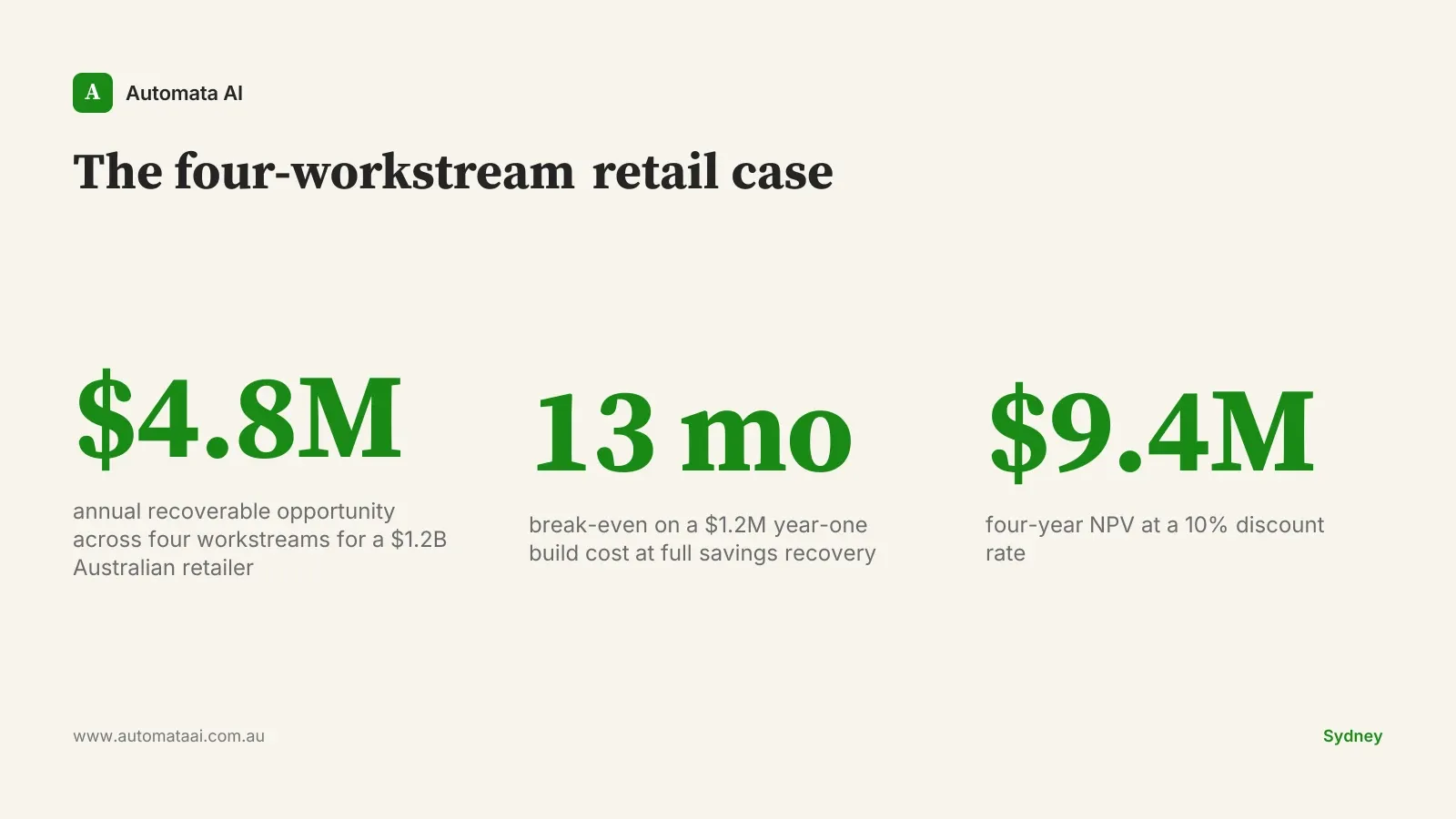
The combined recoverable opportunity across these four workstreams is around $4.8 million a year. That number is built from fully loaded hourly rates, conservative recovery assumptions, and a realistic deployment scope — not from vendor slides.
What it costs and what the board will see
A multi-domain Claude rollout across these four workstreams costs approximately $1.2 million in year one: implementation, integration, change management, and enterprise licensing. Steady-state running sits at around $360,000 a year.
At those numbers, break-even is around 13 months. The four-year NPV at a 10 percent discount rate is approximately $9.4 million. Run the full model yourself in our ROI Calculator. The inputs are in AUD, the assumptions are visible, and it takes three minutes.
The board will ask three things. Answer them before the presentation.
"Is this just buying productivity we already paid for?" No. These hours are not recovered by doing less. They are redirected to higher-value work the team currently cannot reach. The cost-allocation methodology separates productivity displacement from productivity creation.
"What about brand voice in customer service?" Claude's output runs through a brand voice configuration built from your tone guidelines. Human supervisors handle escalations above the model's confidence threshold. The escalation path is defined before go-live, not after the first complaint.
"What if the trading environment turns?" This is the right question, and it is an argument for the rollout, not against it. When margins compress, cost-to-serve matters more, not less. A retailer that has already cut its cost-to-serve by $4.8 million a year can compete on price or protect margin. One still running manual processes cannot.
The rollout sequence that produces the full case
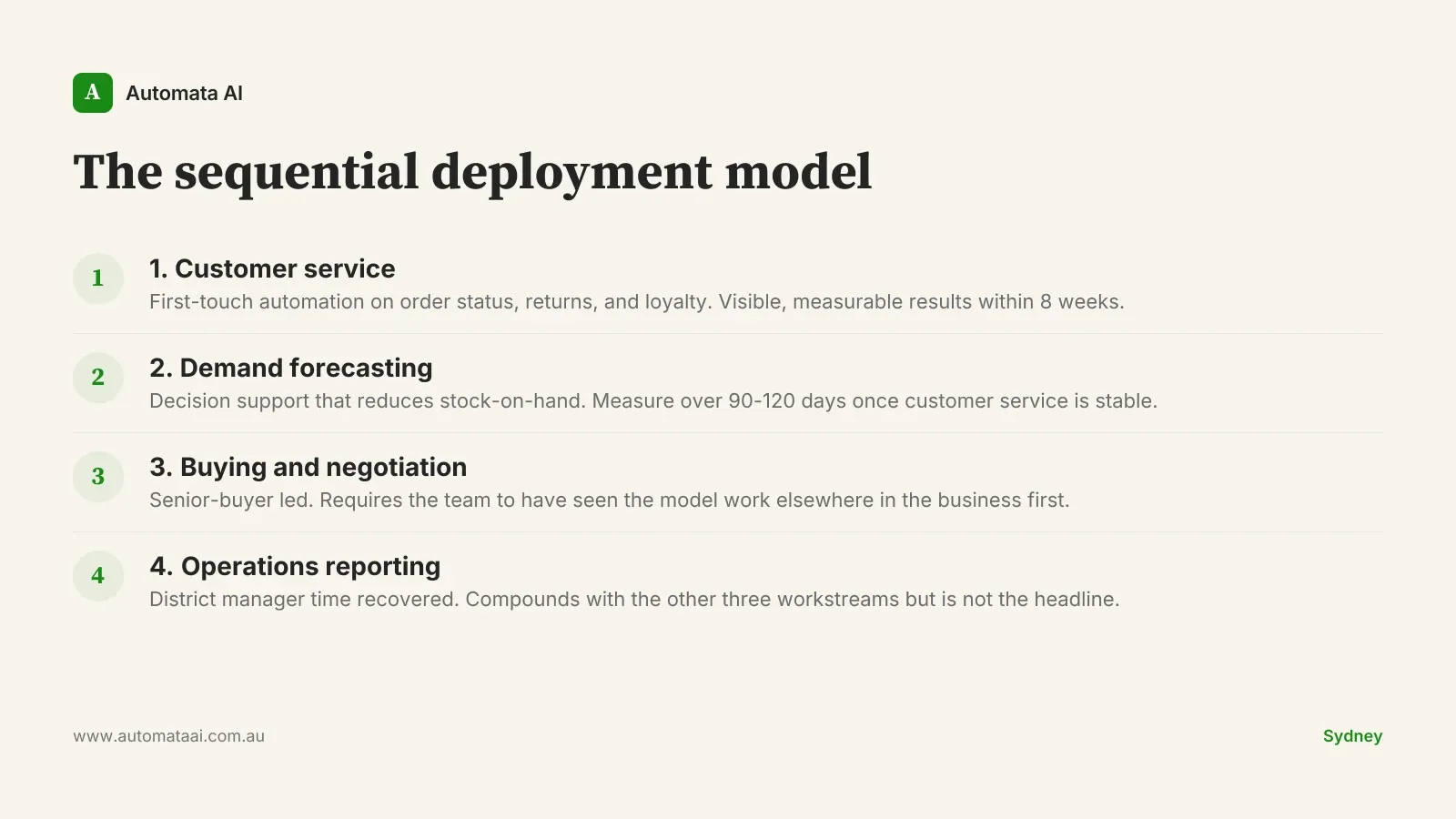
Retailers that try to run all four workstreams simultaneously see middling results across all four. The sequential deployment model runs in four stages, each building trust and infrastructure for the next. It takes 12 to 18 months. The order is not arbitrary.
Customer service goes first. The impact is visible within eight weeks, fast enough to produce a number before the next budget cycle. Sceptics become supporters once the first-touch automation rate is on a dashboard.
Demand forecasting decision support goes second. Some of the data infrastructure from the customer service integration carries over. The measurement cycle is longer: 90 to 120 days before the inventory impact is credible. But you have political capital from the customer service results by then.
Buying and supplier negotiation goes third. This is senior-buyer led, and the buying team needs to have seen the model work somewhere else in the business before they will trust it. Rushing this workstream kills it.
Operations and district reporting goes last. It delivers genuine value, but it is not the headline, and it does not need to be. The first three workstreams carry the case.
When this case doesn't hold
Not every Australian retailer is positioned for a four-workstream Claude rollout. The business case requires a threshold of volume and operational scale to be defensible.
If your revenue is under $200 million, the buying-team workstream will not generate enough hours to justify implementation at this scope. A narrower deployment produces a faster payback with lower execution risk. Our AI Automation Services start at $60,000-$120,000 for a focused four-to-eight-week engagement, which is the right entry point for mid-market retailers below $200M.
The $4.8 million opportunity assumes a $1.2 billion retailer with 60 buyers and 200 customer service FTEs. If those numbers are half that size, the recoverable opportunity is roughly half the size. The ratios hold. The absolute figures do not.
Anchoring the numbers so they survive a board audit
Australian boards that have watched vendor slides for a decade discount productivity claims by default. The way to land this case is to anchor every number to a measured baseline from the retailer's own operations.
A claim that recovered 12,000 buyer hours sourced from internal time logs survives an audit. The same claim sourced from a vendor brochure does not. Before presenting, pull 90 days of time-allocation data from your buying team. Have district managers log their reporting hours for four weeks. Run a customer service ticket analysis. These baselines take two weeks to build and make the rest of the case unanswerable.
Run the model at 50 percent of assumed savings and 150 percent of assumed cost. If the case holds at that haircut — and at these numbers, it does — the board has a position they can defend publicly. If it does not, the case is not ready.
Build a 12-month checkpoint into the contract with a clean exit if recovered value falls below 60 percent of the model. Australian boards respond well to bounded downside in writing. That clause is rarely invoked. But a board that knows the exit exists approves faster than one that suspects an open commitment.
Not sure where your operation sits against these benchmarks? Start with the AI Readiness Assessment. It maps your processes against the four workstreams and identifies your highest-value entry point.
Pick the workstream where your volume is highest. Build the baseline from your own time data. Run the sensitivity check at 50 percent of assumed savings. If the case holds at that haircut, it is ready to go to the board.