A Sydney support team handling 800 tickets a week burns roughly 20 hours in triage before any agent types a single reply.
That's not a service quality issue. That's a capacity maths problem.
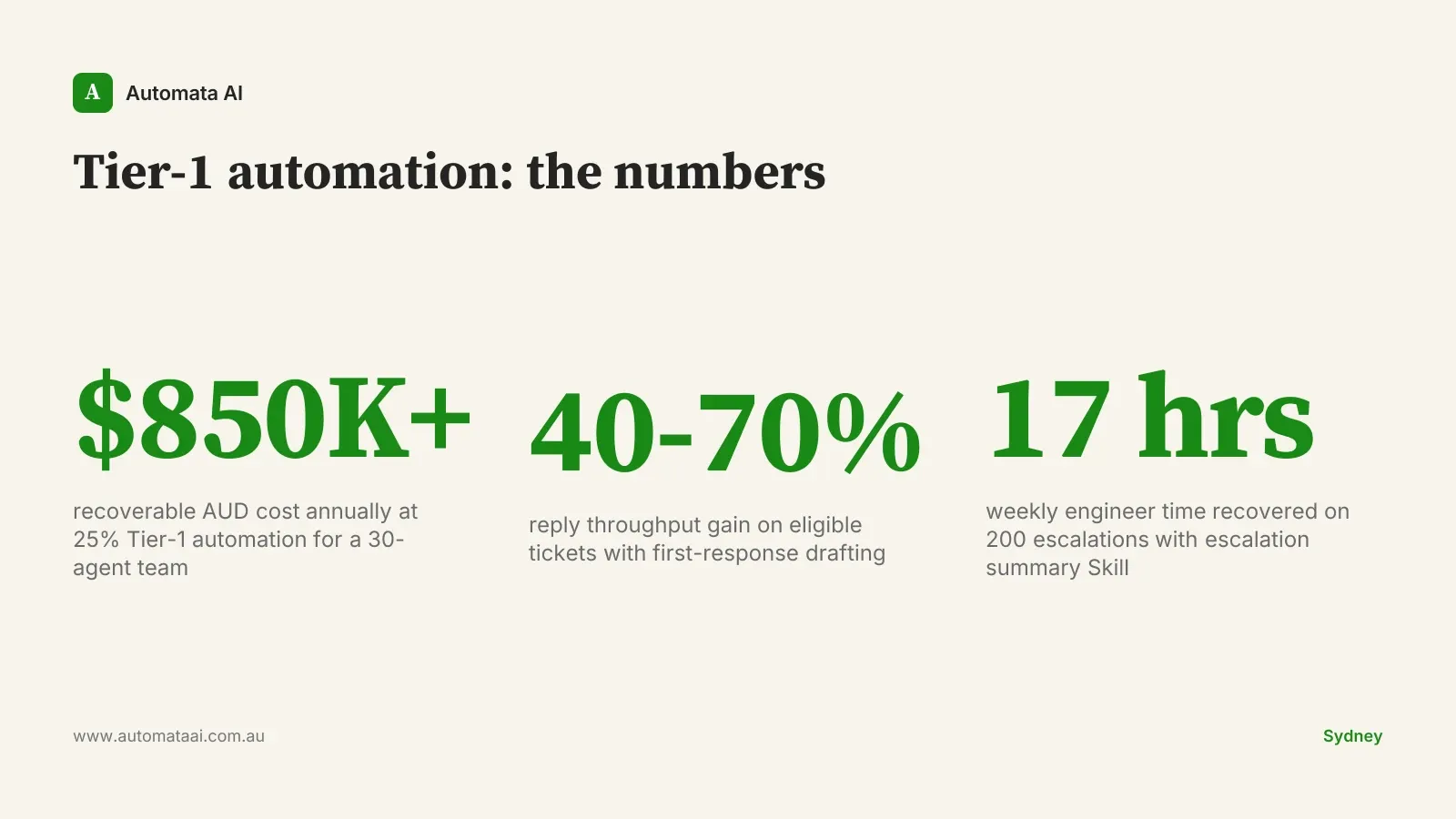
Tier-1 volume keeps growing quarter on quarter. Hire-train cycles eat six to eight weeks per agent. Shift coverage at $45 to $65 per agent hour with on-costs ends up as the largest line in the support budget most quarters. A 30-agent function at the lower end of that range costs around $3.5M AUD a year in payroll alone. A 25 percent automation rate on Tier-1 represents over $850,000 of recoverable cost annually. Most Australian operations managers know this number exists. Few have a clear path to it.
Claude Skills are the mechanism more Australian operators are reaching for to close that gap. They are governed prompt bundles that encode a team's exact handling rules, connect to the existing helpdesk via API, and stay under the team lead's control. No model retraining. No new ticketing platform. Our AI Automation Services team typically sees first Skill deployments live within four weeks, with triage accuracy reaching 85 to 90 percent after one month of tuning.
Skill 1: Triage and routing
A new ticket lands. The Skill reads the subject line, the body, and the customer record. It returns a category, a priority, and a recommended queue. The team lead defines the taxonomy, the SLA rules, and the routing logic in advance. The Skill applies them consistently at scale, without opinion, without fatigue.
Three inputs make this work:
Category taxonomy with worked examples. Not just the label list. At least two real ticket examples per category so the Skill understands the boundary cases, not just the clean ones.
Priority rules tied to plan tier and SLA. The Skill needs to know when a billing issue from an enterprise customer jumps the queue over a general query from a trial account.
Routing rules mapping category and priority to a queue and an owner. This is usually documented somewhere already. If it isn't, that's the real work. It's worth doing regardless of automation.
The Skill writes back to Zendesk, Intercom, Freshdesk, or whichever helpdesk the team runs. The team lead reviews routing accuracy weekly and tunes the prompt rather than retraining a model. Throughput per ticket drops from 90 seconds of human triage to under 10 seconds.
Skill 2: First-response drafting
For categories where a templated response makes sense (password resets, billing FAQs, refund eligibility checks), a draft-response Skill prepares a reply for the agent to review and send. The agent stays in control. The Skill removes the typing.
Three things come back from the Skill:
A drafted reply in the agent's voice. The team's required disclaimers are built into the Skill prompt and cannot be removed by an agent.
A confidence score. If the Skill is uncertain, the draft stays hidden and the ticket routes to a human. The agent never sees a bad draft first.
A policy-sensitivity flag. Any response touching regulated language (refund disputes, subject-access requests, anything that could affect an SLA) triggers a senior-agent review before send.
Agents on this pattern report reply throughput climbing 40 to 70 percent on eligible tickets, with no movement in CSAT once the Skill is calibrated. The honest read: most of the gain comes from removing the cognitive overhead of composing the same reply for the fourteenth time that shift. That overhead is real, and it compounds across an eight-hour day.
Skill 3: Escalation summary
When a ticket escalates to Tier-2, the receiving engineer wastes time reading thread history to reconstruct what's already been tried. An escalation-summary Skill produces a one-paragraph context note plus the three most relevant prior tickets from the same customer, pulled from the helpdesk's history.
This sounds like a minor efficiency gain. On a Sydney support operation handling 200 escalations a week, shaving 5 to 8 minutes off each one recovers over 17 hours of engineer time every week. Over a quarter, that's roughly 220 hours. At $85 to $120 per hour fully loaded for a support engineer, it's between $18,700 and $26,400 returned to the business each quarter from a single Skill.
The Support Tier-1 Stack
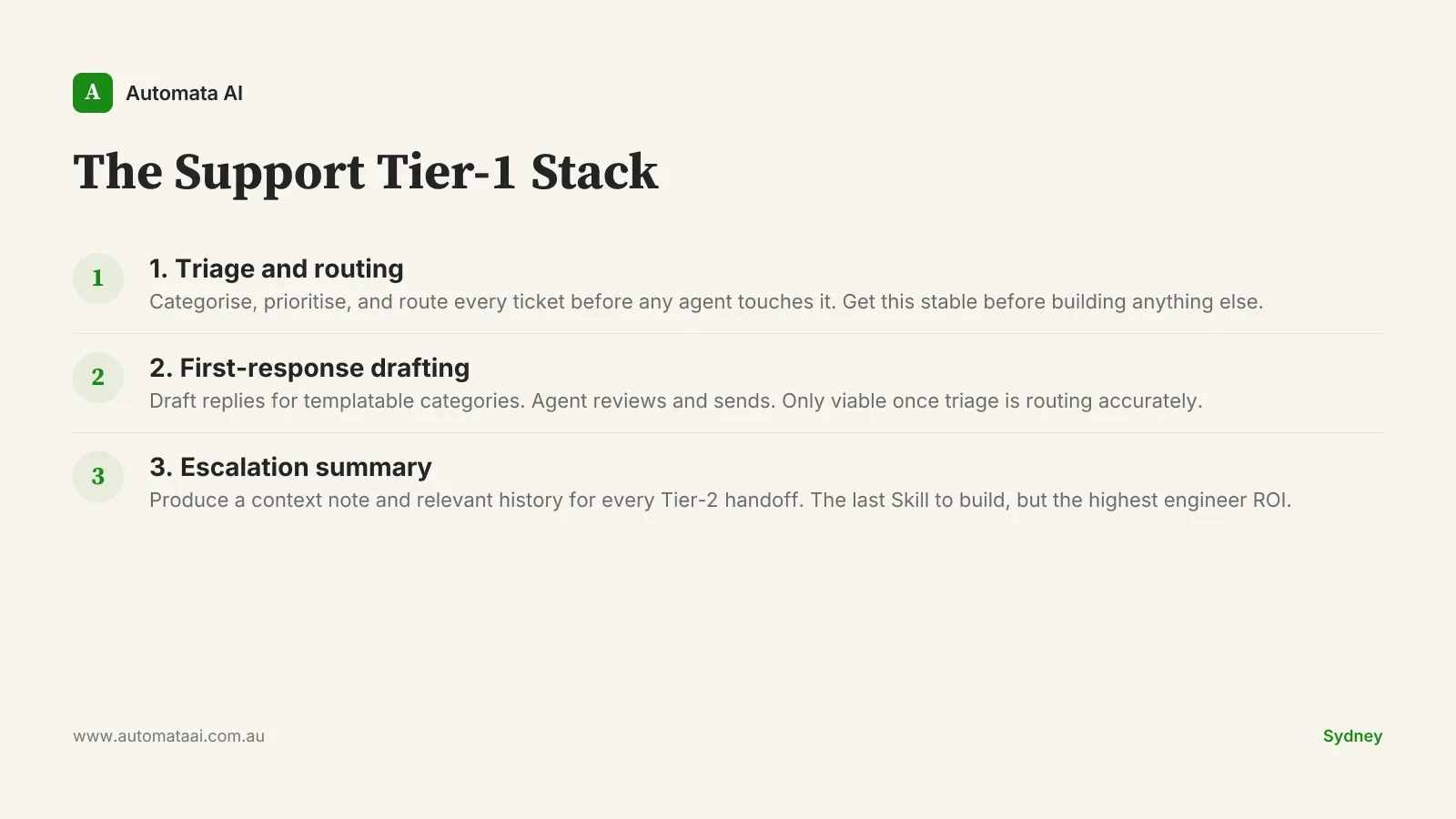
These three Skills form what we call the Support Tier-1 Stack: triage, draft, summarise. The sequencing matters. Triage goes first because routing accuracy determines whether the other two Skills ever see the right tickets. First-response drafting only makes sense once triage is stable enough that drafted replies land in the right inbox. Escalation summary is the final piece because it reduces the cost of the cases that don't resolve at Tier-1. Build in sequence. Skipping ahead is how teams end up with a drafting Skill producing replies that misroute.
When to skip this
Not every Australian support team should build a Skills stack. If Tier-1 ticket volume is under 200 per week, the ROI maths rarely clear. Skill implementation (scoping the taxonomy, building the prompt, wiring the integration, tuning for the first month) requires real operational investment. If the payback period on a $30K to $50K engagement isn't under six months, it's probably not the right moment.
Volume too low. Under 200 tickets per week, throughput gains don't justify the implementation overhead.
Process too unstable. If handling rules change every six weeks, the Skill requires constant maintenance and routing accuracy degrades between updates.
No clean taxonomy. If the team can't agree today on how to categorise tickets, the Skill will route badly until that alignment exists. The taxonomy conversation is the real work.
The teams that get into trouble are the ones that automate before they've documented. A Skill is only as reliable as the rules it encodes. If the team lead can't write down the routing logic clearly enough to hand it to a new starter, the Skill won't apply it correctly either.
Governance is the control point
Skills can be locked at the team-lead level. Agents cannot edit routing logic or disclaimer text. That matters in an Australian context. The Privacy Act (1988) means a misfired response to a subject-access request can carry regulatory risk. In financial services, AFSL obligations sit on top of that. The AI Readiness Assessment we run with support teams maps these obligations before any Skill goes near a production ticket queue.
Most support leaders who've evaluated this budget the implementation at $30K to $50K and model a three to four month payback on high-volume Tier-1 processes. The teams that actually get there start with triage, prove routing accuracy in the first month, and build from that foundation. Run your specific ticket volumes through the ROI Calculator before sizing the engagement.
Pick one Skill. Get the triage working. The rest follows from that.