The pilot ran for eight weeks. The model cut compliance review time by 70 per cent, and the board was impressed. Then the engagement ended. Your team discovered the vendor owns the prompt library. The Skill catalogue lives on their infrastructure. Your internal staff can operate the outputs but not the system.
You are now a customer in a relationship you cannot exit without rebuilding from scratch.
This is the lock-in pattern. It is not accidental.
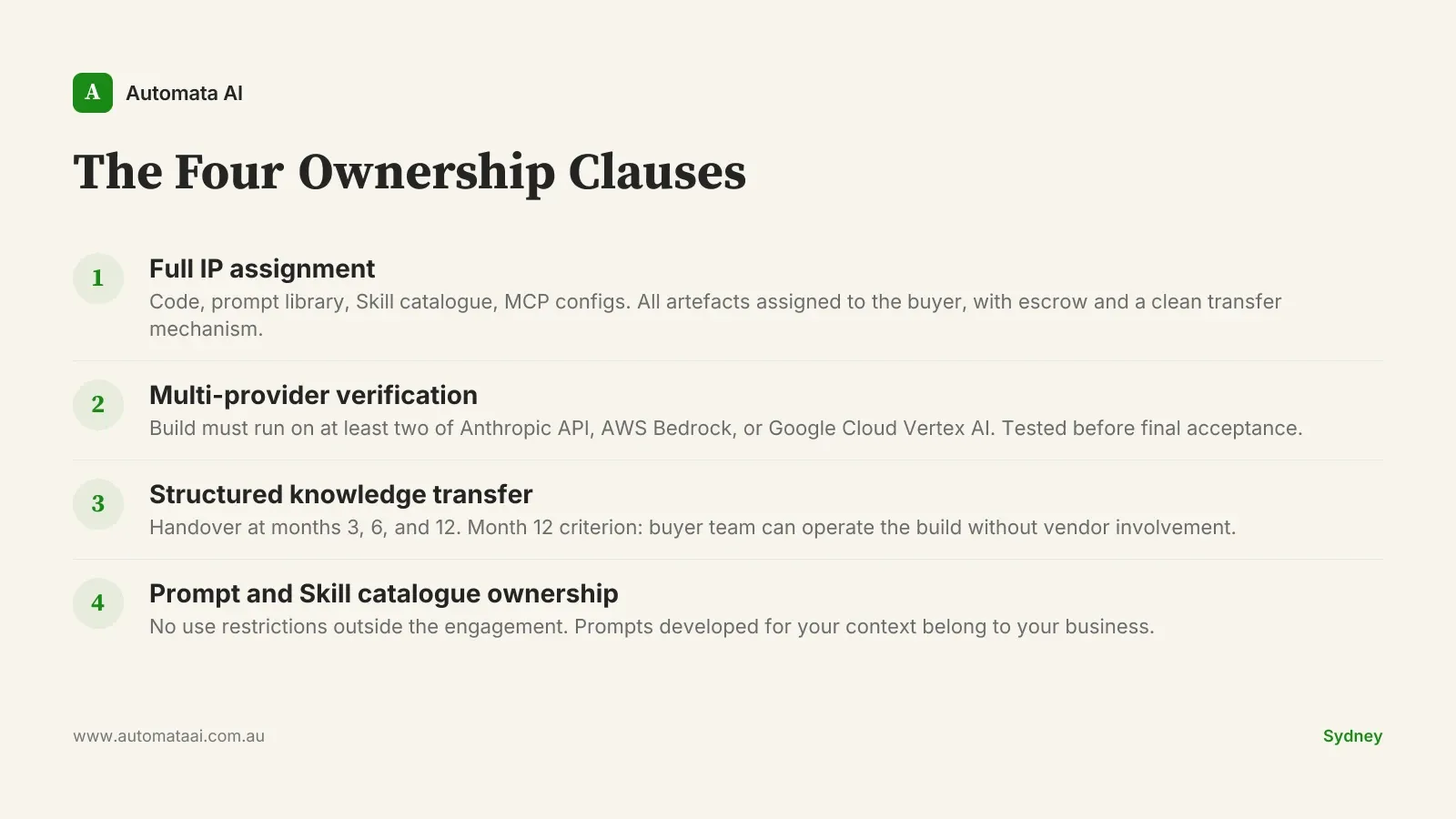
The four ownership clauses
Australian enterprise procurement teams that navigate this successfully insert four clauses into the vendor contract before signing. Not in the scope of work. Not in a side letter. In the contract.
Full IP assignment on all delivered artefacts. Code, prompt library, Skill catalogue, MCP configurations, hook definitions. Every delivered artefact is the buyer's IP, documented in an escrow arrangement with a clean transfer mechanism. If the relationship ends the day after delivery, the buyer operates the build.
Multi-provider verification clause. The build must run on at least two of Anthropic API, AWS Bedrock, or Google Cloud Vertex AI. Provider switching is tested and documented before the engagement closes. Not as a future deliverable. As an acceptance criterion.
Structured knowledge transfer schedule. Documented handover sessions at months three, six, and twelve. The month-twelve acceptance criterion is not that the buyer has the documentation. It is that the buyer's internal team can operate, monitor, and iterate on the build without vendor involvement.
Prompt library and Skill catalogue ownership. No use restrictions outside the engagement. The prompts developed for your business context are not part of the vendor's reusable asset library.
The cost of skipping them
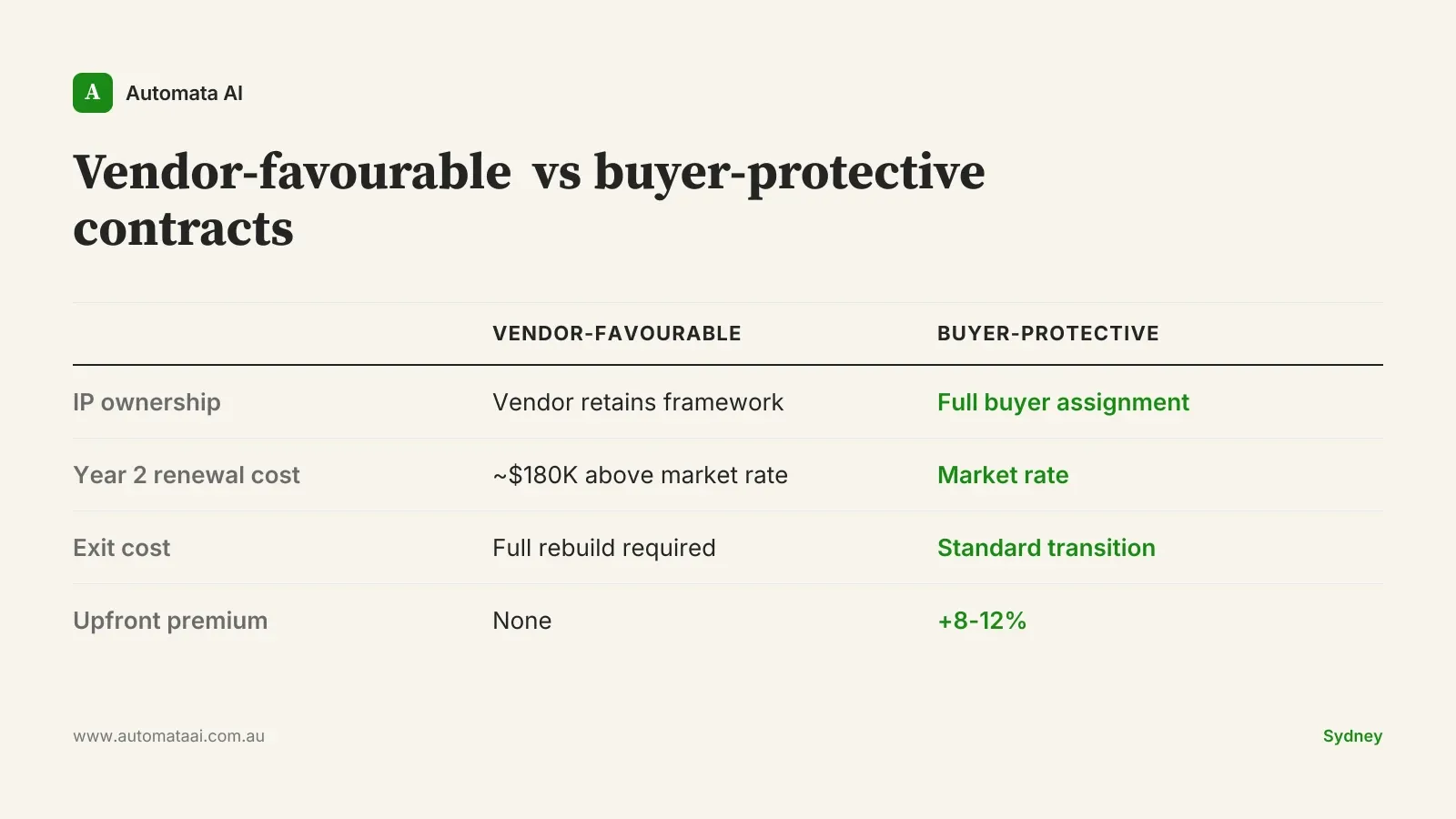
An engagement that includes all four clauses typically prices eight to twelve per cent above a vendor-favourable contract. On a $400,000 build, that is roughly $40,000. Most procurement teams see the premium and stop.
The number they miss: Australian enterprises locked into a single-vendor Claude build typically pay around $180,000 more per year in renewal pricing than buyers with genuine portability. That is the vendor's margin on your inability to walk. Over three years, the $40,000 premium looks different.
There is a second figure worth calculating. A buyer with a clean multi-provider deployment can absorb Anthropic pricing changes, take advantage of AWS Bedrock's Sydney region cost structure, and accommodate model upgrades without commissioning a rebuild. That optionality is worth $80,000 to $200,000 per year depending on workload volume. You can model the numbers for your workload in the ROI Calculator.
Where vendors will push back
Most will. The pushback is predictable enough that you can prepare for it before the first commercial discussion.
IP assignment. The opening position is almost always 'we retain the framework, you own the specific outputs.' This is the wrong split. Push for full IP assignment of every delivered artefact, including the structure that generates them. It is negotiable. It requires insisting.
Multi-provider verification. Consultancies that have only built on the Anthropic API will resist Bedrock and Vertex testing. The resistance is about engineering time, not technical impossibility. Any competent implementation on modern Claude SDKs has a provider abstraction layer. Multi-provider testing adds days, not weeks.
Knowledge transfer. Vendors that survive on services revenue have a structural incentive to keep your team dependent. Insist on the handover schedule and on acceptance criteria, not just calendar slots.
The Australian Claude consultancy market is competitive enough that you have negotiating room on all three. Use it.
When the lock-in risk is low
Not every Claude build warrants this level of contract discipline. Three situations where a vendor-favourable agreement is reasonable:
Short-run experiments. A $15,000 to $25,000 discovery engagement with a hard end date and no renewal on the table. No renewal means no lock-in exposure.
Commodity workloads. If any competent vendor could replicate the build in four weeks, the switching cost is low regardless of what the contract says.
Internal prototypes. A build that lives in a sandboxed environment with no production dependency. The moment it connects to live data or informs a real decision, the calculus changes.
If the build touches your production data, your operations, or your customer experience, the four clauses above are the cost of entry. Treating them as optional is how the $40,000 upfront premium becomes a $540,000 decision over three years.
The negotiation discipline
Enterprises that win these terms share one characteristic: they demonstrate, credibly, that they are prepared to engage a different vendor. This is not a bluff. The Australian market has enough competent Claude integrators that the threat is genuine.
Procurement teams that signal urgency hand the negotiating position away. Tight deadlines, single-source preference, a start date that cannot move. These signals communicate that the terms matter less than the timeline. Vendors read that correctly.
The teams that get the terms table the four clauses in the first commercial discussion and treat them as a prerequisite, not a formality. They are prepared to move to a different vendor if the response is a firm no.
Vendors who won't move on any of these clauses are telling you something about the relationship you are about to enter. Pay attention to it.
A 24-month engagement with full IP assignment, multi-provider verification, and a structured handover schedule produces a different outcome than a 24-month dependency. The vendor still earns the margin. The enterprise owns the capability when it ends.
Automata AI ships Claude builds for Australian enterprise with full IP assignment and exit-friendly contracts as standard. If you are evaluating vendors for the first time, our AI Readiness Assessment helps you scope the build before you negotiate it. If you want to understand our service tiers, the AI Automation Services page covers what is included in each engagement.