Four offshore engineers or six Claude agents. A Sydney SaaS CFO put that exact choice to me last month. It's the wrong frame.
The question that actually leads somewhere useful: which work goes to offshore, and which work goes to agents, and at what risk. Most Australian mid-market SaaS businesses have both kinds of work in roughly equal measure. The hybrid of the two consistently outperforms a bet on either alone, and it manages concentration risk in a way that neither pure play can.
The cost stacks
The numbers are less complicated than most vendors make them, and the comparison is more nuanced than a headline cost-per-head suggests.
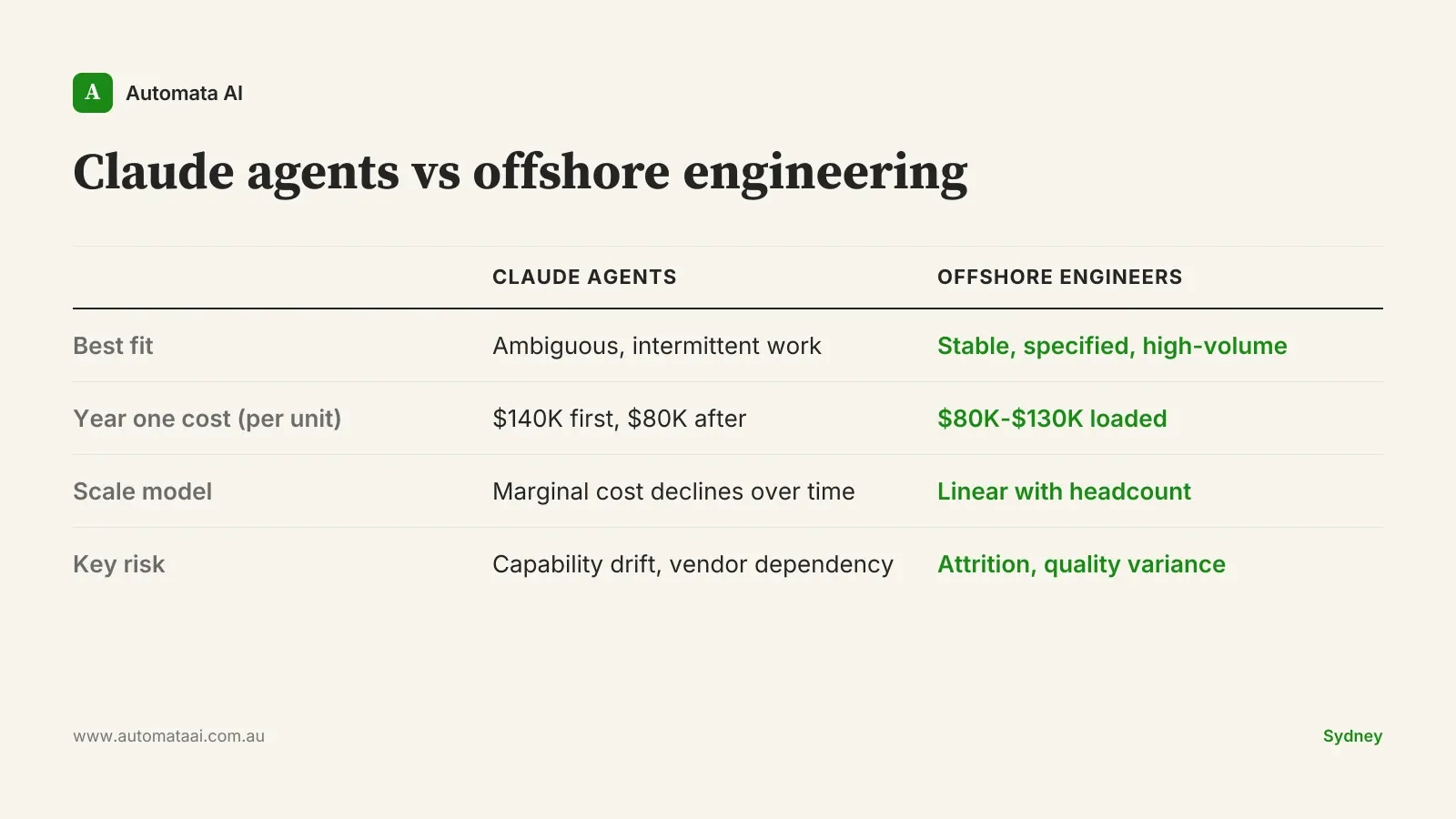
Offshore engineering, mid-tier (India or Vietnam). $80,000 to $130,000 per engineer per year, fully loaded with vendor margin and AU-side management overhead.
Claude agent build, productionised. Approximately $140,000 for the first agent. Around $80,000 for each subsequent agent in the same domain. Then $30,000 per agent per year at steady state.
AU-side platform engineer. Around $250,000 per year fully loaded. You need this role. Without it, neither model delivers reliably.
That $250,000 platform engineer is the most important number on this list. Teams that offshore without an AU-side owner get inconsistent delivery and quality variance that accumulates quietly until it surfaces in a release cycle. Teams that ship Claude agents without someone who understands the orchestration layer get silent failures at 2am on a Saturday that no one finds until Monday morning. In both cases, the hidden cost is the same: rework that was never budgeted. Automata's AI Automation Services include this engineering ownership as part of every engagement, because we've seen what happens when it's absent.
Where each wins
Offshore wins on stable, specified work. If the spec is clear, the domain is settled, and the volume justifies a dedicated hire, offshore is cheaper and more predictable.
Claude agents win on ambiguous, intermittent work. If the process requires judgment on edge cases, runs a few times a week rather than all day, or calls an API that already exists in your stack, agents win on unit cost at scale.
The hybrid wins almost everywhere else. Offshore builds the platform and handles high-volume specified work. Agents handle the ambiguous and the intermittent. One engineer onshore manages the integration and keeps both sides accountable. That combination gives you more coverage for less total spend, provided the three components are designed to work together from day one.
A reference TCO model: the hybrid capacity model
A typical Australian mid-market SaaS at $20M ARR, trying to add $4M of engineering capacity, has several realistic paths. Here is how the hybrid capacity model prices out. Use our ROI Calculator to run the same analysis against your own cost structure.
4 offshore engineers: approximately $440,000 fully loaded
6 Claude agents: approximately $580,000 in year one; $200,000 per year in steady state
1 AU-side platform engineer: approximately $250,000
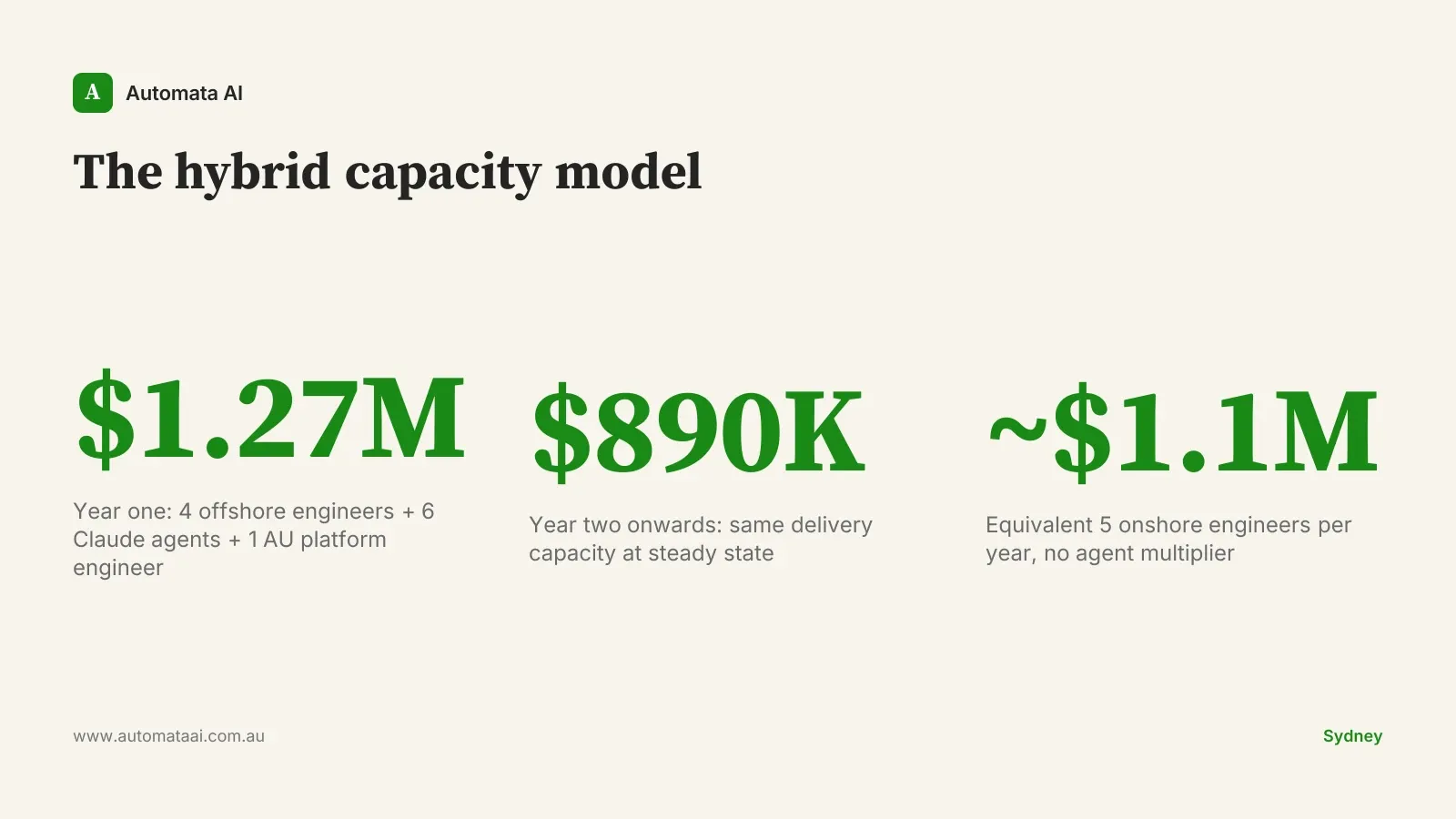
Year one total: approximately $1.27M. Year two onwards, once the agents are at steady state: approximately $890,000. Compare that to five onshore engineers at $200,000+ fully loaded each. You are looking at $1.0M to $1.25M per year with no multiplier, and a hiring pipeline that typically takes three to six months to fill each role in the current Australian market. The hybrid model doesn't just cost less. It scales differently: fewer people, more throughput, and attrition limited to one seat instead of five.
The model requires the offshore team and agent layer to be designed together from the start, not retrofitted. The most common failure mode is the retrofit: agents bolted on top of a system that was never designed to support them. The integration layer is where delivery either compounds or collapses.
When the hybrid is the wrong move
Not every SaaS should run this model. Three conditions make it the wrong choice.
Low API surface area. If your core product is a monolith with no internal APIs and no realistic path to instrumenting it, agents have nothing to call. Fix the architecture before you fix the delivery model.
Sub-$5M ARR. At this stage you usually need one or two great engineers who can do everything. Optimising delivery mix is a later problem.
Compliance-constrained environments. Some Australian financial services firms operating under APRA CPS 230 need human sign-off on process changes. In those contexts, agent autonomy has to be scoped to read-only or advisory functions, which narrows the ROI enough that the cost maths change materially.
There is also a concentration risk inside the hybrid itself. If the AU-side platform engineer leaves, both the offshore delivery and the agent layer degrade at the same time, because both depend on the same integration architecture. That is one person with significant influence over delivery outcomes, and organisations consistently underestimate that dependency until it surfaces. Address it with documentation, runbooks, and a clearly defined succession path before it becomes a production incident. The AI Readiness Assessment includes this dependency audit in its scope.
Defending the case to a sceptical board
Australian boards that have survived a decade of vendor slide decks approach any productivity claim with healthy scepticism. That scepticism is usually justified. Land the case by anchoring every number to a measured baseline from the business's own operations, not from industry averages. 'We recovered 12,000 hours' sourced from internal time logs survives scrutiny. The same claim sourced from a vendor brochure does not. The question a board will ask is where that number came from. Have the answer ready before the meeting.
Run sensitivity analysis before presenting. Model the case at 50% of assumed savings and 150% of assumed cost. If it still works at that haircut, the board has a defensible position they can take to audit. If it does not, the case needs more evidence. A TCO model that only works at base-case assumptions is a liability in a room where people are paid to find the flaw.
The third discipline is exit optionality. The contract should permit a clean exit at month 12 if recovered value is below 60% of the model. That clause is rarely invoked but always reassures a board worried about open-ended commitment. Australian boards respond well to downside framed in writing.
Start with one agent and one offshore hire. Run both in parallel for 90 days. The gap in where each one gets stuck tells you more about your system's actual readiness than any planning exercise. Most businesses discover, at that point, that they want both.