Three weeks into the job, your new junior developer has merged twelve pull requests. The team lead is uneasy. Not because the output looks wrong. Most of it is fine. But because nobody is certain how much of it the developer actually understands.
That is the failure mode nobody names when Claude Code lands in your toolchain without a structured introduction.
The pattern that repeats across Australian engineering teams
Teams hand over Claude Code access on Day 1 because it is already in the stack. The developer opens it, discovers it can scaffold a component from a brief, and ships something in the first 48 hours. Everyone is impressed. By week three, the team lead is doing closer reviews than usual, quietly trying to work out what is happening.
The developer is learning. They are also rubber-stamping output. Usually both at once. The fix is not to restrict the tool. It is to phase the introduction the same way you would phase any other technical onboarding.
The research base on developer onboarding goes back 17 years: Dreyfus skill acquisition, scaffolded practice, graduated autonomy. Applied to Claude Code, this framework collapses a six-week ramp to two weeks while preserving genuine understanding. The difference is structure, not talent. The reason most teams do not apply it is that nobody thought to look for a framework. They assumed Claude Code was self-evident. It is not.
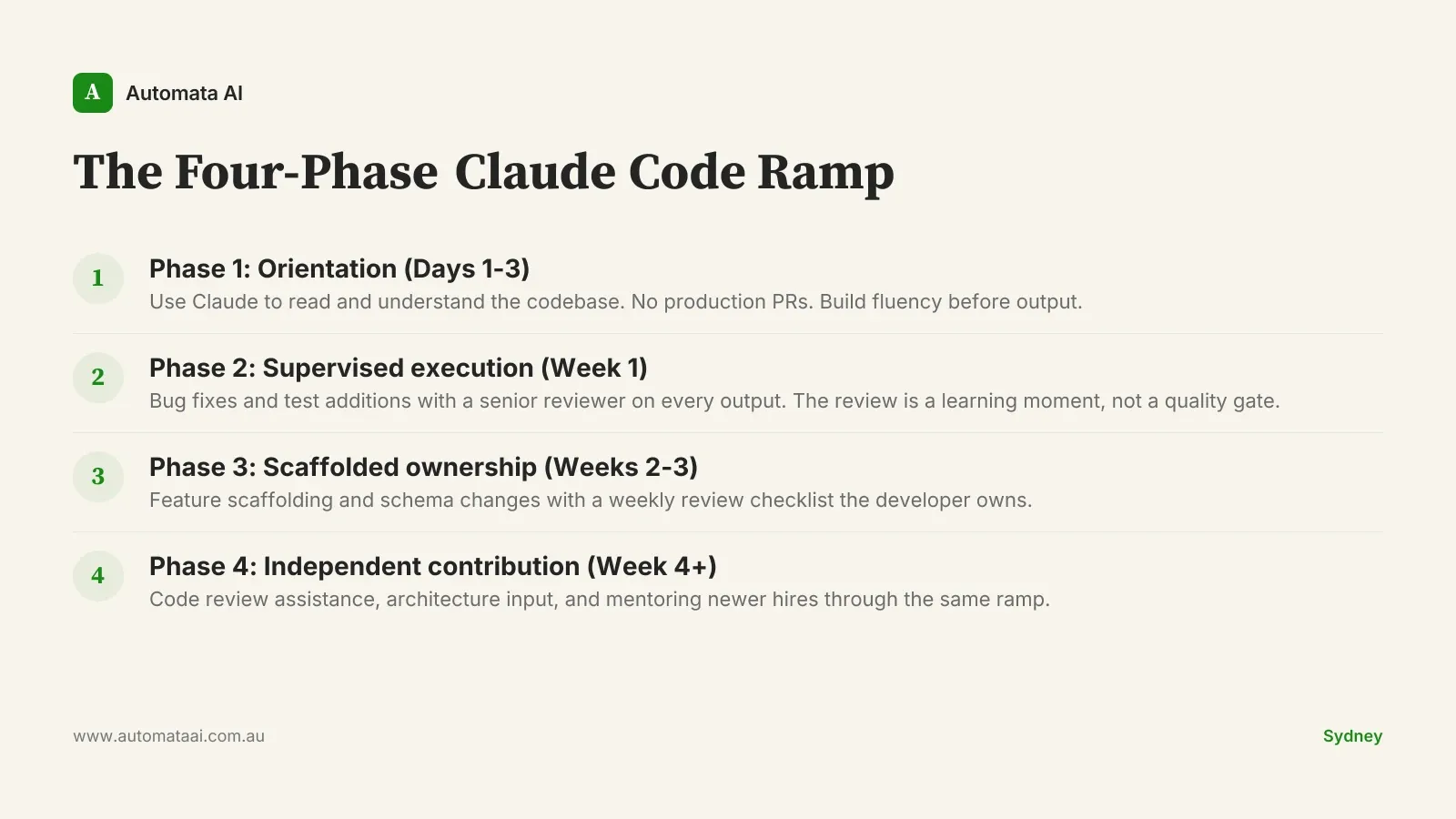
The Four-Phase Claude Code Ramp
The following phases have produced consistent results across engineering teams we have worked with in Sydney and Melbourne. They map to the same cognitive stages tracked in junior developer onboarding research since the early 2000s. The principle is simple: a new developer is not calibrated yet on when to trust AI output and when to question it. That calibration is a skill, and it needs to be developed deliberately. We build this into our AI Automation Services engagements as a standard component of technical enablement.
Phase 1: Orientation (Days 1-3)
Claude Code is introduced as an IDE, not a code generator. File navigation, terminal commands, reading existing code. The developer uses Claude to understand the codebase: asking it to explain what a file does, trace a function, summarise a test suite. No production PRs in this phase. The goal is fluency, not output. This three-day window also gives the team a read on how the developer engages with the tool. Are they reading responses, or clicking accept immediately?
Phase 2: Supervised execution (Week 1)
Small, scoped tasks: bug fixes, test additions, minor refactors. Every output goes through review. Not as a quality gate, but as a learning moment. The reviewer asks: did the developer read what Claude produced? Can they explain it? Can they spot where it made an assumption that does not hold in production? In most cases, the developer can. That is the signal. The ones who cannot yet are the ones who need the pairing extended.
Phase 3: Scaffolded ownership (Weeks 2-3)
Medium tasks with a checklist. Feature scaffolding, schema changes, integration work. The developer owns the output. A review checklist of three to five items, updated weekly, makes the conversation concrete. Most teams develop their own version within the first month. By week three, many developers are writing the checklist themselves. That is when you know Phase 4 is ready.
Phase 4: Independent contribution (Week 4 onwards)
Code review assistance, architecture input, mentoring newer hires through the same ramp. The developer is now using Claude as a force multiplier rather than a crutch. That distinction matters. A crutch comes out when you are tired. A force multiplier changes what you can attempt. Engineers who reach Phase 4 in the first month consistently produce output that surprises their managers. The comparison baseline is still a six-week ramp, and they have been shipping for three.
Three structural patterns that determine adoption
Pair a junior with Claude Code for 30 days. With a named buddy reviewer. The pairing catches unreviewed output while the developer is still calibrating what Claude gets right and what it confidently gets wrong.
Write the guardrails down. Do not use Claude Code for secrets, credentials, or authentication flows. That is not obvious to a new hire. It needs to be in the onboarding document, not assumed.
Run a weekly Claude Code clinic. Fifteen minutes, the whole team. Patterns that work and patterns that do not both surface faster when everyone is in the same conversation.
The 30-day pairing in particular is the one most teams skip because it feels patronising. It is not. It is acknowledgement that a new developer navigating a new codebase with a new AI tool simultaneously has a lot of context to calibrate at once. The pairing reduces that surface area.
When phased onboarding is the wrong move
Two situations where this approach creates friction rather than removing it. Both are common in Australian teams, and both are worth naming before you design your onboarding rollout.
Senior engineers with five or more years of production experience. They do not need phases. They need permission, working examples, and a 15-minute demonstration in their specific stack. Over-structuring an experienced engineer's introduction to any new tool slows the feedback loop you actually want.
Teams without an existing code review culture. Claude Code exposes the absence faster than it creates conditions to fix it. If PRs are not reviewed consistently before Claude Code arrives, adding it accelerates the problem. Fix the review culture first.
If you are unsure whether your team's review practices are strong enough to support structured adoption, the AI Readiness Assessment surfaces those gaps in 20 minutes.
What this costs Australian engineering teams
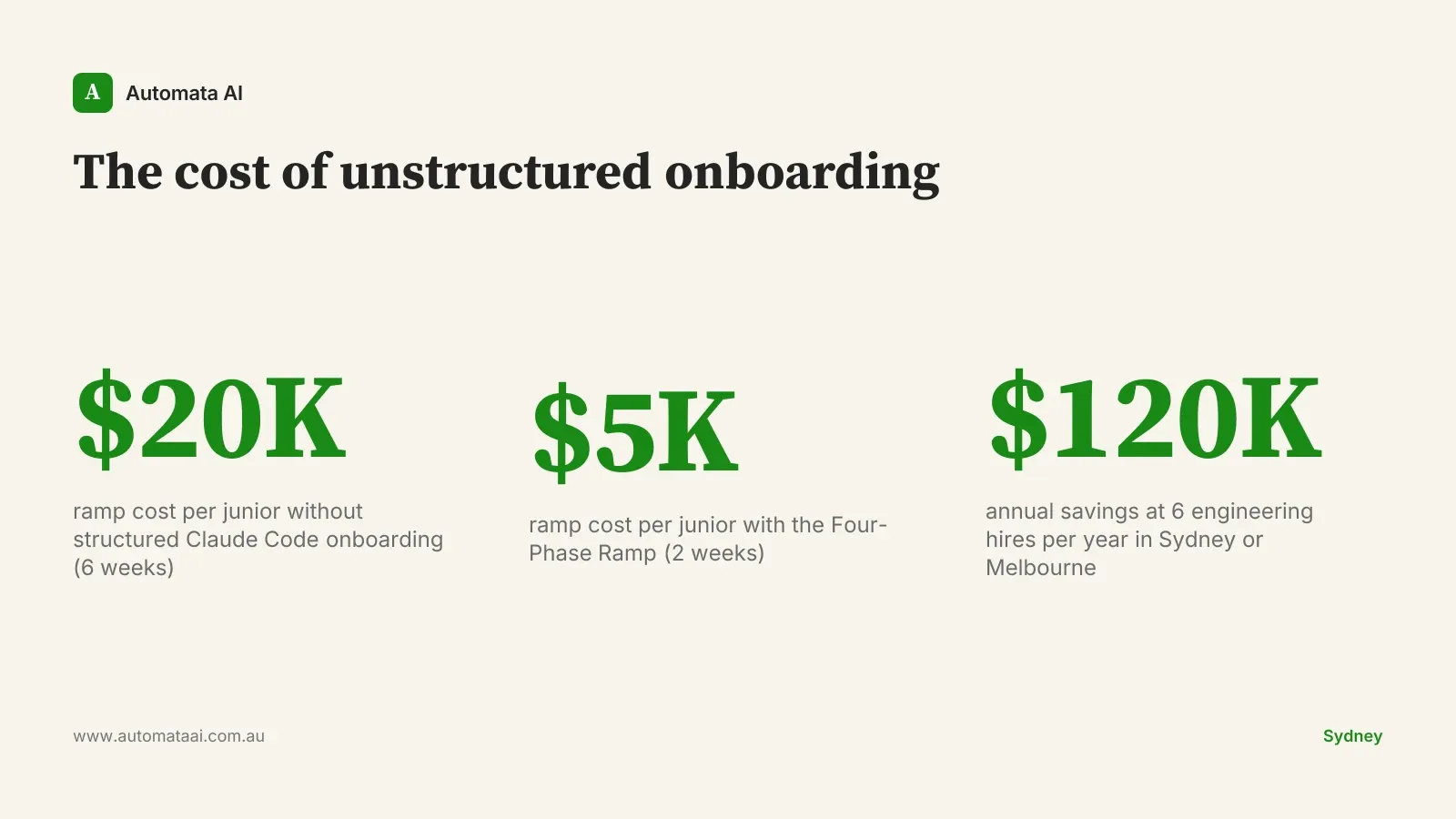
A junior developer in Sydney or Melbourne runs $450 to $600 per day fully loaded: salary, superannuation, equipment, and overhead. A six-week ramp without structured tooling costs $20,000 or more in time before the developer reaches independent contribution. That number is per hire. For a team hiring four juniors a year, it is $80,000 in ramp overhead before anyone is operating at full capacity.
With the Four-Phase Ramp, the same transition takes two weeks. Ramp cost drops to around $5,000. The saving per hire is $14,000 to $20,000 in AUD. Run the numbers for your specific hire rate through the ROI Calculator. It works in AUD and accounts for fully-loaded costs.
At four to six hires per year, a moderate growth rate for a Sydney or Melbourne engineering team, that is $56,000 to $120,000 in recovered capacity annually. Breakeven on any Claude Code tooling investment sits inside the first quarter.
Start with one hire. Run the four phases deliberately. Track the week-by-week output quality and the review time each phase requires. The data from that one case will tell you more than any industry benchmark.