Most Australian businesses know their manual processes are expensive. Few know exactly how expensive. Here's how to calculate the true cost — and when automation makes financial sense.
You're probably underestimating the cost
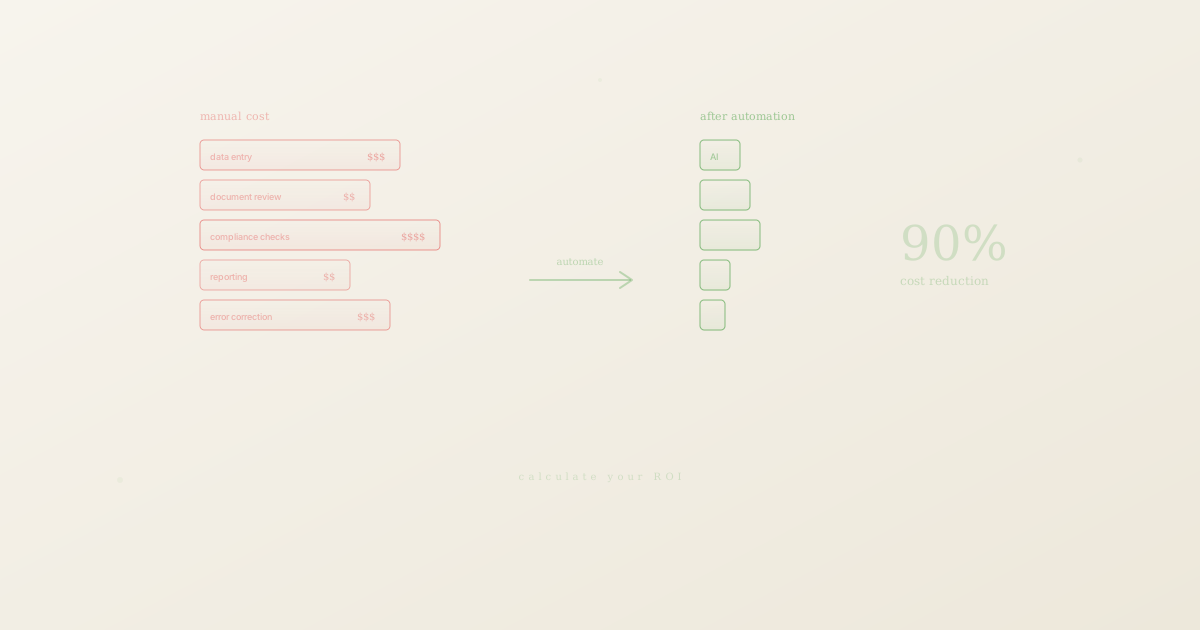
When we ask mid-market leaders how much their manual processes cost, they usually quote labour hours. "Our team spends about 20 hours a week on compliance reporting." That's the visible cost.
The invisible costs are bigger:
Error remediation. Manual data entry has a 1-4% error rate. Each error triggers rework, corrections, and sometimes regulatory consequences.
Opportunity cost. Your compliance analyst spending 20 hours on manual reporting is 20 hours not spent on risk analysis, client service, or process improvement. At $85-$120/hour fully loaded, that's $88,400-$124,800/year on one process.
Speed cost. A firm that takes 10 days to onboard a new client while competitors do it in 2 days isn't just slower — they're losing deals.
Scale ceiling. Manual processes that work at 50 clients break at 200. Every growth milestone forces a choice: hire more people or fix the process.
The automation ROI formula
Step 1: Calculate the annual manual cost
Annual Manual Cost = (Hours per week) x (52 weeks) x (Fully loaded hourly rate) x (Number of people involved)
Example: Compliance reporting — 20 hours/week x 52 weeks x $100/hour x 2 people = $208,000/year
Step 2: Add hidden costs
True Annual Cost = Annual Manual Cost + Error Cost + Delay Cost + Opportunity Cost
Example: Error remediation $15,000 + Delay cost $25,000 + Opportunity cost $40,000 = True Annual Cost: $288,000/year
Step 3: Estimate automation investment
For mid-market Australian businesses, typical AI automation costs:
Simple process automation: $30,000-$60,000 implementation + $5,000-$10,000/year maintenance
Complex process automation: $80,000-$150,000 implementation + $15,000-$25,000/year maintenance
Step 4: Calculate payback period
Payback Period = Automation Investment / (True Annual Cost x Automation Percentage)
Example: $45,000 investment / ($288,000 x 85%) = 2.2 months payback. That's not a typo.
When automation does NOT make sense
Not every process should be automated. Skip it when:
Volume is too low. If a process runs once a month for 2 hours, the ROI won't justify implementation.
The process isn't stable. If rules change every quarter, automation will require constant maintenance.
Data doesn't exist. Automation needs structured input data.
People are the product. Automate admin around relationship management, not the core activity.
Five processes worth automating first
1. Regulatory reporting and compliance
Typical savings: 80-90% of manual hours. Best for: Financial services, healthcare, insurance.
2. Customer onboarding and KYC
Typical savings: 70-80% faster processing. Best for: Financial services, professional services.
3. Invoice processing and accounts payable
Typical savings: 60-75% cost reduction. Best for: Any business processing 100+ invoices/month.
4. Customer service triage
Typical savings: 40-60% of tier-1 queries automated. Best for: 50+ queries/day.
5. Data extraction and reporting
Typical savings: 85-95% time reduction. Best for: Weekly/monthly reports from multiple data sources.
How to build the business case
Pick one process. Don't propose automating everything. Pick the highest-ROI process.
Quantify the current cost. Use the formula above. Include hidden costs. Be conservative.
Define the outcome. "Reduce compliance reporting from 2,000 hours/year to 200 hours/year."
Show the payback. If under 6 months, the business case almost sells itself.
Start with Discovery. A 2-week assessment ($5,000-$10,000) validates the opportunity.