Sydney businesses booking their first AI strategy workshop in 2026 walk into a market saturated with two-day events that cost $30,000 to $80,000 AUD and produce slide decks instead of action. The workshop format that actually pays back is a focused engagement with explicit, working outputs the buyer can use the Monday after.
For a Sydney mid-market business at $30M to $200M revenue, a working AI strategy workshop costs $15,000 to $60,000 AUD and produces four concrete artefacts: an AI policy, a prioritised opportunity list, a vendor decision framework, and a 90-day plan with named owners. The price of a workshop is rarely the determining factor in whether it produces value. The brief, the facilitator, and the follow-through are.
Why most strategy workshops fail to produce action
The standard Sydney pattern is a two-day offsite, a hotel boardroom, a generic five-pillar framework, and a 60-slide report two weeks later. By the time the report lands, the operating context has moved on, the executive sponsor is in a different meeting, and the prioritised opportunity list reads like every other AI deck the buyer has already seen. The artefacts have no anchor in the buyer's own systems, so nobody on Monday morning knows what to do first.
A workshop that produces action looks structurally different. The facilitator arrives with a working understanding of the buyer's stack and current systems. The sessions produce drafts the buyer's team edits in the room. The deliverables ship to the buyer's intranet, not a vendor-branded PDF. The 90-day plan names real people inside the buyer's organisation, not generic role titles.
What good outputs look like
A strategy workshop that produces value generates four artefacts the buyer's team can adopt immediately:
An AI policy with clear acceptable-use, governance, and data-handling rules calibrated to the buyer's existing Privacy Act and information-security posture.
A prioritised opportunity list with effort, value, and risk scoring, anchored to named systems and named workflows.
A vendor and tooling decision framework that distinguishes Claude, OpenAI, and AU sovereign options on the criteria that matter for the buyer's regulatory exposure.
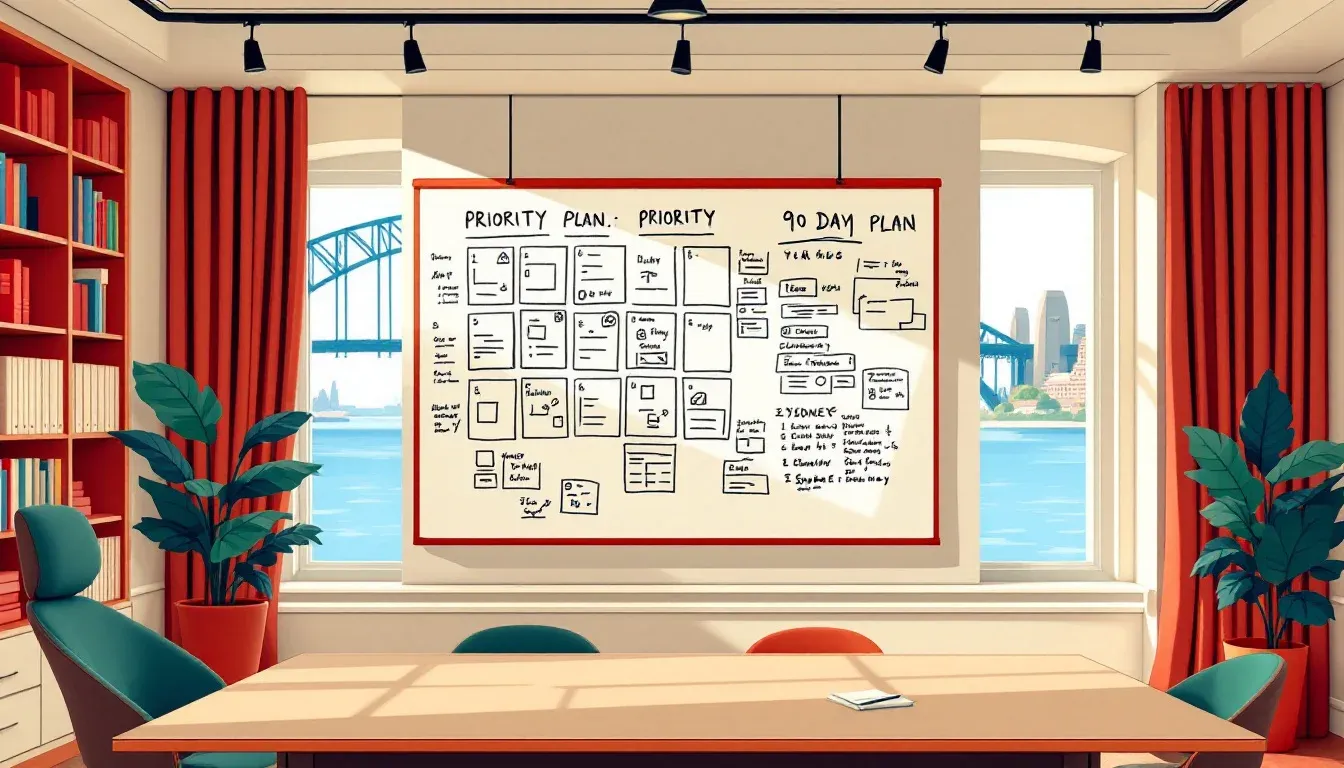
A 90-day plan with specific projects, named owners, budget envelopes, and decision gates.
If the workshop produces a glossy report and no actionable artefacts, the buyer has wasted the money. The right facilitator focuses relentlessly on what the buyer's team will do in the first week, not on the architecture of the buyer's three-year vision.
A format that produces decisions, not decks
Effective workshop formats for Sydney mid-market in 2026 share five traits:
Two to four sessions across two to three weeks, not a single intensive day. The cognitive load of a one-day offsite produces excitement followed by inertia.
Pre-work the buyer's team completes before each session so the time in the room produces decisions, not catch-up.
Active participation by the buyer's senior leaders, not delegated to middle management. Workshops without authority in the room produce recommendations nobody can approve.
A facilitator with hands-on delivery experience on the same tools the buyer will adopt, not a generalist consultant.
Concrete deliverables produced session by session, edited live, and signed off before the next session begins.
Who should be in the room
The right attendees depend on workshop scope, but the constant is that decision authority must be in the room. For an org-level strategy workshop the CEO, COO, and CFO are non-negotiable. For a function-specific workshop the function lead plus the senior platform or IT representative. For any workshop touching customer data the privacy, legal, and risk leads attend the relevant sessions.
AU mid-market businesses that try to run strategy workshops without senior leaders in the room produce recommendations that stall at the next executive review. The cost is not just the wasted workshop fee. It is the six-month delay before the org is ready to try again.
What to avoid
Common Sydney workshop traps the buyer's procurement team should screen for:
Vendors disguised as facilitators pushing their own platform under the guise of independent advice.
Generic five-pillar frameworks copy-pasted from generic decks, with the buyer's company name dropped in over the original client name.
Workshop programmes priced as loss leaders for a six-figure follow-on consulting engagement.
Outputs that are decks rather than working artefacts the buyer's team can edit and ship.
Buyers should ask the facilitator for sample outputs from prior workshops, redacted for confidentiality, before signing. A facilitator who cannot show real artefacts has nothing to offer beyond the brand on the title page.
Cost reality for Sydney mid-market
Sydney AI strategy workshops in 2026 sit in a wide pricing band:
$5,000 to $15,000 for a focused single-session workshop with one or two facilitators.
$15,000 to $40,000 for a multi-session workshop with deliverables.
$40,000 to $120,000 for an enterprise-scale strategy programme run over six to twelve weeks with multiple working groups.
Most Sydney mid-market buyers benefit from the middle tier. The single-session price point is too thin to produce the four artefacts that matter. The enterprise tier is appropriate when the buyer is committing to a defined transformation programme with a named executive sponsor and a budget already approved.
A Claude-first workshop variant
Sydney buyers that have already chosen Claude as their primary AI platform should ask for a workshop variant calibrated to the Claude product family. The framework changes: the vendor decision section collapses, the platform section expands to cover Claude.ai for end users, Claude Code for engineering, Cowork for non-technical staff, and the Claude API plus MCP for system integration. The 90-day plan names the specific Claude products by tier and the AU billing path.
The advantage of a Claude-first workshop is the avoidance of a meandering vendor-comparison phase that delivers no decision. The buyer arrives knowing the model family and leaves with a configured rollout plan. The trade-off is that the buyer commits to the Claude stack as the default; the workshop is not the right place to relitigate that decision.
Follow-through is the real determinant of value
The single biggest determinant of workshop value is what the buyer does in the 30 days after the final session. A workshop with a 90-day plan and no follow-through is a workshop that wasted money. A workshop with a thin plan but disciplined follow-through often outperforms a polished plan that nobody owns.
Disciplined follow-through has four traits. The buyer assigns named owners to each plan item before the workshop ends. A 30-day check-in with the facilitator or internal sponsor is booked in the same week. A quarterly review measures the plan against actual progress. The plan adapts as new information arrives, including changes in the Claude product line or the AU regulatory environment.
If you are sizing an AI strategy workshop for a Sydney mid-market business, book a workshop scoping conversation at /contact.