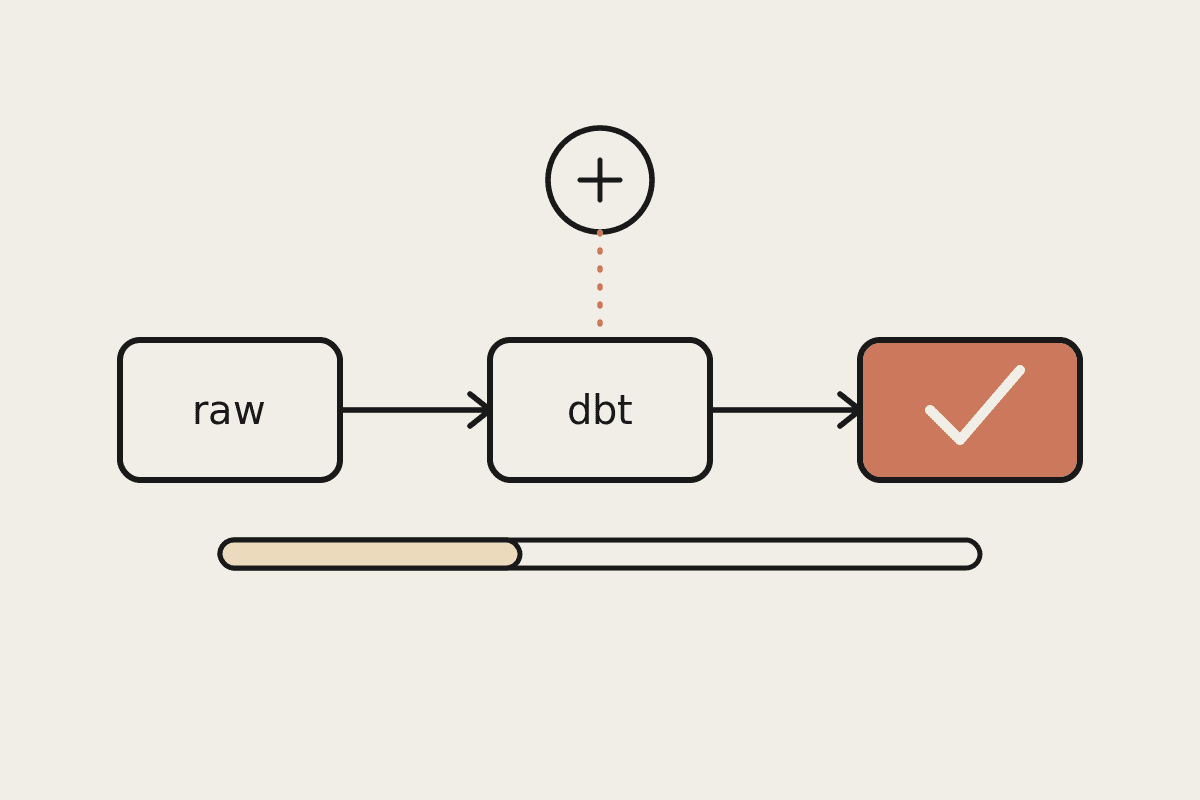
Most Sydney data teams already own the standard stack: a warehouse, dbt for transformation, some kind of orchestrator, and a pile of Slack alerts nobody reads until a dashboard breaks. What's usually missing isn't more tooling. It's someone with the time to read a stack trace, trace it back through three dbt models, and write the fix before the CFO asks why the revenue number changed overnight.
That's the gap Claude Code is actually good at closing for data engineers, and it's a narrower, more concrete gap than most of the AI-for-data-teams pitch decks suggest. This isn't about an agent that designs your warehouse architecture unsupervised. It's about giving a data engineer a competent second pair of hands for the repetitive, context-heavy work that eats a working week: writing and refactoring dbt models, chasing down broken tests, and drafting the data contracts that keep pipelines from quietly breaking downstream teams.
Where Claude Code earns its keep in a dbt pipeline
Claude Code works directly against your repository, so it can read your existing dbt project structure, your naming conventions, and your test coverage before it writes a single line. That context matters more in analytics engineering than almost anywhere else in software, because a model that's technically correct but doesn't match team conventions just creates more work in code review.
Drafting new staging and mart models from a source schema, following the project's existing folder structure, naming rules, and materialisation settings rather than inventing new ones.
Writing dbt tests (not_null, relationships, accepted_values, and custom generic tests) against columns that currently have none, then flagging which existing tests look redundant.
Tracing a failed dbt run back through the DAG, reading the compiled SQL, and proposing the specific fix rather than a generic "check your joins" comment.
Refactoring a sprawling legacy model into cleaner CTEs with documentation, without changing the output column contract downstream tables depend on.
Writing the YAML documentation and column descriptions that almost every team intends to keep current and almost none actually do.
The pattern across all of these is the same: Claude Code is doing the reading and the drafting, and the data engineer is doing the reviewing and the judgement calls. A Melbourne fintech client of ours measured this directly across a quarter: routine model and test authoring that used to take a mid-level analytics engineer roughly six hours a week now takes under ninety minutes, freeing up close to $45,000 a year of engineering time per person at a loaded cost of around $140,000, based on their own payroll figures rather than a vendor estimate.
Data contracts are just tests someone has to write and maintain
A data contract is a promise: this table will have these columns, these types, this grain, and this freshness, and if that promise breaks, the producer team hears about it before the consumer team does. Most Australian data teams know they should have contracts in place between producing and consuming systems. Very few actually maintain them, because writing and updating a contract schema by hand is tedious enough that it slips whenever a sprint gets busy.
This is a strong fit for Claude Code because a contract is fundamentally a translation task: turn a dbt model's compiled output, or a source table's current schema, into a structured contract definition (JSON Schema, a dbt contract block, or whatever format your platform team has standardised on), and flag any column that changed type or went missing since the last version. Claude Code can generate the first draft of that contract from the actual schema in minutes, including the edge cases a human reviewer might skim past on a Friday afternoon.
A worked example: catching a silent schema drift
One pattern worth setting up deliberately: on every pull request that touches a dbt model feeding a downstream contract, have Claude Code diff the new compiled schema against the last published contract and write a plain-English summary of what changed. For a regulated business, this is the difference between a schema change being a planned event and being a production incident discovered by an analyst three weeks later. Teams operating under APRA data governance expectations, or anyone handling data covered by the Privacy Act, tend to care about this kind of traceability more than most, because "we didn't notice the column changed" is not an answer a regulator or an auditor accepts.
What stays with the data engineer, deliberately
None of this works if a data engineer treats Claude Code's output as ready to merge. The failure mode we see most often with Australian teams adopting Claude Code for data work isn't that the model writes bad SQL. It's that reviewers get comfortable and stop reading the generated model closely enough to catch a subtly wrong join or an aggregation that silently double-counts a row.
Grain and join logic on anything touching financial, payroll, or customer PII tables always gets a human read line by line, not a skim.
Contract changes that affect an external-facing API or a partner data feed go through the same sign-off as a manual change would.
Claude Code drafts the test, but the data engineer decides what "correct" means for that column, especially around nulls and default values.
Any model touching cross-border data transfer gets flagged for a second look against the business's Privacy Act obligations before it ships.
The teams getting the most out of this in Sydney and Brisbane aren't the ones handing pipeline design to an agent. They're the ones who've worked out exactly which 60% of a data engineer's week is repetitive enough to draft automatically, and which 40% needs a human who understands the business logic behind the numbers. Get that split right and a small analytics engineering team can maintain a pipeline estate that would otherwise need two extra hires.
If your dbt project has grown past the point where anyone fully remembers what half the models do, that's usually the sign it's worth a proper look at where Claude Code fits into the workflow. Book a working session and we'll walk through your actual repo, not a demo one.