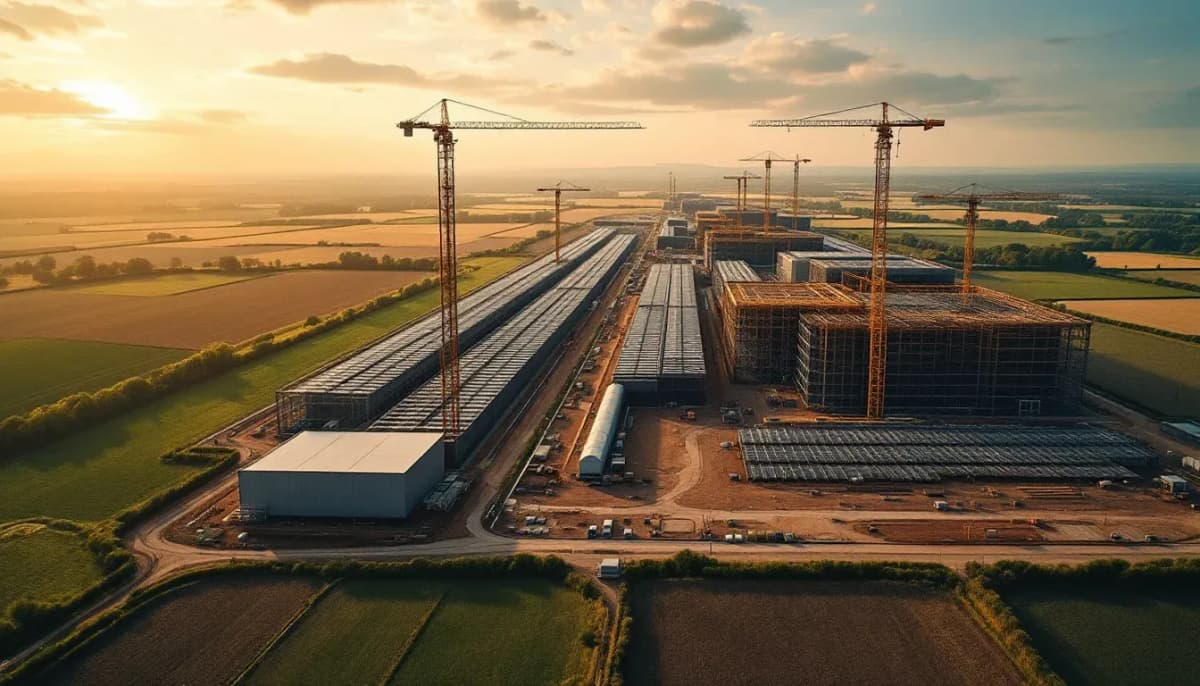
On 1 June 2026, OpenAI broke ground on a project it calls The Barn: a one-gigawatt Stargate data centre campus in Saline Township, Michigan, developed with Oracle, Related Digital, Walbridge and Blackstone. The headline number is roughly $16 billion USD, and analyst estimates put the eventual total closer to $30 to $40 billion USD once GPUs and networking are included. If you run an Australian business and Claude is part of your stack, or you are deciding whether it should be, the obvious question is what any of this has to do with you. The answer is more than you might think, and less than the headlines suggest.
What OpenAI actually announced
Stripped of press-release gloss, here is what is actually being built in Michigan, based on the announcement and independent reporting from construction and data centre trade press.
About 250 acres holding three single-storey halls of roughly 550,000 square feet each, with construction underway on all three at once
More than 2,500 union construction jobs during the build, 450 permanent onsite roles, and a claimed 1,500 county-wide jobs plus 1,000 indirect positions
$10 million USD toward the Saline Recreation Center, plus up to $45 million USD in Codex credits for eligible Michigan students in the 2026-27 academic year
A closed-loop cooling system that OpenAI says consumes about as much water as a typical office building
The Barn is one campus in OpenAI's wider Stargate program, and it will not be the last. The message underneath the announcement is simple: frontier AI has become an infrastructure-capital game, and OpenAI has chosen to play it by owning the concrete.
How Anthropic funds Claude's compute differently
Anthropic, the company behind Claude, is scaling compute just as aggressively but with a different capital model. Rather than self-building campuses, Anthropic's compute rides on partnerships: Project Rainier with Amazon, one of the largest AI compute clusters in the world, and a multi-billion dollar TPU arrangement with Google. The construction risk, the land and the cooling towers sit on partner balance sheets, while Anthropic buys capability.
Neither approach is automatically better. Owning your data centres gives you control of the full stack and a long-term cost story. Partnering gives you flexibility, faster access to multiple chip architectures, and a balance sheet that is not anchored to 250 acres of Michigan farmland. What the difference does affect is who carries the capital risk, and how the model reaches your business. Claude reaches Australian customers through AWS Bedrock and Google Vertex AI, both with Sydney-region options, which puts local data residency on the table without special arrangements.
The questions that actually matter for Australian businesses
When a vendor announces a gigawatt campus, the implied pitch is that more compute means a better product. There is some truth in that over the long run. But for an Australian SMB or mid-market firm choosing an AI platform this year, press-release gigawatts are close to irrelevant. Three questions do the real work:
Where does my data live? Claude served from Sydney-region infrastructure through Bedrock or Vertex AI simplifies Privacy Act compliance, and that is the kind of answer APRA-regulated firms need in writing before anything goes near production
How reliable is the service? Uptime history, enterprise SLAs and capacity headroom matter far more than whose construction site is bigger
What does each business outcome cost? The unit that matters is not dollars per gigawatt but dollars per resolved ticket, per drafted contract, per reconciled invoice
That last question is where the infrastructure race becomes invisible. A single well-chosen Claude automation in a mid-market Australian team is commonly worth $80,000 or more a year in recovered staff time. Whether the tokens behind it were generated in Michigan, Indiana or an AWS region makes no difference to that result. Capability, data residency and integration fit decide the outcome; the construction photos do not.
What this means for your AI platform decision
The compute arms race does tell you something useful: both frontier labs expect demand to keep compounding, and both are securing the supply to meet it. Vendor stability matters when you are building business processes on top of a model, and billions of dollars of committed infrastructure, however it is financed, is a reasonable proxy for staying power. On that measure, Claude's position is strong. Anthropic's compute partnerships with Amazon and Google tie it to the two cloud providers Australian enterprises already run on, which shortens the path from pilot to production for most teams.
Our advice to Australian businesses is unchanged by the Michigan announcement. Choose your model on capability against your actual workload, on where your data sits, and on how well it connects to the systems you already run. If you are weighing what the AI infrastructure race means for your own stack, book a brainstorm with a Claude specialist and we will work through it with you.