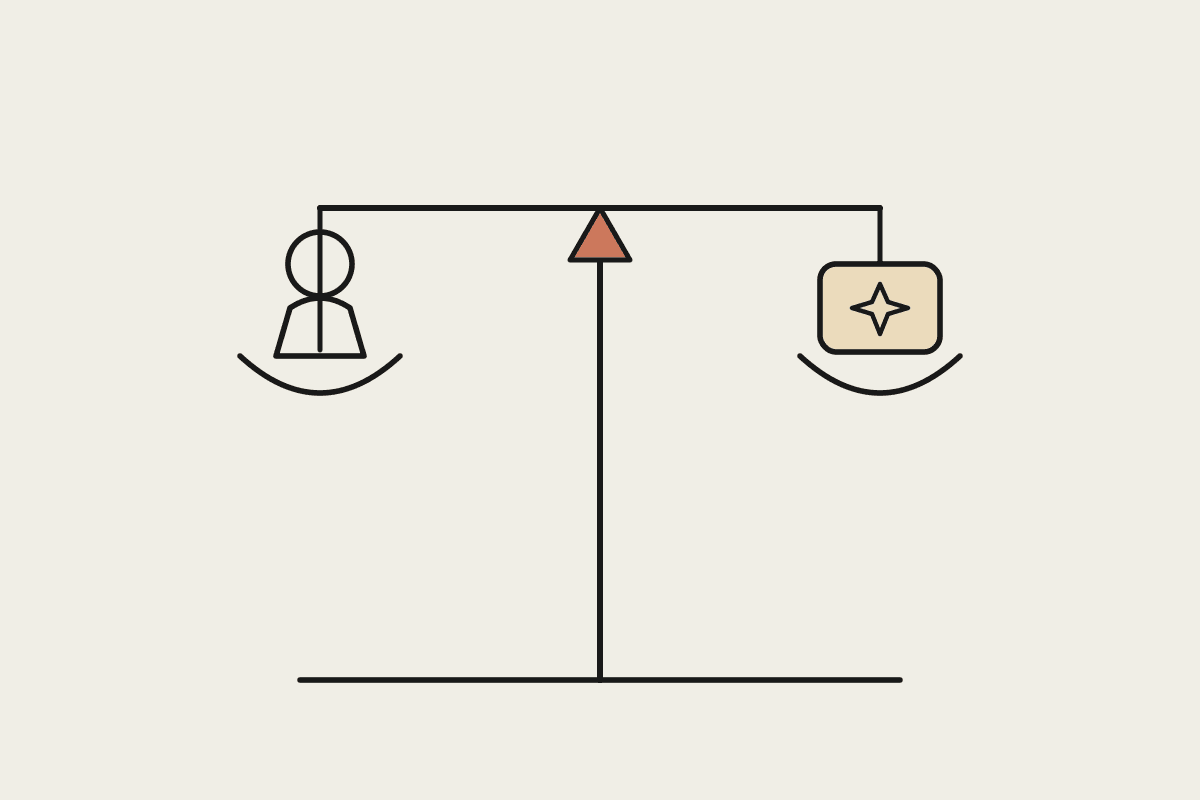
Australian business owners keep asking the same question: is Claude going to replace my junior hire? It's the wrong frame from the start. A junior employee and an AI assistant solve different problems, and treating them as substitutes leads to bad hiring decisions and worse automation decisions. The comparison that actually matters isn't Claude versus a person, it's task versus role.
Why the comparison keeps getting made
The instinct makes sense on the surface. A junior accountant, paralegal, or marketing coordinator in Sydney costs an employer somewhere between $65,000 and $85,000 a year once you add superannuation, payroll tax, and onboarding time. Claude's business plans cost a fraction of that per seat per month. Put those two numbers side by side and the math looks obvious. But that math only holds if a junior hire and an AI subscription do the same job, and they don't. A junior employee accumulates context about your clients, builds relationships, makes judgment calls under ambiguity, and grows into more responsibility over eighteen months. Claude answers the question you ask it, right now, with the context you give it, and forgets everything the moment the session ends unless you've built memory or connectors into the workflow.
What Claude actually replaces, and what it doesn't
Claude is very good at a specific category of work: well-defined, repeatable, text-and-data-heavy tasks where the inputs and the acceptable output are reasonably clear. That's most of what fills a junior employee's first year on the job.
First-draft correspondence, meeting notes, and status reports.
Reconciling spreadsheets and extracting data from PDFs and invoices.
Researching a topic and summarising it into a brief.
Answering routine client questions against a knowledge base.
Reviewing contracts or documents for specific red flags.
What Claude doesn't do is build the client relationship, notice that a customer sounded upset on a call, or decide that a project needs escalating before anyone asked it to. Those are judgment calls that come from accountability, and accountability is a human property, not a software feature. Firms that hand Claude the repeatable 60 percent of a junior role and keep a person accountable for the rest tend to get better outcomes than firms trying to replace the whole role.
The real cost math for an Australian business
Run the numbers properly and the comparison changes. A junior hire on $70,000 plus 11.5 percent superannuation and typical on-costs lands close to $85,000 a year in total employer cost, before management time, desk space, and software licences. A Claude Team or Enterprise seat runs a few hundred dollars a year per person. That's not the interesting number, though. The interesting number is what happens to the junior hire's output when Claude removes the repeatable 60 percent of their task list. A junior who used to spend two days a week on data entry and first drafts can spend that time on client-facing work, on quality checking, on the parts of the job that actually build their career. One Melbourne bookkeeping practice we've worked with reassigned roughly 12 hours a week per junior staff member away from manual reconciliation once Claude was handling the first pass, and redirected that time into client advisory work billed at a materially higher rate. The AI didn't replace the $75,000 hire. It changed what that $75,000 bought.
Where a junior hire still wins
There's a version of this decision that goes too far the other way: business owners who decide not to hire at all because Claude looks cheap. That's a mistake for a different reason. Junior staff are how a business builds its next generation of senior staff. Nobody has been promoted into a partner or department head role by prompting well. Client trust, especially in regulated industries where the Privacy Act and, for financial services, APRA and ASIC expectations shape how work gets reviewed, still runs through a person who can be held accountable in a way software can't. If your growth plan depends on having capable people running the business in five years, cutting junior hiring now to save on a subscription is a false economy.
The better question to ask
The useful question isn't Claude versus a junior hire. It's which tasks in a junior role are worth paying $75,000 to $95,000 a year for a human to do, and which tasks were only ever filling time because nobody had automated them yet. Most Australian small businesses we talk to have never actually audited that split. That's usually the first thing worth doing before any hiring or automation decision: list what the role does today, mark what's repeatable, and see what's left. If you want a hand running that audit for your own team, book a session and we'll go through it with you.