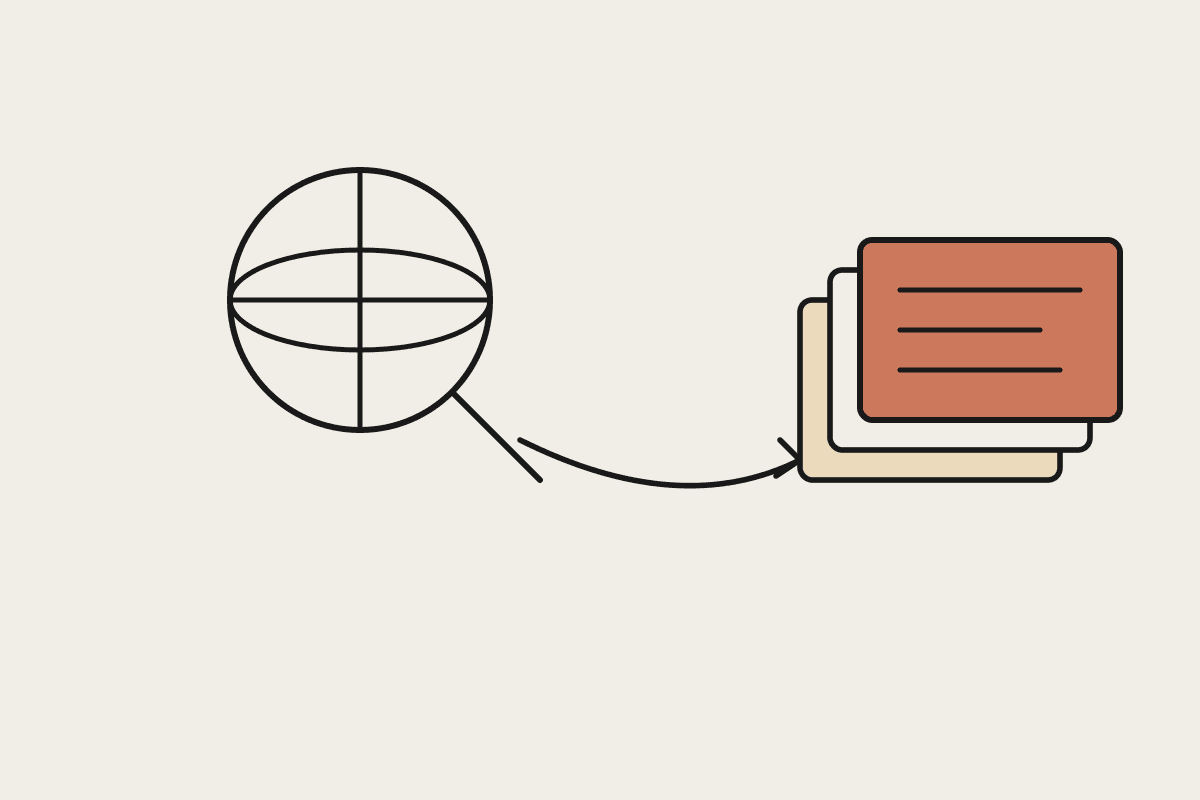
Claude's web search tool is a server-side tool built into the Messages API. You switch it on with a single flag, and Claude decides when a question needs a live answer rather than a stored one. It runs the search, reads the results, and folds the relevant facts back into its reply with a citation attached to each claim. There is no scraping pipeline to maintain and no separate retrieval index to keep warm.
For a production application, this changes the shape of the problem. Instead of building a retrieval-augmented generation stack just to answer "what changed this week," you let Claude reach for the web only when it needs to, and use your own data sources for everything else.
A Melbourne logistics client of ours had this exact split. Their own document store held contracts, rate cards, and internal policy, all handled by retrieval as before. The gap was anything that changed outside their walls: port congestion updates, a supplier's published lead times, a competitor's new surcharge. Web search filled that gap without a second retrieval pipeline to maintain.
Where it earns its place in a production stack
Not every application needs live search bolted on. It earns its keep in a specific set of situations:
Support bots answering questions tied to pricing, stock, or policy pages that change without warning
Research assistants summarising regulatory movement from ASIC, AUSTRAC, or the Privacy Act rather than a stale internal wiki
Sales and account teams prepping for calls, where a five-minute company scan beats a blank brief
Internal tools checking what a competitor changed on their site this month
If the answer lives in a document you already control, keep using retrieval over your own data. Web search is for the parts of the world you don't own.
Latency, cost, and citation handling in practice
A search-augmented turn takes longer than a plain completion, typically a few extra seconds while Claude issues the query, reads back results, and decides whether it has enough to answer. For a chat interface that's tolerable if you show a "searching the web" state. For anything latency-sensitive, gate the tool to specific intents rather than leaving it on for every message.
Cost sits on top of the usual token cost, billed per search performed rather than per result returned. For a Sydney firm running a support bot that triggers live search on roughly one in five conversations, the added search spend landed under $2,400 a year, well inside the $18,000 they had budgeted for the wider assistant build once support hours saved were subtracted.
Citations are the part worth testing hardest before launch. Claude attaches a source to each web-derived claim, which is what makes the output auditable, but you still need to decide what the user sees: inline links, a source list at the end, or nothing until they ask. For anything client-facing, show the sources. It's the difference between a tool people trust and one they quietly stop using after the first wrong answer.
Compliance considerations for Australian businesses
Live web search means Claude is sending query text to Anthropic's search infrastructure, and the results it reads back may include third-party pages you don't control. Two things matter here for an Australian business.
First, check what's in the query. If a support bot builds its search query from a customer's message, make sure you're not pushing personal information into that query unnecessarily, in line with your obligations under the Privacy Act. Strip names, account numbers, and anything else that doesn't need to travel.
Second, treat search results as untrusted input, the same way you'd treat a file a customer uploads. A page Claude reads during a search could contain misleading or manipulated content. Keep a human in the loop for anything that affects a customer's money or legal position, and log the sources Claude cited so you can review them later if a decision gets questioned.
A financial services team we spoke with in Sydney treats every web-sourced answer the same way they treat an unverified tip from a call centre: useful as a lead, not a fact, until someone checks the primary source. That habit costs almost nothing to build in and saves a lot of embarrassment later.
A simple architecture pattern
The pattern that has worked well across the builds we've done:
Classify the incoming request first, cheaply, to decide if it needs live data at all
Only enable the web search tool on that branch of the conversation
Cap the number of searches per turn so one ambiguous question doesn't spawn five queries
Log every query and every cited source alongside the final answer
Review a sample of search-triggered conversations weekly for the first month after launch
This keeps the tool contained to where it adds value and gives you an audit trail if a decision ever gets questioned.
Getting the rollout right
Most teams switch the tool on for everything during testing, notice it slows down simple questions, then narrow the trigger conditions before shipping. Skip that detour. Start narrow, watch which conversations actually needed a live answer, and widen from there.
Before go-live, run a week of shadow traffic where the tool fires but a human reviews every search-triggered answer before it reaches a customer. It's the fastest way to find the ten percent of queries where Claude reaches for the web when your own documents already had the answer, and to tighten the trigger before real customers see the gap.
If you're weighing whether a Claude-based assistant needs web search, retrieval over your own documents, or both, that's a scoping conversation worth having before anyone writes a line of code. Book a brainstorm and we'll map it out.