Most people meet Claude as a chat window. You ask, it answers, you ask again. That turn-based pattern is useful, but it is only the first rung on a ladder. Claude's product guidance now describes how the same model moves from answering when prompted to running work on its own: goal-based loops that keep going until a target is met, time-based loops that run on a schedule, and proactive loops that watch for a condition and act. For an Australian business owner, the practical question is not whether this is clever. It is which rung earns its keep, and where the extra autonomy needs a guardrail.
What a loop actually is
A loop is the difference between a tool that responds and a system that works. In a turn-based exchange, a person drives every step. In a loop, Claude holds a goal, takes an action, checks the result, and decides the next step without waiting to be asked each time. The model is the same. What changes is how much of the cycle runs on its own, and how long it keeps going before it hands back to a human.
The maturity ladder we walk clients up
We find it helps to name the stages plainly, because most teams reach for full autonomy first and then get burned. Each stage adds capability and, with it, the need for more care.
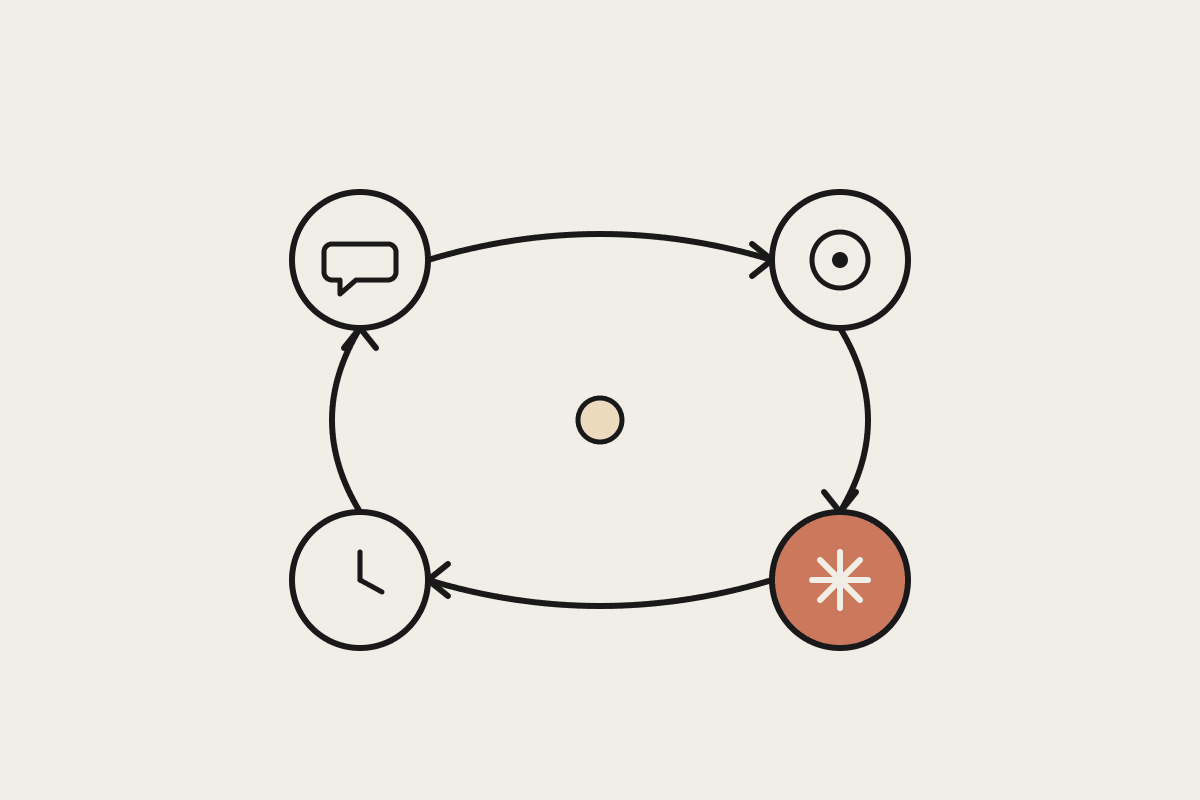
Turn-based: an assistant that answers when you ask. Low risk, low autonomy, and still the right choice for one-off research or drafting.
Goal-based: a loop that keeps working until a defined target is met, such as reconciling a list or drafting every product description in a catalogue.
Time-based: a loop that runs on a schedule, for example a task that checks an inbox each morning and prepares a summary before you sit down.
Proactive: a loop that watches for a condition and acts on it, such as flagging an overdue invoice the moment it crosses a threshold.
The jump that matters most is from answering to acting. A goal-based or proactive loop can do real work while you are asleep, which is exactly why it needs review points a person cannot skip on anything high-stakes.
Map each stage to a real use case
Abstract stages are hard to budget for, so tie each one to a job you already pay someone to do. A proactive loop is how our own scheduled tasks run at Automata AI: a job watches a queue or an inbox and acts without anyone kicking it off. A Sydney services firm might start with a time-based loop that assembles a Monday morning brief from last week's numbers, then move up to a goal-based loop that chases every unpaid invoice on a set cadence.
Start where the work is repeatable and the cost of a small mistake is low.
Give the loop one clear owner, a human who is accountable for the outcome.
Define what good looks like before you let it run unattended.
The honest trade-off
More autonomy is not free. Every rung up the ladder needs more guardrails, more approval steps, and more visibility into what the loop did and why. A loop with no review gate is not a time-saver, it is an incident waiting to happen. The rule we give clients is simple: automate the boring, well-understood middle of a process first, and keep a human on the two ends, the goal it starts from and the decision it finishes with.
This is also where the money maths lives. A single well-scoped time-based loop that saves a staff member five hours a week is worth roughly A$15,000 a year in recovered time on an average Australian salary, and it costs a fraction of that to build and run. A poorly scoped proactive loop that emails the wrong customer can cost far more than that in a single morning. The gap between those two outcomes is design, not luck.
What a loop is not
A loop is not a promise that Claude runs your business unattended. It is a way to hand over well-defined, repeatable work while keeping judgement, exceptions, and client relationships with a person. The failure modes are predictable: an under-specified goal, no review gate, or no clear owner. Name those three before you build and most of the risk goes away. Treat a loop as a junior team member you are training, not a switch you flip and forget.
Where to start this week
You do not need a platform migration to begin. Pick one workflow that runs on a predictable rhythm, is tedious to do by hand, and would not cause harm if it got something slightly wrong on the first pass. Write down the goal, the owner, and the check that has to happen before the output is trusted. Run it turn-based a few times so you can see the reasoning, then let it run on a schedule once you trust it. That is the whole method: prove it with a human in the loop, then step back from the parts that are safe to hand over.
Most of our Australian client builds price this work in AUD as a system rather than a one-off script, because the value sits in the plumbing around the model: the schedule, the review gates, the shared memory between runs, and the logging. That is the shift worth understanding. Loops are how a chat window becomes something that does the work.
If you want help picking the first loop worth building and putting the right guardrails around it, book a brainstorm with Automata AI and we will map it against your actual workflow.