Australian operations teams hearing pitches about multi-agent systems in 2026 face a real decision. When does orchestrating several agents actually beat a single, well-designed model call? The honest answer depends on the shape of the workflow, not on the framework diagram printed across the vendor slide.
For a $50M revenue Australian mid-market operations team, picking the wrong architecture early can lock in $250,000 to $600,000 of unnecessary build cost, plus six to twelve months of operational complexity that never pays back. Picking right is mostly an exercise in restraint, and that is good news for the budget.
When a single model is the right answer
A single Claude call wins for most workflows. If the task fits in context, the model can reason from start to finish, and the output structure is predictable, then reaching for multiple agents adds cost without adding capability. The model already runs a multi-step plan internally, calling tools in sequence and holding its own working state.
Workflows that should usually stay single-model:
Document classification and field extraction from invoices, contracts, or forms
Email triage and first-draft replies routed to a human for approval
Code review against a defined checklist
Customer support reply drafting from a knowledge base
Report generation from a structured template
The temptation is to add agents because a workflow has several steps. Several steps are not the same as several agents. A Sydney logistics firm we spoke with had scoped a five-agent pipeline for shipping-document processing. One Claude call with a clear system prompt and three tools did the same job at a fraction of the running cost, and it was far easier to debug when a customs form arrived in an unexpected layout.
When multiple agents earn their complexity
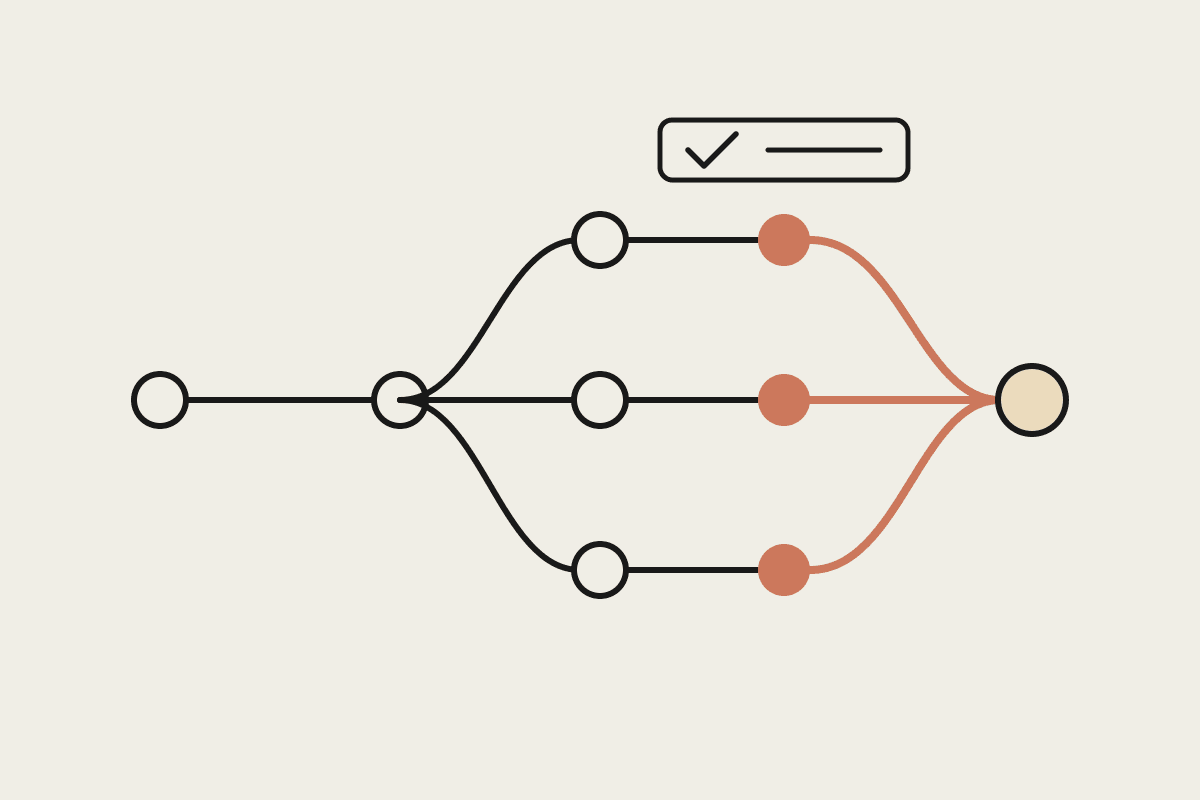
Multi-agent architectures justify their overhead in three patterns. If your workflow matches one of these, the extra machinery is buying you something real.
Specialisation: one agent carries tooling and prompting for a narrow task that would clutter a generalist agent, such as a pricing calculator with its own validation rules.
Parallelism: many small agents run independently and return results faster than a single serial pipeline could.
Boundary control: one agent can reach a sensitive system while another cannot, and the workflow needs both under separate permissions.
A workflow that touches a customer-facing surface, a billing system, and a fraud check is a genuine candidate for multi-agent design. Each agent holds scoped permissions, and the orchestrator owns the conversation state. For regulated Australian operators, that boundary control is not a nicety. Keeping the billing-access agent separate from the customer-chat agent is exactly the kind of separation an APRA-supervised business wants to point to in an audit.
What multi-agent actually costs
Multi-agent systems cost more on three axes, and the bill is easy to underestimate at the design stage.
Token spend rises roughly two to five times, because each agent carries its own context overhead on every call.
Operational complexity rises, because a failure can occur in any agent and propagate through the chain.
Evaluation surface area rises, because the team now needs evals for each agent and for the composition as a whole.
For a workflow running 5,000 executions a day, the gap between a single-model design and a multi-agent one can reach $30,000 to $90,000 AUD per month in token cost alone. That is before the additional engineering time to keep a distributed system observable. If the multi-agent design is not solving a problem the single model genuinely failed at, that money is buying complexity, not capability.
A decision framework for Australian operations teams
A working sequence for choosing between architectures, in order:
Start with a single model and a clear system prompt. Ship it and measure.
Move to multi-agent only when the single model has demonstrably failed on a measurable axis: latency, accuracy, or permission scope.
Document the specific failure that triggered the move, so the architecture can be reversed if the underlying model improves.
Keep the agent count low, ideally two to four, never the twelve-box diagram from a vendor pitch.
Most Australian mid-market workflows that look like multi-agent on paper resolve to a single model with disciplined prompting once the team actually tries it. Orchestration is a tool for a specific class of problem, not a maturity badge. The teams that save the most are the ones who reach for it last, after the simpler design has earned its place or proven it cannot do the job.
If you are sizing an architecture for an Australian operations workflow and want a second opinion before committing the build budget, book a short architecture consult.