Most Australian finance teams entered FY26 with AI spending scattered across a dozen software subscriptions and a handful of pilot projects nobody could fully account for. Heading into FY27, that approach no longer holds. AI has shifted from experiment to operating cost, and it deserves a proper line in the budget rather than a footnote under general software. This guide walks through the line items a Sydney or Melbourne CFO should plan for, with realistic AUD ranges drawn from what we see across Australian small and mid-sized businesses.
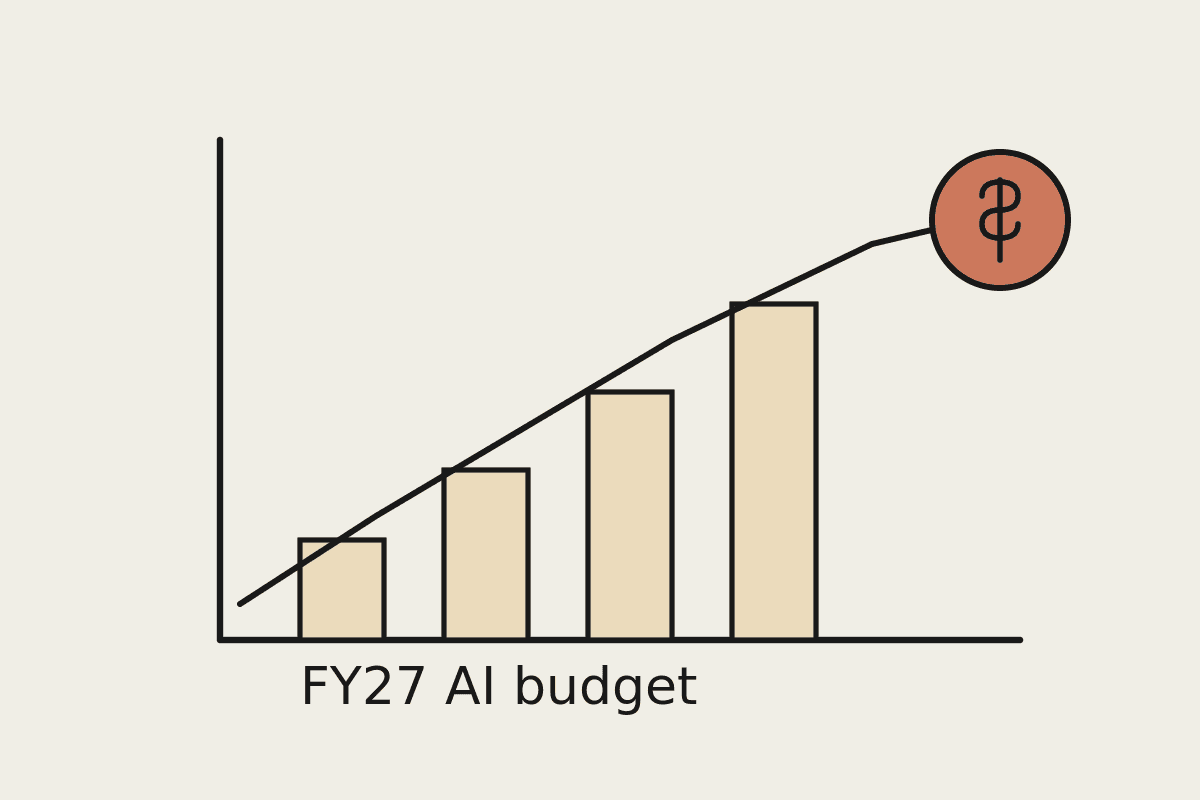
Why AI earns its own budget line
When AI costs sit inside a catch-all software category, two things go wrong. Finance loses the ability to measure return, because the spend is invisible against the outcomes it produces. And department heads treat the tools as free, which drives usage patterns that surprise everyone at invoice time. Separating AI into its own cost centre fixes both problems at once.
It also matches how auditors and the Australian Taxation Office increasingly expect technology investment to be documented, especially where you are claiming deductions or R&D offsets on development work. For a business running Claude across support, finance, and operations, a clear budget line answers the question every board now asks: what are we spending on AI, and what are we getting back?
There is a governance benefit as well. When a single owner holds the AI line, one person is accountable for both the spend and the outcomes, which is what a cautious board or an APRA-regulated client wants to see before approving any further investment. It turns AI from a spread of small mystery charges into a managed programme with an owner, a number, and a review date.
The line items to expect
An AI budget is not a single subscription. Expect roughly six categories, each with its own cost driver and its own risk of blowing out if left unwatched.
Model and usage costs. If you run Claude through the API, you pay per token, so cost scales with volume. A team automating document review might spend $400 to $2,000 a month depending on throughput. Seat-based plans are steadier at a fixed price per user.
Licences and seats. Beyond the model itself, you pay for the surrounding tools: CRM add-ons, the automation platform, the analytics layer. Budget these separately so a price rise in one does not hide inside another.
Implementation and integration. The one-off cost of connecting AI to your existing systems. For a focused first project this typically runs $15,000 to $45,000 with an Australian consultancy, and more if you are wiring into older finance software.
Data and security. Access controls, logging, and a review of where data flows. Under the Privacy Act and the recent reforms, this is not optional for any business handling customer information.
Training and change management. The line most often left out, and most often the reason a project stalls. Allow for staff time, not just a single workshop invoice.
Ongoing operations. Monitoring, prompt maintenance, and the quarterly review that checks the tools still earn their keep.
Two of these categories cause the most trouble at the end of the year. Usage costs surprise teams that never set a monthly ceiling, and change management is chronically underfunded, so tools get bought but never properly adopted. Putting a named figure against each line, even a rough one, is what separates a plan finance can defend from a wish list.
A worked example for a Brisbane firm
Consider a 40-person professional services firm in Brisbane moving its first two workflows onto Claude in FY27: client intake and invoice processing. A realistic first-year budget might run as follows. Implementation across both workflows: $38,000. Seat licences for fifteen active users at roughly $50 a month each: about $9,000 for the year. API usage for the automated invoice pipeline: $6,000. Security review and access setup: $8,000. Training and internal change time: $12,000.
That comes to roughly $73,000 in year one, of which about $35,000 is recurring. Against it, the firm expects to recover close to 25 hours a week of administrative time. At a blended $65 an hour, that is more than $80,000 a year in recovered capacity. The return is real, but it is only visible because the costs were budgeted as a distinct line rather than buried in general overheads.
How to phase the FY27 spend
You do not commit the full amount on day one. Sensible phasing protects cash flow and builds in decision points where you can stop, adjust, or scale.
Quarter one: fund a single pilot plus the security groundwork. Cap the spend and set a clear success measure before you scale anything.
Quarter two: if the pilot clears its measure, fund the second workflow and the training that makes adoption stick.
Quarter three: add seats as usage proves out, and switch on proper monitoring so costs stay visible.
Quarter four: run a full review against the return you projected, then set the FY28 baseline from actuals rather than guesses.
The Australian businesses getting value from AI in FY27 are not the ones spending the most. They are the ones who can tell you, to the dollar, what they spend and what it returns. If you would like help building a defensible AI budget against your own workflows, you can book a short planning session and we will work through the line items against your own numbers, so the figure you take to the board is one you can stand behind.