Ask three software vendors what business process automation means and you will get three answers, usually shaped by whatever they happen to sell. For an Australian owner trying to cut admin hours, the label matters less than the mechanics. Some tasks need rigid, predictable rules. Others need judgement about messy, one-off situations. Knowing which is which saves you from buying the wrong tool and then blaming the technology when it underperforms.
The short version: business process automation follows instructions you write in advance. AI automation, built around a model like Claude, reads context and decides what to do when the instructions run out. Most real workflows need a bit of both, and the businesses that get the most from either are the ones that put each to work on the tasks it actually suits.
What business process automation actually means
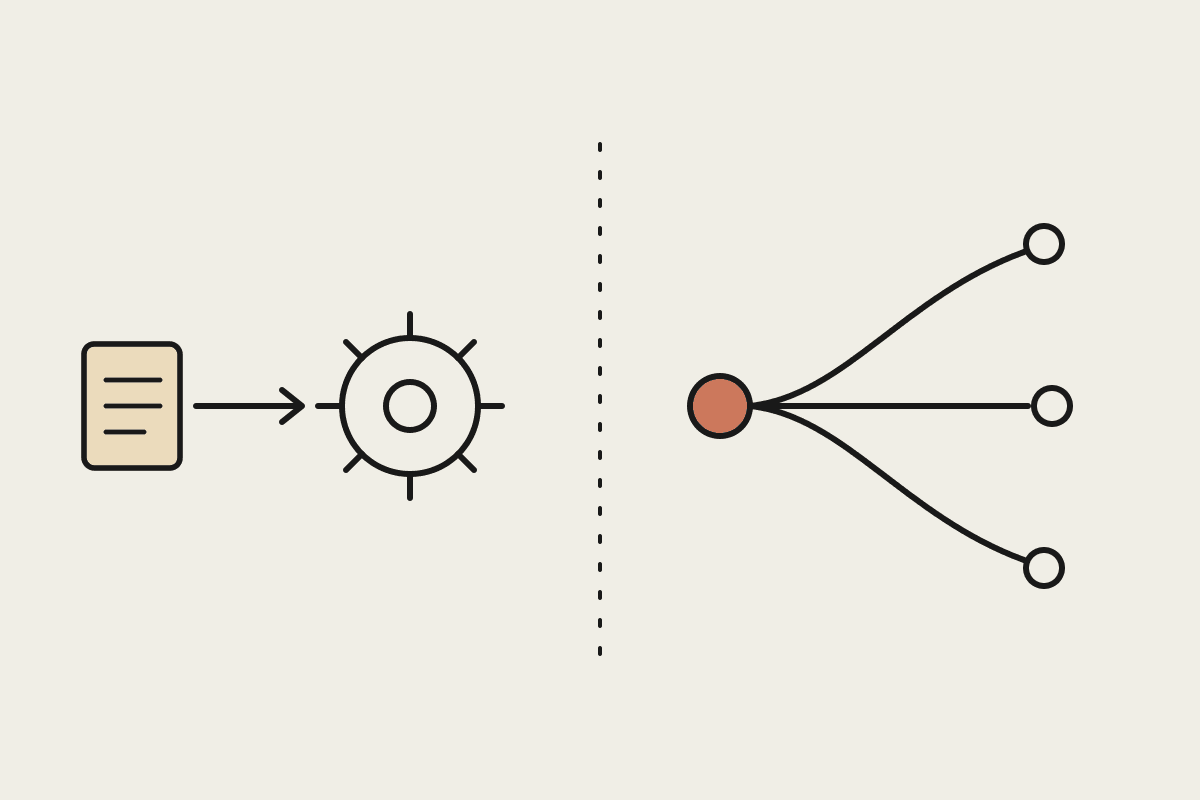
Business process automation, often shortened to BPA, covers the tools that move work along a fixed path. Picture an order that arrives, gets logged in your system, triggers an invoice, and sends a confirmation email. Every step is defined ahead of time. Platforms like Zapier, Make, and Microsoft Power Automate sit in this category, along with the robotic process tools that click through legacy screens the way a person would.
This kind of automation is fast, cheap to run, and completely predictable, which is exactly what you want for high-volume, repetitive work. It has one hard limit: it only handles the situations you anticipated. The moment an input arrives in a format the rules did not expect, the process either stops or, worse, does the wrong thing quietly.
High volume and repetitive, where the same steps run hundreds of times a week
Structured, with inputs that always arrive in the same shape, like a web form or a fixed CSV
Rule-bound, where clear if-this-then-that logic covers almost every case
Low judgement, where a wrong guess is rare and easy to catch after the fact
Where AI automation is different
AI automation puts a language model in the loop so the workflow can read unstructured information and make a call. Claude can take a supplier email written in plain prose, pull out the order details, notice that the delivery date clashes with a public holiday, and flag it for a person. No two of those emails look the same, and no set of rules would have caught every variation. That is the work AI automation is built for.
The trade-off is that a model reasons rather than follows a script, so you design these workflows differently. You give Claude clear instructions, examples of good output, and a defined place to escalate when it is unsure, rather than trying to list every possible path. Done well, this absorbs the long tail of exceptions that used to land on someone's desk. Done carelessly, it produces confident answers to questions it should have flagged, which is why review steps matter.
Unstructured, where inputs are emails, PDFs, handwritten notes, or call transcripts rather than tidy fields
Judgement-heavy, where the right action depends on context that shifts case to case
Exception-prone, where the interesting work is the ten percent that does not fit the template
Language-shaped, involving summarising, drafting, classifying, or pulling meaning out of text
A quick test for which one a task needs
Before you shop for a platform, look hard at the task itself. If you can write down the full set of rules on a single page and be confident they cover almost everything, business process automation will do the job cheaply and reliably. If the task keeps throwing up cases your rules do not cover, and a person currently uses judgement to resolve them, that is a signal for AI automation. Plenty of workflows split neatly: rules move the predictable middle, and Claude handles the ragged edges.
What each costs in practice
Costs land in very different places. A rule-based automation platform might run you $2,000 to $8,000 a year in licences plus a one-off build, and the running cost barely moves as volume grows. AI automation carries a per-task inference cost and more design effort upfront, but it removes labour that rules never could. Consider a Sydney services firm paying a staff member $45,000 a year to triage inbound requests: if a Claude-based workflow handles the first pass and routes only genuine exceptions to a person, the saving is measured against that salary, not against a software licence. We have seen builds land anywhere from $8,000 for a focused single-workflow project to well past $150,000 for a program that reshapes a whole operations team. The figure that matters is the labour you free up, not the sticker price.
Where Australian businesses get the mix right
The common mistake is reaching for AI on a task that plain rules would have handled for a fraction of the cost, or forcing rules onto work that genuinely needs judgement and then wondering why staff keep stepping in. There is also a compliance angle. Under the Privacy Act, and with regulators like ASIC and AUSTRAC watching how regulated firms handle information, any automated step that touches personal or financial data needs a clear record of what happened and a person accountable for the outcome. Claude-based workflows can log their reasoning and escalate rather than guess, which suits Australian businesses that have to show their working. Melbourne and Brisbane firms in finance, legal, and healthcare tend to start there: automate the reading and drafting, keep a person on the decision.
Start with the task, not the tool
Vendors will keep blurring the terms, because it suits them to sell whichever product they already have. You do not have to play along. Map the task first. Sort the parts that follow fixed rules from the parts that need judgement, put cheap rule-based automation on the former and Claude on the latter, and keep a person on anything with a compliance or customer-trust cost. That is how the mix actually pays off for an Australian business.
If you want a second opinion on which of your workflows suit rules and which suit AI, we are happy to map it with you. You can book a brainstorm and we will talk through where automation earns its keep in your business.